ERC-20 is the technical standard that defines how fungible tokens work on the Ethereum blockchain. Introduced in 2015, it is the template behind the vast majority of tokens you will meet, from stablecoins to project tokens. Here is what ERC-20 is, the functions it defines, and its trade-offs.
What ERC-20 means
ERC-20 stands for “Ethereum Request for Comment 20,” the twentieth such proposal, formally documented in November 2015. It is not a token itself but a set of rules that any token on Ethereum can follow. Because it is a standard rather than a product, thousands of different tokens — each with its own name and purpose — all behave in the same predictable way, which is exactly what lets wallets and exchanges support them so easily.
The functions it defines
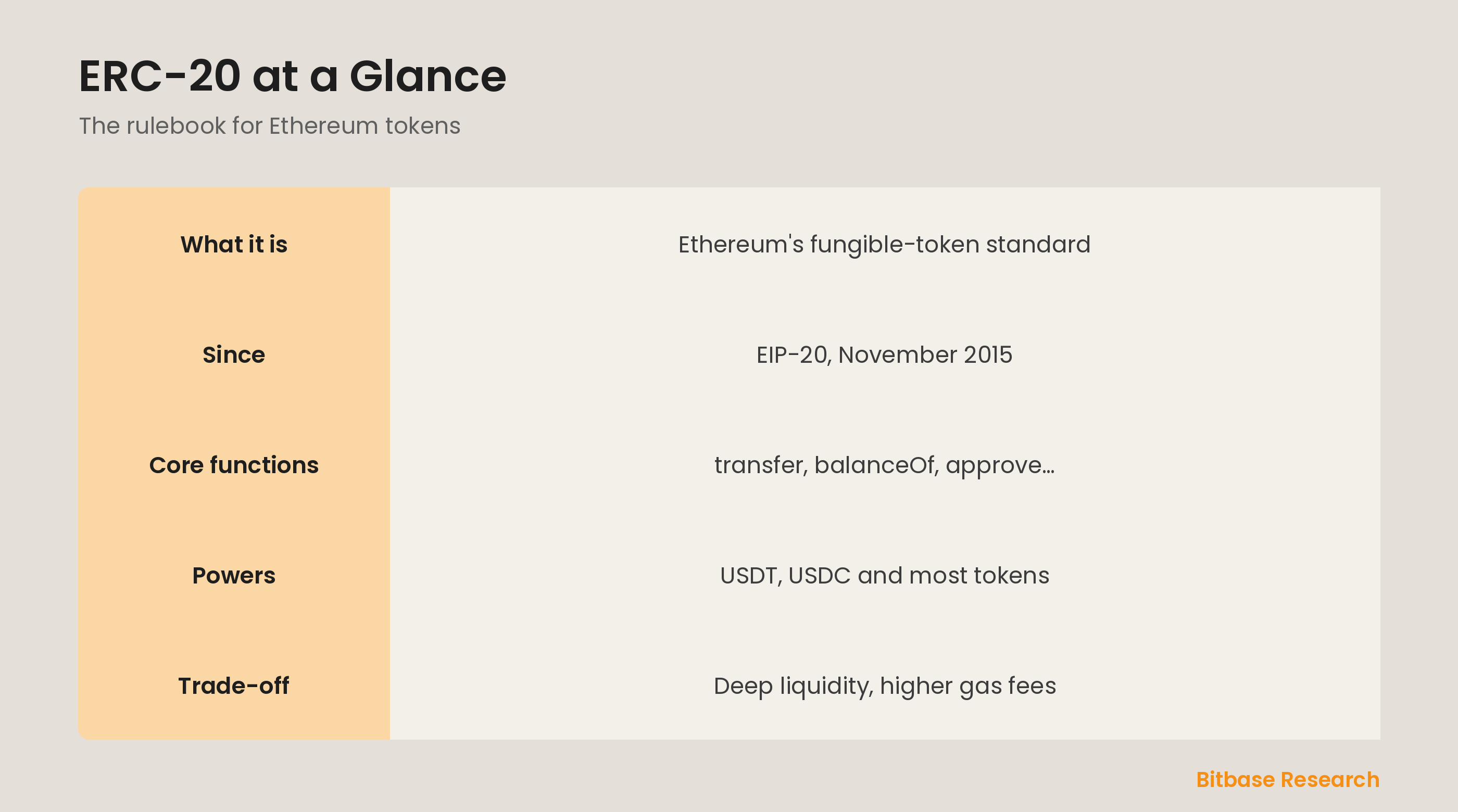
ERC-20 specifies a handful of core functions every compliant token must implement. totalSupply reports how many tokens exist; balanceOf checks an address's balance; transfer moves tokens to another address; and approve together with transferFrom lets a third party, such as a DeFi app, spend a set amount on your behalf. These few functions are enough for wallets, exchanges, and smart contracts to support any ERC-20 token without special handling.
Why it matters
ERC-20 is why the Ethereum token economy works. A wallet that supports the standard can hold any ERC-20 token, and a decentralized exchange can list one just by pointing to its contract address. The largest stablecoins, USDT and USDC, run as ERC-20 tokens, and Ethereum offers the deepest liquidity and widest DeFi support of any network. In everyday use, “a token” usually means an ERC-20 token unless stated otherwise.
The trade-offs
The main drawback is cost. Ethereum processes only around 15 transactions per second, so during busy periods the gas fee to send an ERC-20 token can climb to many dollars — sometimes more than the value being sent for small transfers. This is why the same asset is often also issued on cheaper networks as a BEP-20 or TRC-20 token. ERC-20 buys you liquidity and ecosystem depth; you pay for it in higher fees.
The bottom line
ERC-20 is the rulebook for fungible tokens on Ethereum and the reason so many different tokens work seamlessly together. When you send or receive an ERC-20 token, you are moving it on Ethereum and paying the gas fee in ETH. It offers unmatched liquidity and support — at the price of higher fees than newer, faster chains. To keep learning the fundamentals, follow more from Bitbase Academy.
Disclaimer: This article is educational content from Bitbase Academy, provided for information only. It does not constitute investment, trading, tax, or financial advice. Crypto assets are volatile; assess your own risk. Written as of June 2026; refer to the latest official information.
References
[1] Ethereum.org, "ERC-20 Token Standard" ethereum.org
[2] Ethereum Improvement Proposals, "EIP-20: Token Standard" eips.ethereum.org
[3] Investopedia, "What Is ERC-20? Ethereum Token Standard Definition" investopedia.com