Most crypto is not stolen by breaking cryptography — it is handed over by people who believed they were dealing with someone or something they trusted. Impersonation is the beating heart of crypto crime: fake websites, fake support staff, fake founders, even fake wallet addresses. Understanding how these deceptions work is the single best defence, because on-chain, a mistake made in trust is usually irreversible.
Why impersonation dominates crypto crime
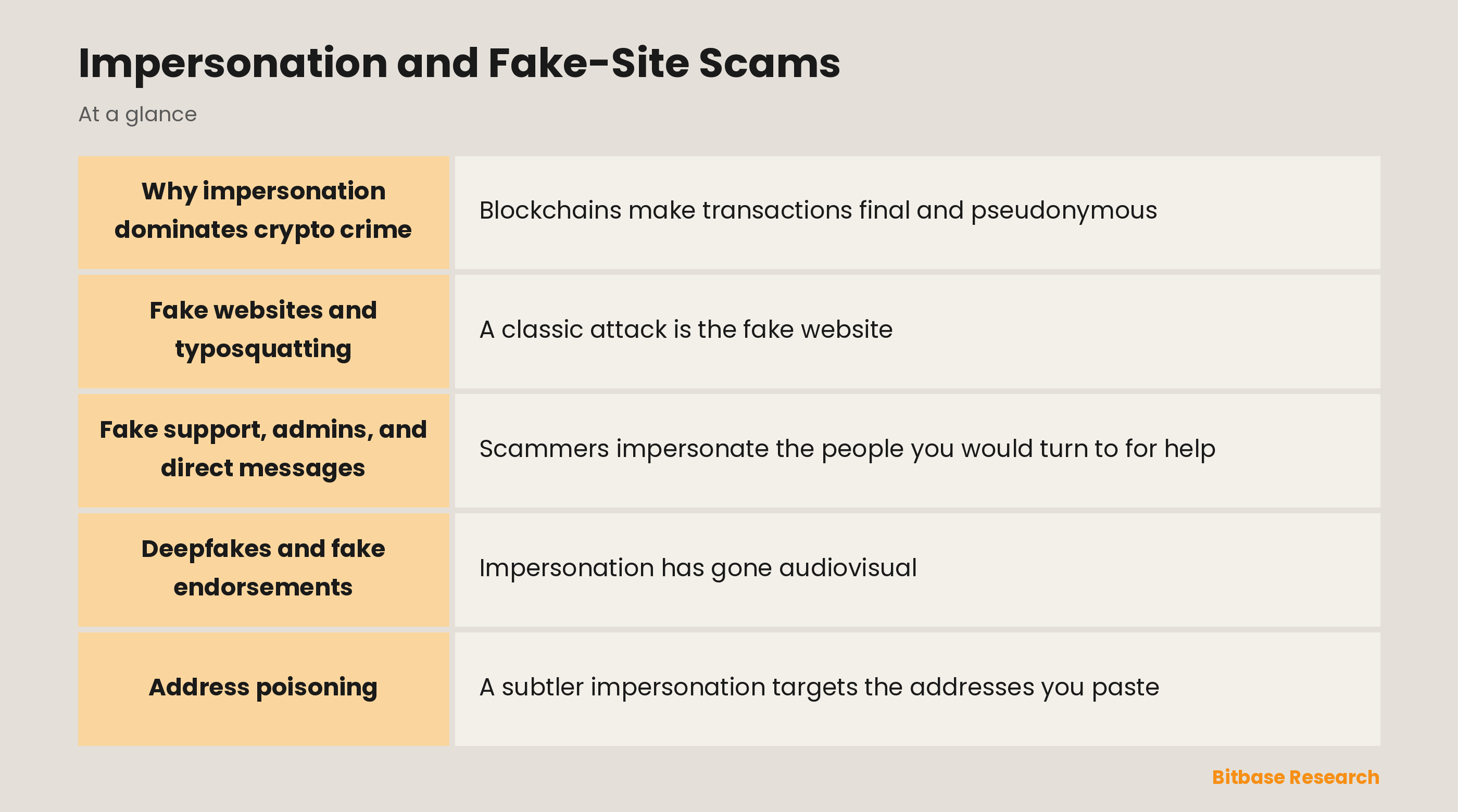
Blockchains make transactions final and pseudonymous, so once you are tricked into sending funds or approving access, there is rarely any recall or refund. That permanence makes deception far more valuable to criminals than hacking. Rather than attack the technology, scammers attack your trust — convincing you that a fake thing is the real one. Nearly every major crypto scam, from phishing to fake giveaways, is at its core an act of impersonation, which is why learning to verify identity matters more than any single trick.
Fake websites and typosquatting
A classic attack is the fake website: a near-perfect copy of a real exchange, wallet, or app, designed to steal your login or drain your wallet when you connect. Scammers register lookalike domains with tiny misspellings, buy ads that appear above the real site in search results, and share links in messages and comments. The moment you enter a seed phrase or approve a transaction on such a site, your funds are gone. Always reach services through your own saved bookmarks and inspect the full address before trusting it.
Fake support, admins, and direct messages
Scammers impersonate the people you would turn to for help. In chat groups and comments they pose as support staff, moderators, or admins, and they very often message you first. A real support team will not slide into your direct messages, ask for your seed phrase, or request remote access to your device — but impostors do all three, usually with manufactured urgency. Treat any unsolicited "helper" as hostile by default, and only seek support through a project's official channels that you navigated to yourself.
Deepfakes and fake endorsements
Impersonation has gone audiovisual. Scammers now use AI-generated videos and voices of well-known founders, executives, and celebrities to promote fake giveaways, investment schemes, and token launches that look startlingly real. A convincing clip of a famous figure promising to double your crypto is designed to borrow their credibility and short-circuit your caution. No legitimate person or company will ever ask you to send crypto first in order to receive more back; that promise is the signature of a scam, no matter whose face delivers it.
Address poisoning
A subtler impersonation targets the addresses you paste. In address poisoning, an attacker sends you a tiny transaction from an address engineered to look almost identical to one you recently used, so it appears in your history. Later, when you copy an address from that history to reuse it, you may grab the attacker's lookalike by mistake and send your funds straight to them. Never trust an address from your transaction history; verify the full string every time, or better, use a saved and labelled address book.
The bottom line
Impersonation scams work by counterfeiting trust rather than breaking code — through fake sites, fake support, fake famous endorsements, and fake lookalike addresses. Because on-chain mistakes cannot be undone, your defence is relentless verification: reach services only via your own bookmarks, distrust anyone who contacts you first, ignore any offer to multiply your crypto, and check every address in full. In crypto, the healthiest instinct is to assume that anything urgent, unsolicited, or too good to be true is someone pretending to be someone else.
Disclaimer: This article is educational content from Bitbase Academy, provided for informational purposes only. It is not investment, trading, tax, or financial advice. Written as of July 2026; rely on the latest official information.
References
[1] ScamSniffer, "Wallet drainers and phishing report" scamsniffer.io
[2] FBI, "Cryptocurrency fraud and impersonation schemes" fbi.gov