
Few things in crypto excite people like a "free" airdrop — a project handing out tokens that can be worth real money. Chasing them has grown into a whole activity called airdrop farming, complete with points programs, spreadsheets, and armies of wallets. But the game has changed, and it is riddled with scams. Here is how airdrops and farming actually work in 2026.
What an airdrop is
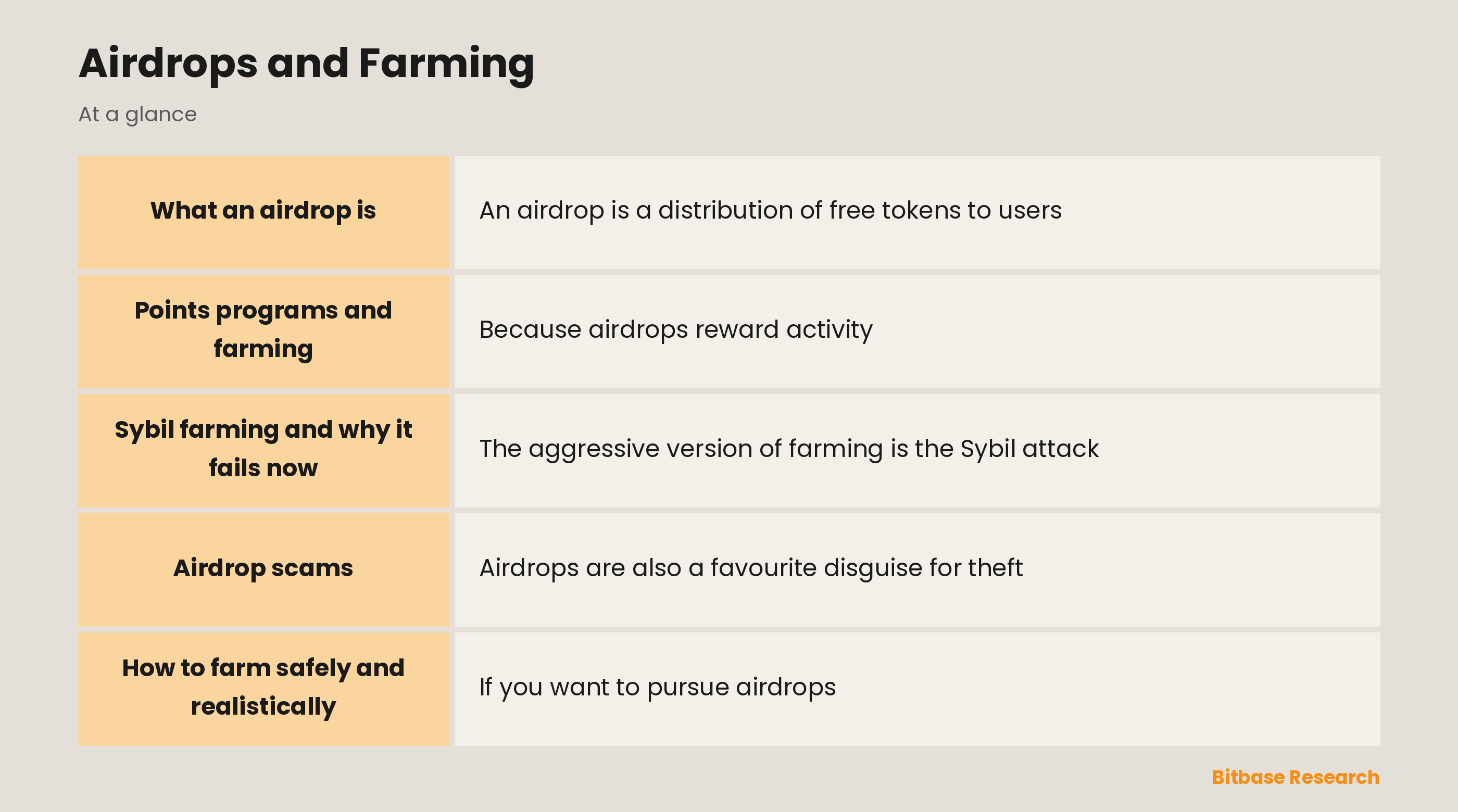
An airdrop is a distribution of free tokens to users, usually to reward early participation and decentralise ownership of a new project. Instead of selling all its tokens, a project gives some away to people who used it, held a related asset, or contributed to its community. When those tokens turn out to be valuable, an airdrop can be a meaningful windfall, which is exactly why they attract so much attention and so much gaming.
Points programs and farming
Because airdrops reward activity, people try to qualify by farming — deliberately using a project to become eligible before any token exists. Modern projects often run points programs first, awarding points for actions like providing liquidity, trading, or referring others, with the strong implication that points will convert into a future airdrop. Farming is the practice of chasing that eligibility. Done with genuine engagement it is legitimate; done as pure box-ticking it is a grind with no guarantee the reward ever arrives.
Sybil farming and why it fails now
The aggressive version of farming is the Sybil attack: running dozens or thousands of wallets to multiply a single person's share of an airdrop. This once worked, but projects now fight it hard. Sophisticated, often AI-driven detection maps funding trails and behaviour, flagging tell-tale patterns like wallets funding each other in circles, identical amounts, brand-new wallets with no history, and coordinated timing. Flagged farmers are commonly excluded entirely, so mass Sybil farming has become a losing bet against improving defences.
Airdrop scams
Airdrops are also a favourite disguise for theft. Fake "claim your airdrop" websites are everywhere, designed to look official and to drain your wallet the moment you connect and approve. Unsolicited tokens or NFTs appearing in your wallet often lead to scam sites when you investigate them. The rule is simple: only ever act on airdrop news from a project's genuine, verified channels, never from a direct message or a random link, and never approve a transaction just to "claim" something unexpected.
How to farm safely and realistically
If you want to pursue airdrops, do it with clear eyes. Focus on genuinely using promising projects you would explore anyway, rather than spamming empty transactions across countless wallets. Use a dedicated wallet with limited funds for interacting with new and unaudited apps, verify every site independently, and revoke token approvals you no longer need. Treat any potential airdrop as a possible bonus, never a paycheck, since most farming earns little and the surest outcome is the time you spend.
The bottom line
Airdrops distribute free tokens to reward real users, and farming is the pursuit of qualifying for them, increasingly organised around points programs. But mass Sybil farming is being defeated by better detection, and airdrop-themed phishing is one of the most common ways people lose funds. Engage by genuinely using projects, protect yourself with a burner wallet and strict verification, and remember that the word "free" in crypto is exactly where you should be most careful.
Disclaimer: This article is educational content from Bitbase Academy, provided for informational purposes only. It is not investment, trading, tax, or financial advice. Written as of July 2026; rely on the latest official information.
References
[1] CoinGecko, "What is a crypto airdrop?" coingecko.com
[2] Kraken, "Airdrops and how to stay safe" kraken.com