The most active corner of real-world asset tokenization is not property or art but the familiar building blocks of investing: money-market funds, government bonds, stocks, and credit — reissued as blockchain tokens. Major asset managers are now running billions of dollars of tokenized funds on public chains. Here is what tokenized securities and funds are, the main kinds, and what to weigh before touching them.
What tokenized securities and funds are
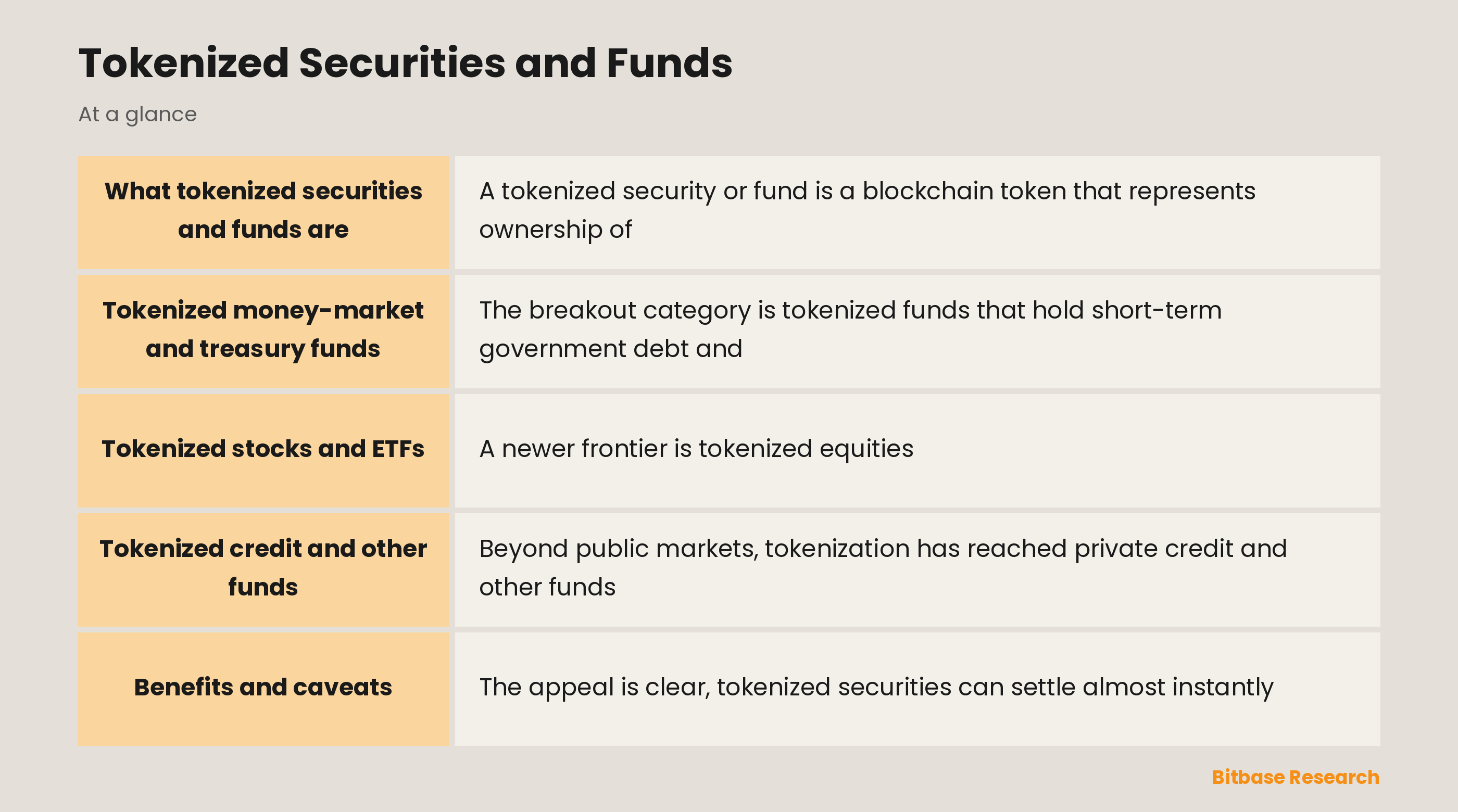
A tokenized security or fund is a blockchain token that represents ownership of, or economic exposure to, a regulated financial product. Rather than issuing a share through a traditional registrar, the issuer records ownership on-chain, so the token can move and settle on blockchain rails while the underlying remains a real, regulated asset. The token is wrapped in a legal structure that gives it genuine rights to the security or fund behind it, blending the mechanics of crypto with the substance of traditional finance.
Tokenized money-market and treasury funds
The breakout category is tokenized funds that hold short-term government debt and pay yield on-chain. Large asset managers now offer digital fund shares, backed by treasuries and cash equivalents, that live as tokens and distribute interest directly to holders' wallets. This gives on-chain users a way to earn a regulated, relatively low-risk yield without leaving the blockchain, and it has become the anchor of the whole tokenization trend, attracting the most capital and the most established issuers.
Tokenized stocks and ETFs
A newer frontier is tokenized equities: tokens that track the price of individual stocks or exchange-traded funds. These let users gain exposure to shares like major tech names or broad index funds on-chain, often around the clock. It is important to understand what such a token usually is — economic exposure to a share held by an issuer, rather than a direct registered shareholding — which affects your rights, voting, and protections. The convenience is real, but the legal substance can differ meaningfully from owning the stock outright.
Tokenized credit and other funds
Beyond public markets, tokenization has reached private credit and other funds that are normally hard to access. On-chain platforms tokenize loans and credit portfolios, letting investors gain exposure to yields from private lending, and similar structures wrap other investment strategies. These products can offer attractive returns, but they also carry the risks of the underlying credit plus the added complexity of the on-chain wrapper, and they are typically restricted to qualified or institutional participants.
Benefits and caveats
The appeal is clear: tokenized securities can settle almost instantly, trade beyond traditional market hours, be split into small fractions, and slot directly into on-chain applications as collateral or yield. But the caveats are just as important. A token is only as strong as its legal wrapper and the issuer and custodian behind it; access is often gated by regulation to certain investors; redeeming for the underlying can involve real-world processes; and the rules differ sharply across jurisdictions. Convenience on-chain does not erase counterparty and legal risk off-chain.
The bottom line
Tokenized securities and funds bring investing's core instruments — treasury funds, stocks, ETFs, and credit — onto blockchains, with tokenized treasury funds leading and serious institutions issuing them. They offer instant settlement, fractional access, and composability, but each token is a legal claim whose value rests on the issuer, custodian, and regulator behind it, and many are limited to qualified investors. Understand exactly what a given token entitles you to before treating it as equivalent to owning the asset itself.
Disclaimer: This article is educational content from Bitbase Academy, provided for informational purposes only. It is not investment, trading, tax, or financial advice. Written as of July 2026; rely on the latest official information.
References
[1] BlackRock, "USD Institutional Digital Liquidity Fund (BUIDL)" blackrock.com
[2] Ondo Finance, "Tokenized funds and securities" ondo.finance