"DePIN" is a single label stretched over a surprisingly diverse family of networks — some renting out graphics cards, some running wireless coverage, others storing files or mapping roads. Grouping them by what physical resource they coordinate is the clearest way to understand the sector. Here are the main types of DePIN networks, what each provides, and how to judge one.
An overview of the main types
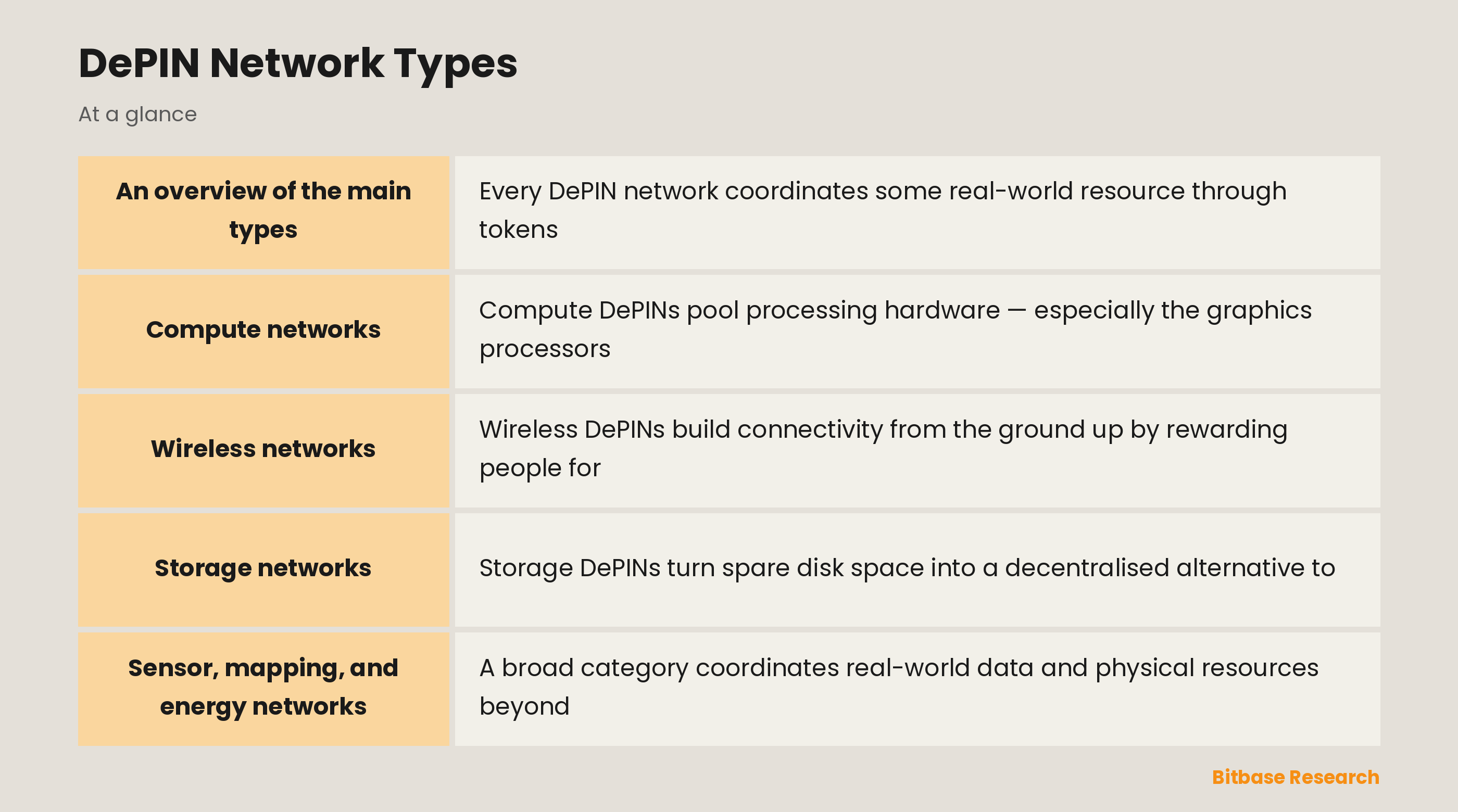
Every DePIN network coordinates some real-world resource through tokens, but the resource differs sharply. The main categories are compute, which supplies processing power; wireless, which supplies connectivity; storage, which supplies data capacity; and sensor or mapping networks, which supply real-world data. A newer category coordinates decentralised intelligence itself. Each type solves a different problem and faces different economics, so understanding the categories is the first step to evaluating any project.
Compute networks
Compute DePINs pool processing hardware — especially the graphics processors prized for AI and rendering — from many owners into a shared marketplace. Data centres and individuals contribute idle machines, and users rent that power for tasks like model training, inference, or visual rendering, paying through the network's token. Because demand for AI compute has surged while much hardware sits idle, this has become one of the most active DePIN categories, competing with centralised clouds on flexibility and price.
Wireless networks
Wireless DePINs build connectivity from the ground up by rewarding people for running radios and hotspots that provide coverage. Instead of a telecom company erecting every tower, independent operators host the hardware and earn tokens for the coverage and data they carry. The flagship examples focus on low-power and mobile connectivity. Their long-term value depends less on how many devices are deployed and more on whether real users actually route meaningful traffic through the network.
Storage networks
Storage DePINs turn spare disk space into a decentralised alternative to centralised cloud storage. Operators pledge capacity and are paid to reliably store other people's data, with the blockchain coordinating deals and proving that files remain intact over time. This offers a censorship-resistant, competitively priced way to keep data without trusting a single provider, and decentralised storage is among the oldest and most established DePIN categories, with networks holding large volumes of real customer data.
Sensor, mapping, and energy networks
A broad category coordinates real-world data and physical resources beyond compute and connectivity. Mapping networks reward drivers or devices for collecting street-level imagery and location data, building geographic datasets from the crowd. Sensor networks gather environmental or weather readings, and energy-focused DePINs coordinate distributed power resources. What unites them is turning dispersed, hard-to-collect physical data or capacity into a shared network that pays contributors for genuinely useful, verifiable input.
The bottom line
DePIN spans compute, wireless, storage, sensor and mapping, energy, and even decentralised intelligence, each coordinating a different real-world resource through tokens. When evaluating any of them, look past the category label to the same core questions: is there real, paying demand for the resource; can the network verify that contributors actually deliver it; and does its token capture value from genuine usage rather than subsidies alone. The type tells you what a network does; those questions tell you whether it will last.
Disclaimer: This article is educational content from Bitbase Academy, provided for informational purposes only. It is not investment, trading, tax, or financial advice. Written as of July 2026; rely on the latest official information.
References
[1] Helium, "The People's Network" helium.com
[2] Filecoin, "Decentralized storage network" filecoin.io