As money goes digital, three very different kinds of "digital money" are being built at once — central bank currencies, tokenized bank deposits, and private stablecoins — and they are easy to confuse. Who issues each, and who is on the hook if it fails, differs completely. Here is what CBDCs and tokenized deposits are, how they compare to stablecoins, and where each is headed.
Three kinds of digital money
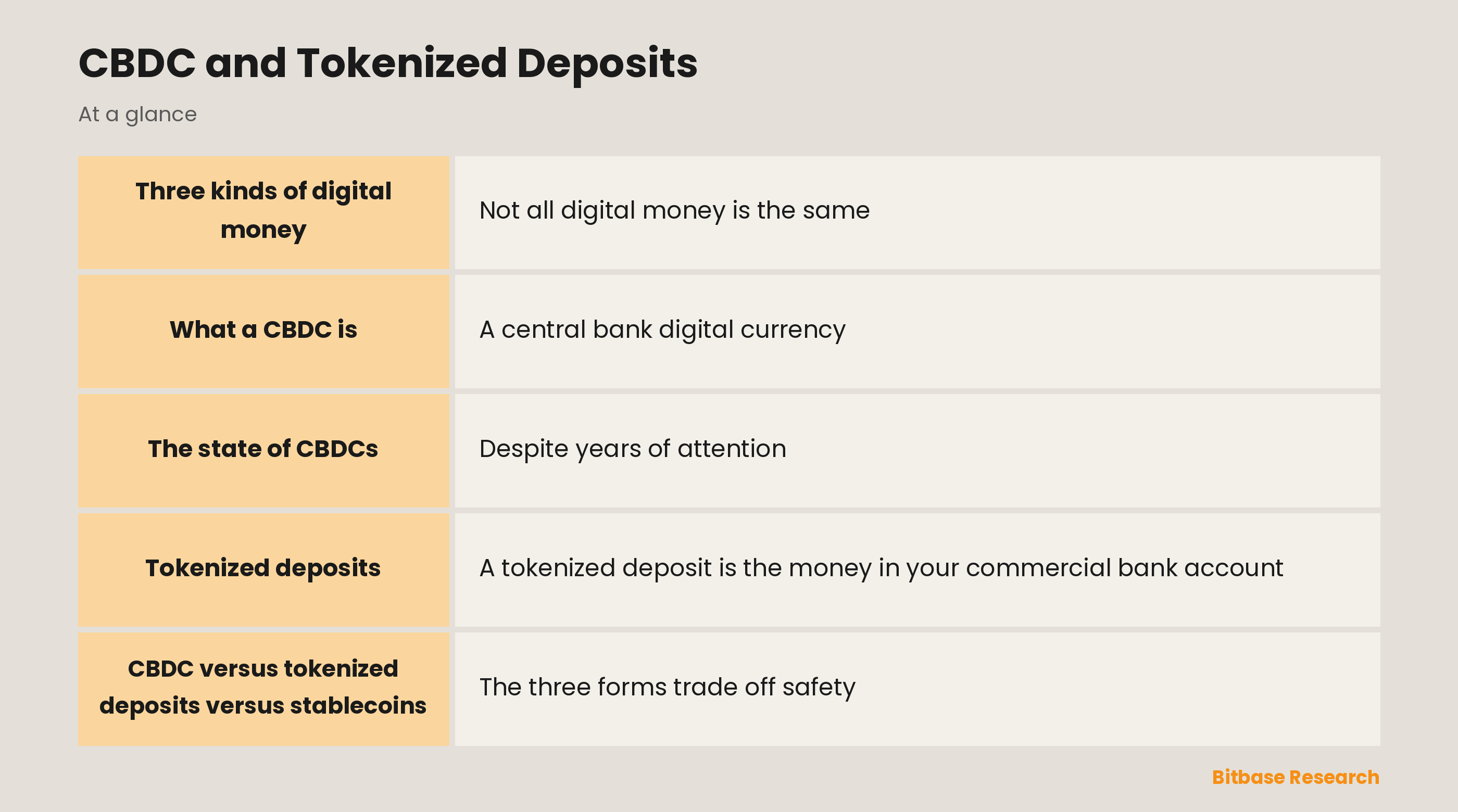
Not all digital money is the same, and the crucial difference is who stands behind it. A central bank digital currency is issued directly by a central bank and is a claim on the state itself. A tokenized deposit is commercial bank money placed on a blockchain, a claim on your bank. A stablecoin is issued by a private company and backed by its reserves. All three can look similar on-screen, but they carry different issuers, different risks, and different rules, which is the key to telling them apart.
What a CBDC is
A central bank digital currency, or CBDC, is a digital form of a nation's official money, issued and backed directly by its central bank. That makes it the safest form of digital money, since it is a direct liability of the state rather than a private institution. CBDCs come in two flavours: retail versions meant for everyday public use, like cash in digital form, and wholesale versions used only between banks and financial institutions for large-value settlement. The two serve very different purposes and raise very different questions.
The state of CBDCs
Despite years of attention, retail CBDCs have struggled to find real adoption. Only a handful are live for public use, dozens more sit in pilot stages, and several high-profile projects have cooled. One of the largest retail programmes has shifted its focus toward tokenized bank deposits after limited public uptake, and major economies like the euro area remain in a lengthy preparation phase with public issuance still years away. Wholesale CBDCs, by contrast, are advancing more quietly as tools for interbank settlement.
Tokenized deposits
A tokenized deposit is the money in your commercial bank account, represented as a token on a blockchain. It remains a claim on your bank, backed by the bank the same way an ordinary deposit is, but it gains programmability and can settle instantly on-chain. This fits neatly into a two-tier model that many central banks favour: the central bank issues wholesale CBDC to banks, and the banks issue tokenized deposits to the public. It keeps the familiar role of commercial banks while modernising how their money moves.
CBDC versus tokenized deposits versus stablecoins
The three forms trade off safety, control, and openness differently. A CBDC is the safest, being central-bank money, but raises concerns about privacy and state control. A tokenized deposit keeps money within the regulated banking system and suits institutional settlement, but depends on the health of the issuing bank. A stablecoin is the most open and borderless, thriving in crypto and cross-border payments, but relies on trusting a private issuer's reserves. Each excels in a different arena rather than one simply winning.
The bottom line
CBDCs and tokenized deposits are two institutional forms of digital money — one issued by the central bank, one by commercial banks — that sit alongside private stablecoins as the emerging plumbing of a tokenized financial system. Retail CBDCs have underwhelmed, wholesale CBDC and tokenized deposits are advancing through a two-tier bank model, and stablecoins hold their own in open and cross-border use. The label matters less than the question behind every digital token: who issued it, what backs it, and who bears the risk if it breaks.
Disclaimer: This article is educational content from Bitbase Academy, provided for informational purposes only. It is not investment, trading, tax, or financial advice. Written as of July 2026; rely on the latest official information.
References
[1] Atlantic Council, "Central Bank Digital Currency Tracker" atlanticcouncil.org
[2] BIS, "CBDCs and tokenized deposits" bis.org