TRC-20 is the token standard for the Tron blockchain. Like BEP-20, it was modeled on Ethereum's ERC-20, so tokens behave the same way — but Tron's fees are close to zero, which is why an enormous share of stablecoin transfers happens here. Here is what TRC-20 is, why it is so widely used, and the rule to remember when sending it.
What TRC-20 is
TRC-20 is the technical standard for fungible tokens on Tron. It defines the same core functions as ERC-20 — reading balances, transferring, approving spends — so any TRC-20 token works consistently across wallets and apps. TRX is Tron's native coin and pays the network's fees, while the tokens issued on top, above all dollar stablecoins, follow the TRC-20 standard.
Why it is everywhere
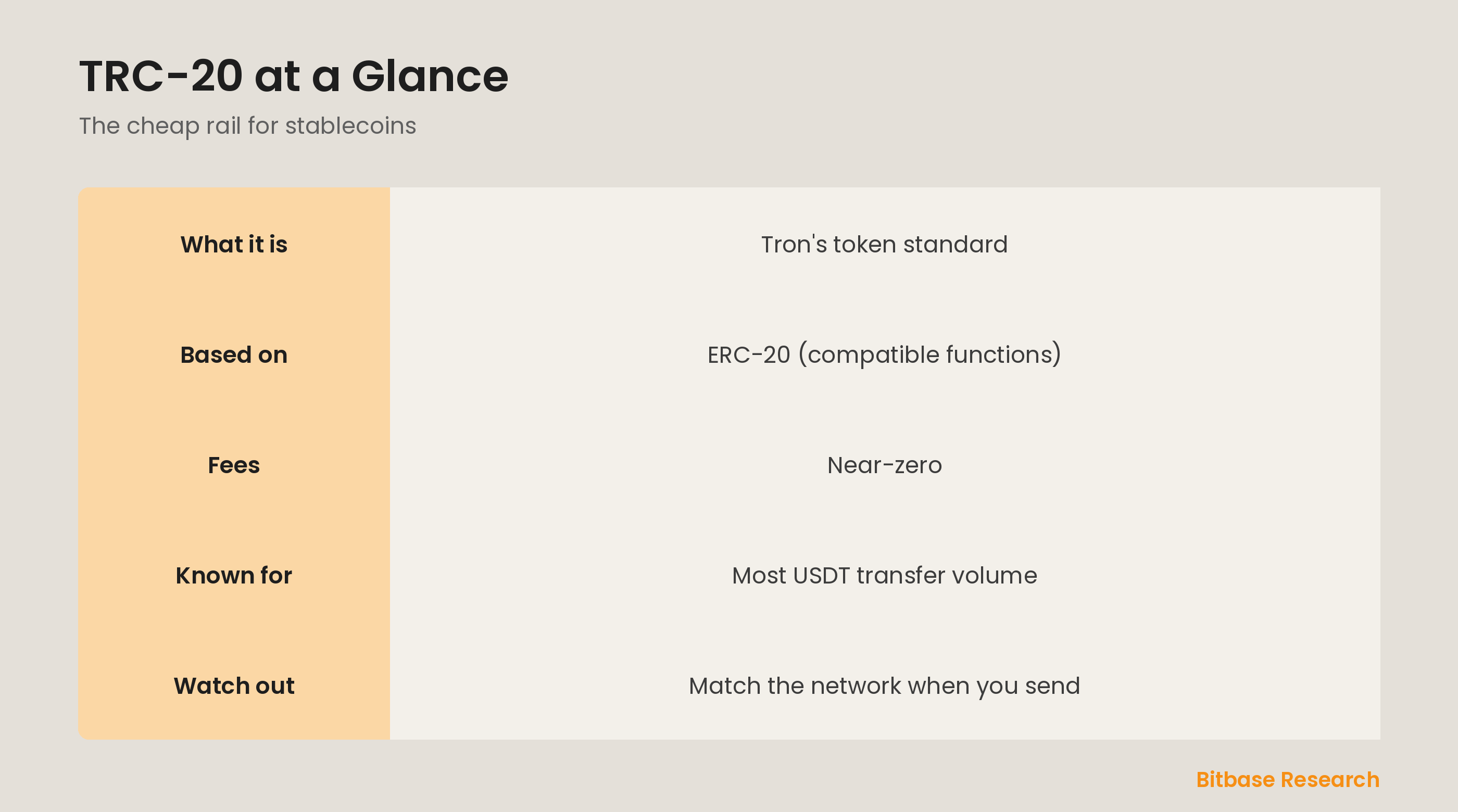
TRC-20's popularity comes down to cost and speed. Tron is built for high throughput and charges fees that are effectively negligible for most transfers, which makes it ideal for moving stablecoins frequently — for trading, arbitrage, or simply sending dollars. As a result, Tron carries one of the largest shares of global USDT transfer volume, and TRC-20 USDT has become a default way to move stablecoins cheaply.
Speed and cost
Where Ethereum handles only a handful of transactions per second and can charge several dollars in gas, Tron processes a far higher volume at a tiny fraction of the cost. For a user, that means a stablecoin transfer that clears quickly and costs almost nothing. The trade-off is ecosystem depth: Tron's DeFi and app landscape is narrower than Ethereum's, so TRC-20 is used mainly as a low-cost settlement rail rather than a hub for complex applications.
The rule to remember
As with every standard, the same stablecoin can exist as ERC-20, BEP-20, and TRC-20 versions, and the network must match on both ends of a transfer. Sending TRC-20 USDT to an address or exchange expecting a different network can lose the funds permanently. Before you send or withdraw, check that you have selected Tron (TRC-20) at both ends and that the receiving address supports it.
The bottom line
TRC-20 is Tron's take on the ERC-20 standard, optimised for cheap, fast transfers — which is why it moves so much of the world's stablecoin volume. It is the rail of choice when the priority is sending dollars at minimal cost. Just remember that a TRC-20 token lives on Tron, and always confirm the network matches before you transfer. To keep learning the fundamentals, follow more from Bitbase Academy.
Disclaimer: This article is educational content from Bitbase Academy, provided for information only. It does not constitute investment, trading, tax, or financial advice. Crypto assets are volatile; assess your own risk. Written as of June 2026; refer to the latest official information.
References
[1] TRON Developer Hub, "TRC-20 Token Standard" developers.tron.network
[2] Investopedia, "Tron (TRX): What It Is, How It Works, History" investopedia.com
[3] Ethereum.org, "ERC-20 Token Standard" ethereum.org