A regular stop-loss sits at one fixed price. A trailing stop is smarter: it follows the price up as your trade gains, locking in more of the profit while still protecting you if the market turns. It is one of the most useful exit tools once you understand its two settings, the activation price and the callback rate. Here is how a trailing stop works and how to set one well.
What a trailing stop is
A trailing stop is a stop-loss that automatically moves in your favor as the price advances, keeping a set distance behind the best price reached. On a long position, as the price climbs, the stop climbs with it, always trailing a fixed gap below. If the price then falls back by that gap, the stop triggers and you exit, having locked in gains you would have given back with a static stop. Crucially, it only moves up, never down.
Activation price and callback rate
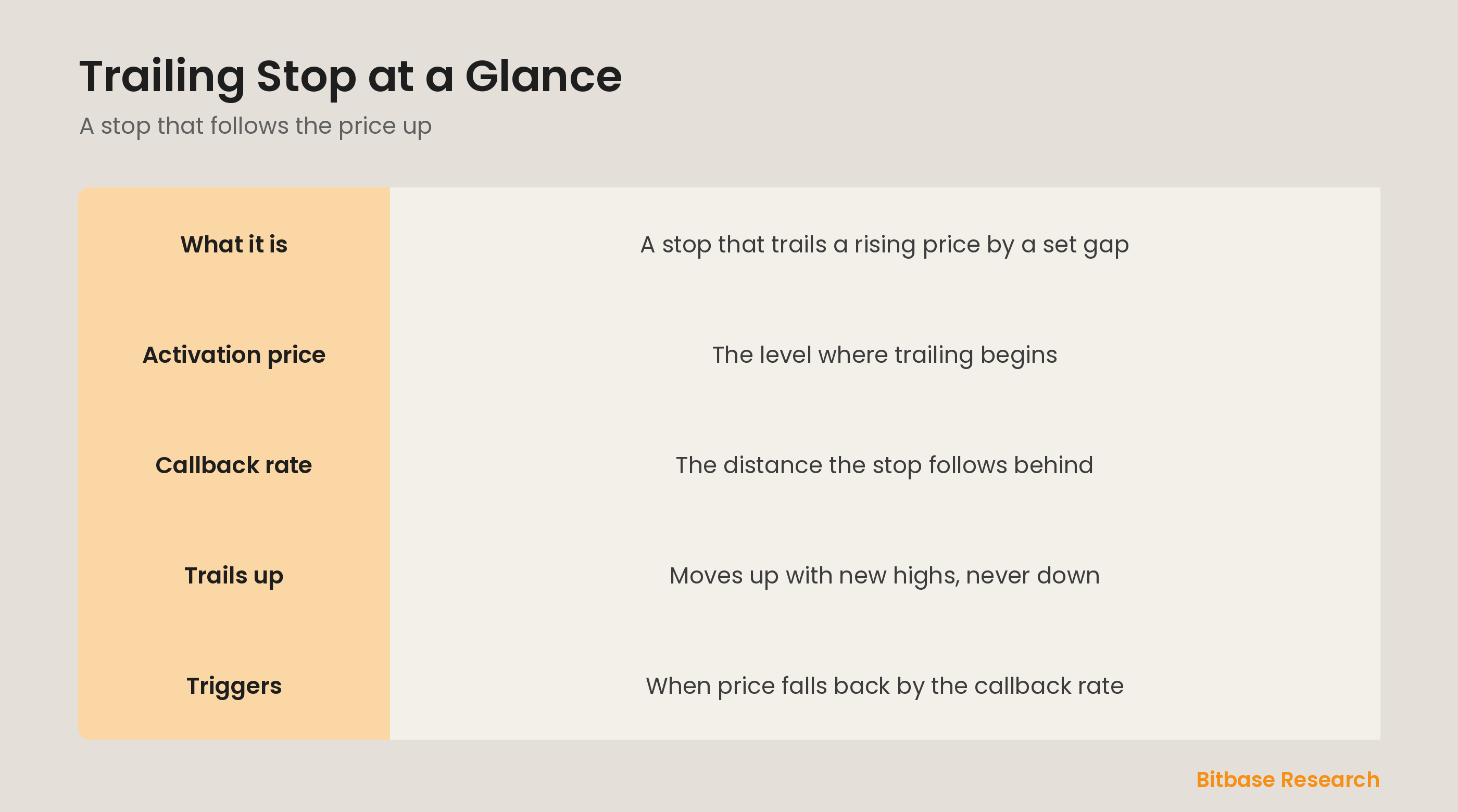
Two settings define it. The activation price is the level at which trailing begins: until the price reaches it, the stop does not start following, which lets you wait for a trade to move into profit before the trail kicks in. The callback rate is the distance the stop keeps behind the peak, usually set as a percentage. A tight callback locks gains quickly but risks being stopped out by small wobbles; a wide callback gives the trade room but gives back more on a reversal.
How it locks in gains
Imagine a long with a 5 percent callback. As the price rises to new highs, the stop follows 5 percent below each new peak. If the price keeps climbing, your stop keeps ratcheting up, protecting ever more profit. The moment the price drops 5 percent from its highest point, the stop fires and you are out, near the top rather than back at your entry. The trail does the work of moving your stop that you would otherwise have to do by hand.
Setting one well
Choose the callback rate to fit the asset and your patience: volatile coins need a wider callback to avoid being shaken out, while calmer ones can use a tighter one. Use the activation price to delay trailing until the trade is genuinely in profit. And remember the trade-off: a trailing stop captures trends beautifully but will always exit somewhat below the peak, because it needs a pullback to trigger. That is the price of letting a winner run.
The bottom line
A trailing stop is a stop that follows a rising price by a set callback rate, locking in more profit as a trade works and triggering only when price pulls back by that gap. The activation price decides when trailing starts, and the callback rate decides how closely it follows. Set the callback to match the asset's volatility, and a trailing stop lets you ride a trend while automatically protecting the gains you have made. To keep learning the fundamentals, follow more from Bitbase Academy.
Disclaimer: This article is educational content from Bitbase Academy, provided for information only. It does not constitute investment, trading, tax, or financial advice. Crypto assets are volatile; assess your own risk. Written as of June 2026; refer to the latest official information.
References
[1] Investopedia, "Trailing Stop: What It Is, How It Works, Example" investopedia.com
[2] Investopedia, "Stop-Loss Order: Definition, How It Works, and Examples" investopedia.com
[3] Investopedia, "Limit Order: Definition, How It Works, and Types" investopedia.com