
What if a global network of wireless hotspots, data-storage drives, or GPUs could be built by ordinary people plugging in hardware and earning tokens, with no central company owning it? That is the promise of DePIN — decentralized physical infrastructure networks. Here is what DePIN is, how its token incentives work, and why the model is both powerful and precarious.
What DePIN is
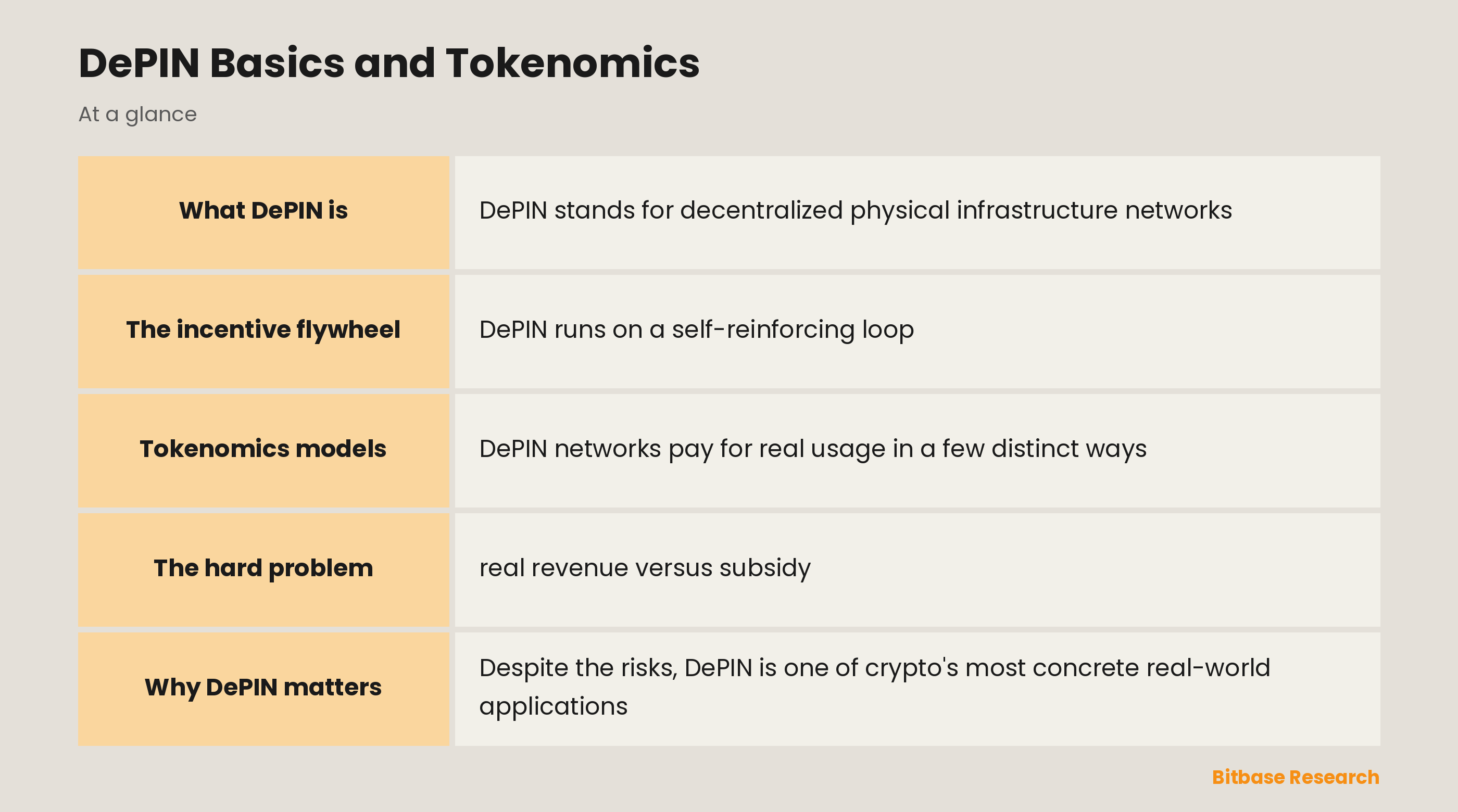
DePIN stands for decentralized physical infrastructure networks: blockchain projects that coordinate real-world hardware through token rewards. Instead of a corporation building and owning infrastructure, thousands of independent operators contribute physical resources — wireless coverage, storage space, computing power, sensor data — and are paid in the network's token for doing so. The blockchain handles coordination, verification of contributions, and payment, letting a decentralised crowd assemble infrastructure that traditionally required enormous centralised capital.
The incentive flywheel
DePIN runs on a self-reinforcing loop. In the early days, when there is little real demand, the network issues tokens to reward people for supplying hardware, bootstrapping supply that would otherwise never appear. As coverage or capacity grows, real customers arrive and pay to use the network, and that genuine revenue makes the token more valuable, which attracts still more operators. When it works, this flywheel builds a global network far faster and cheaper than a single company could — supply and demand pulling each other upward.
Tokenomics models
DePIN networks pay for real usage in a few distinct ways. A common design is a burn-and-mint model, where customers buy non-transferable credits priced in dollars by burning the network's token, giving users stable pricing while creating steady demand for the token. Others let customers pay directly in the native token, tying network usage straight to token demand. Some simply accept stablecoins for services and use the token mainly for rewards and governance. Each model balances price stability, token demand, and simplicity differently.
The hard problem: real revenue versus subsidy
The central challenge is the gap between token rewards and real income. Early on, most of what operators earn is a subsidy paid in freshly issued tokens, not payment from actual customers. A healthy DePIN must eventually replace those subsidies with genuine demand, or the token inflates while usage stays thin and the flywheel stalls. A second hard problem is verification: proving that a contributor's hardware actually did the work — provided real coverage, stored the data, ran the computation — rather than faking it to farm rewards.
Why DePIN matters
Despite the risks, DePIN is one of crypto's most concrete real-world applications. It offers a way to build capital-intensive infrastructure without a single company fronting the money, aligning a global crowd of contributors through shared token ownership. Leading networks already earn real revenue from paying customers for storage, compute, wireless data, and mapping, proving the model is more than theory. It points toward infrastructure that its users and operators own collectively rather than rent from a monopoly.
The bottom line
DePIN uses token incentives to crowdsource real physical infrastructure, powered by a flywheel where rewards bootstrap supply until real demand can sustain it. Its tokenomics — burn-and-mint credits, native-token payment, or stablecoins — all try to convert usage into durable token value. The make-or-break questions are whether real revenue eventually replaces token subsidies and whether physical work can be verified honestly. Judge any DePIN network by real usage and revenue, not token price, because that is where the model succeeds or fails.
Disclaimer: This article is educational content from Bitbase Academy, provided for informational purposes only. It is not investment, trading, tax, or financial advice. Written as of July 2026; rely on the latest official information.
References
[1] Messari, "The state of DePIN" messari.io
[2] CoinMarketCap, "What is DePIN?" coinmarketcap.com