
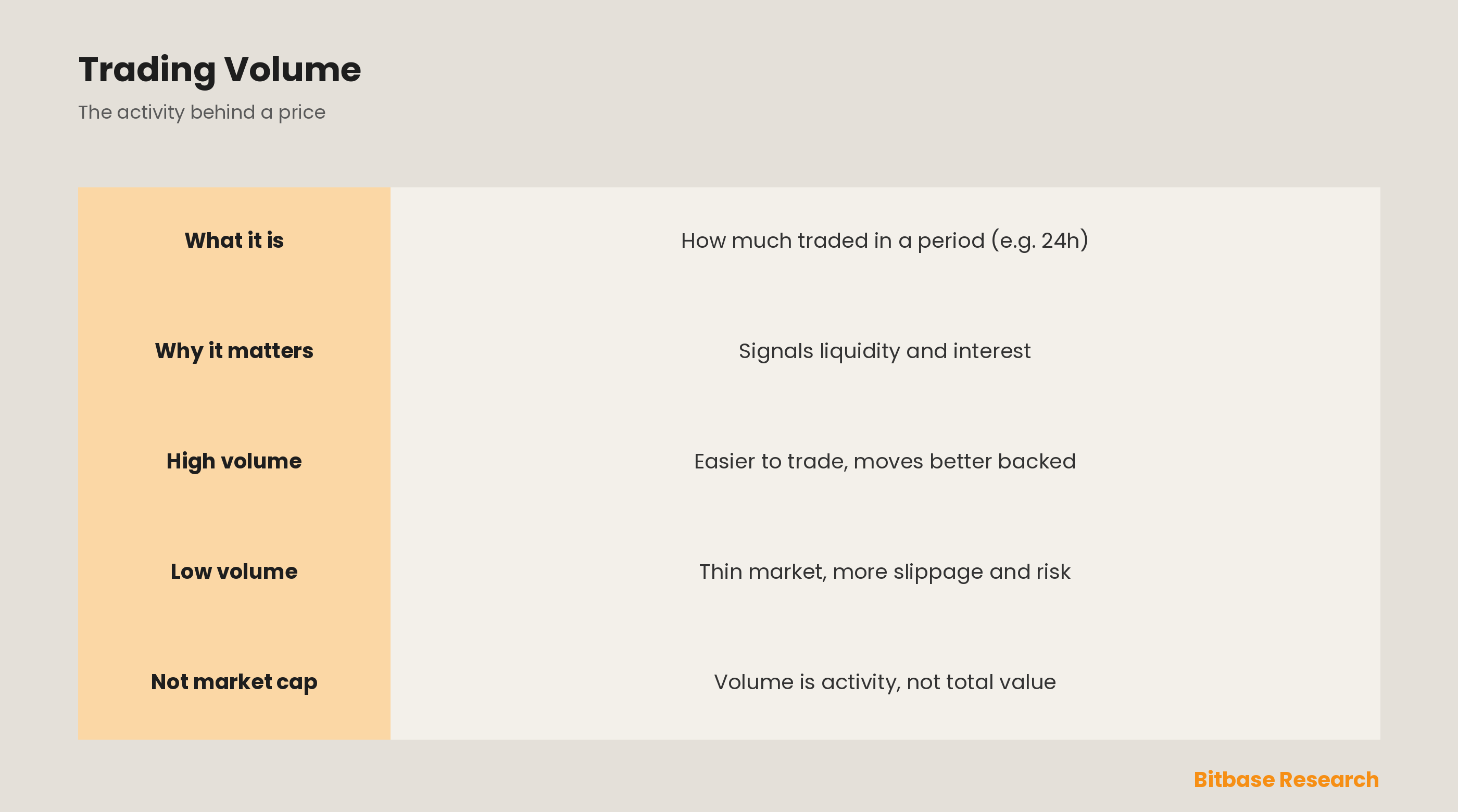
Trading volume is how much of an asset changed hands over a period, like the last 24 hours. It's a quick read on liquidity and interest: high volume means easier trading and more meaningful price moves, while low volume can mean a thin, riskier market. Here's how to use it.
What the number tells you
Volume counts the total amount traded in a window — you'll often see "24h volume" on an exchange or data site [1]. High volume signals an active, liquid market: it's easier to buy or sell without moving the price much, and a price move backed by heavy volume is more convincing. Low volume signals a thin market, where it's harder to exit and prices can be pushed around more easily [2].
Reading it in practice
Read volume alongside the price move rather than on its own. When a rally or a sell-off comes on high volume, many buyers and sellers actually traded, so the move carries more weight and entering or exiting is easier. When the same move comes on low volume, few trades sit behind it: the move is weaker, the price is easier to push, and the position is harder to exit.
The bottom line
Think of volume as the activity behind a price. A rally or drop on high volume shows real participation and is more trustworthy; the same move on low volume is weaker and easier to manipulate. Volume isn't a buy or sell signal by itself, but it's a useful gauge of liquidity and conviction — and it's different from market cap, which measures total value, not activity. To keep learning the fundamentals, follow more from Bitbase Academy.
Related reading
Other Bitbase articles on this topic:
- The MACD Indicator Explained
- ATR Indicator: How Average True Range Measures Volatility
- The Stochastic Oscillator Explained
Disclaimer: This article is educational content from Bitbase Academy, provided for information only. It does not constitute investment, trading, tax, or financial advice. Crypto assets are volatile; assess your own risk. Written as of June 2026; refer to the latest official information.
References
[1] Coinbase, "What is trading volume?" coinbase.com
[2] Kraken, "Understanding trading volume." kraken.com