
A weak proof of reserves disclosure is usually weak in a specific, recognisable way. The signals worth noticing are all about what is missing rather than what is claimed, because claims cost nothing to make and artefacts cost something to produce. This is a list of what to look for, and it ends with the things that look alarming but are not.
What counts as a red flag here
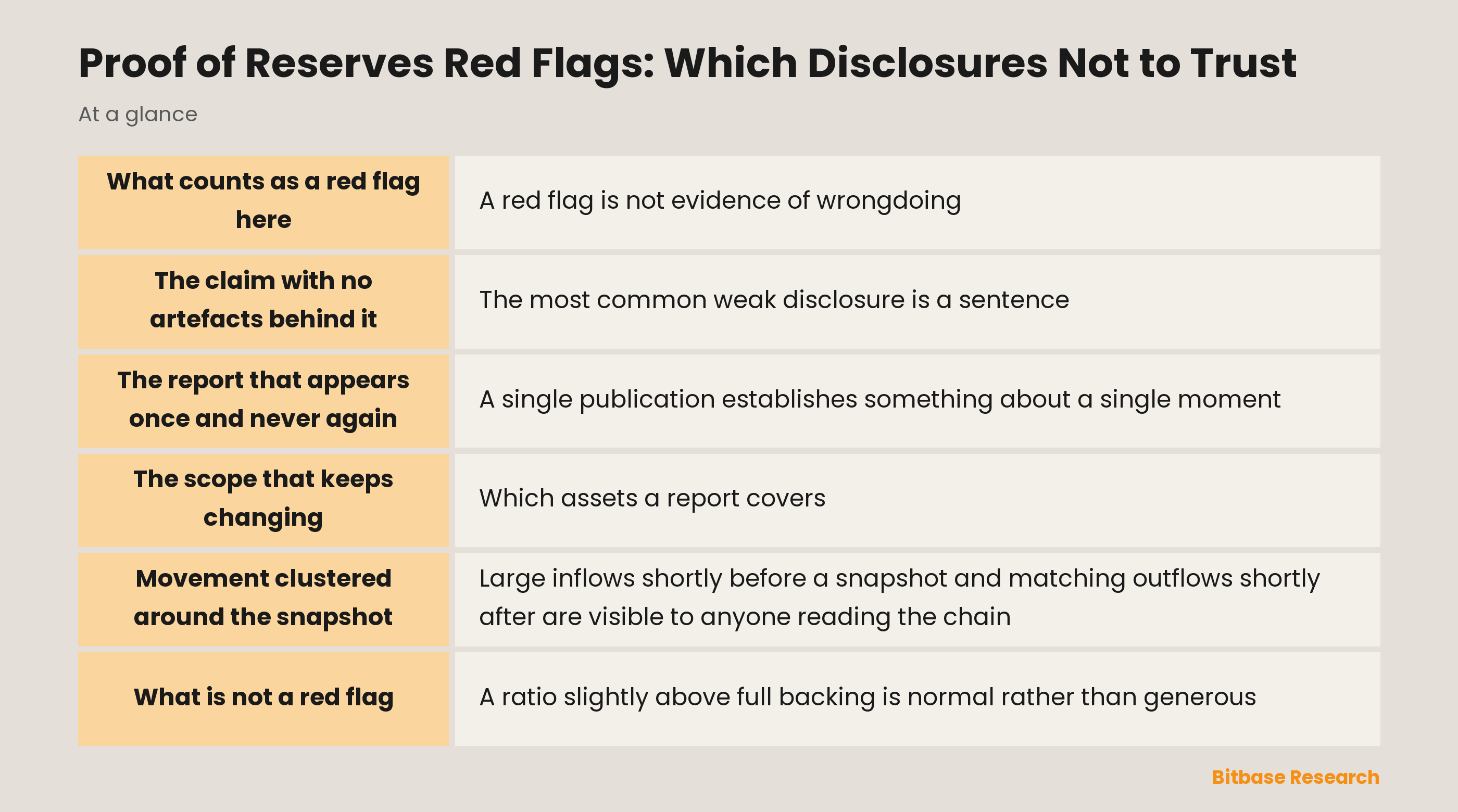
A red flag is not evidence of wrongdoing. It is a place where a disclosure stops being checkable, which means you are back to trusting a statement rather than reading a document.
That framing matters because it keeps the list proportionate. Most of what follows has innocent explanations, and an operator who has simply not finished building the machinery looks the same from outside as one who has chosen not to. What you can conclude is the same in both cases: the claim is currently unverified.
It also keeps the reader out of a trap that catches people who go looking for problems: a list of warning signs read uncharitably will find something wrong with almost any document. The useful habit is to ask what each element of a disclosure would let you do. If the answer is nothing, that element is decoration, however confidently it is worded.
Red flags and why each one matters
| Red flag | Why it matters |
|---|---|
| A claim with no addresses published | Nothing in it can be checked by anyone outside |
| No signatures from the listed addresses | Pointing at a wallet is not the same as controlling it |
| One blended ratio, no per-asset breakdown | A shortfall in one coin hides behind a surplus in another |
| No stated snapshot time | You cannot line your own balance up against anything |
| Addresses published after the balances were read | The list could have been chosen to look good |
| Reserves leaning on the platform's own token | That asset falls at the moment the reserve is needed |
Read the second column rather than counting flags, because one structural gap can matter more than three cosmetic ones. The fifth row is the one people miss most often, because the artefacts all exist and only their order is wrong.
The claim with no artefacts behind it
The most common weak disclosure is a sentence. Full backing is asserted on a page, no addresses appear, no method is described, and no date is given, and a reader is left with exactly as much information as before.
The natural follow-up is short. Where are the addresses, what was signed, what period does this cover, and where is the tool. An operator who has done the work has these answers in one place, and an operator who has not will offer reassurance instead.
Reassurance is the tell. The difference between a document and a promise is that a document tells you what you may conclude and a promise tells you how to feel, and only one of those survives a bad week. What each field of a real report contains is set out in how to read a proof of reserves report.
The report that appears once and never again
A single publication establishes something about a single moment. A series establishes a habit, and the difference between the two is larger than it looks.
When a report exists for one period and then stops, the most likely explanations are ordinary: it was expensive, the team changed, or it was produced for a reason that has passed. None of that is sinister and all of it leaves you without current information.
There is a milder version of the same signal, which is a report that arrives at irregular intervals with no announced schedule, since a publisher who chooses the date can choose a good one. Regularity is therefore worth more than any single strong result. A modest disclosure published every month on a stated schedule tells you more than an elaborate one produced once, because the schedule is a commitment that can be seen to be kept.
The scope that keeps changing
Which assets a report covers, which wallets are included and how locked or staked positions are counted are all decisions made by the publisher. Changing them is legitimate, and changing them without saying so is the problem.
An unannounced scope change makes two periods look comparable when they are not, and it can move a ratio without a single coin moving anywhere. A reader who compares the two figures reaches a conclusion the data does not support.
The version of this worth watching for is an asset quietly leaving the report, since coverage that narrows without comment removes exactly the figure a reader might have wanted to compare. Good disclosures state the frame explicitly and flag when it changes. The quality question underneath this one is what the reserves are actually made of, which is taken up in crypto exchange reserve composition.
Movement clustered around the snapshot
Large inflows shortly before a snapshot and matching outflows shortly after are visible to anyone reading the chain, and this pattern is worth asking about precisely because it is checkable.
It has entirely ordinary causes. Operators consolidate wallets, settle with partners and move funds for operational reasons, and the timing of a snapshot does not stop normal business from happening around it.
But the pattern is also what borrowing assets for the occasion would look like, and no signature can distinguish the two, because a signature proves control at that moment rather than ownership over time. How much the chain can settle here is covered in on-chain verification of proof of reserves.
What is not a red flag
A ratio slightly above full backing is normal rather than generous, and a very high ratio on a small asset usually means the denominator is tiny. Neither is a signal about anything.
A report that states its own limitations is a good sign and not a confession. Disclosures that explain what they do not cover are easier to trust than ones that imply they cover everything, and the phrase most worth distrusting is the one that leaves no gap at all, which is discussed in what fully backed actually means.
Nor is a correction. A publisher who republishes a period with a stated reason is doing something more accountable than one whose numbers never need revising. Finally, a missing feature is not a scandal. An exchange without zero-knowledge proofs, or without third-party assurance, is behind rather than dishonest, and reading absence as guilt makes the whole exercise less useful rather than more careful.
The bottom line
The red flags that matter are structural: no addresses, no signatures, no per-asset breakdown, no stated time, a list assembled after the fact, and a reserve resting on the platform's own token.
The common thread is that each removes your ability to check something yourself, which returns you to trusting a claim. Judge disclosures by how much they let you verify, not by how confident they sound, and most of this becomes easy to read. For more from Bitbase Academy, keep reading.
Disclaimer: This article is educational content from Bitbase Academy, provided for information only. It does not constitute investment, trading, tax, or financial advice. Crypto assets are volatile; assess your own risk. Written as of September 2026; refer to the latest official information.
References
[1] Bitbase, Proof of Reserves — monthly disclosure, Merkle root and open-source verifier www.bitbase.com