Proof of reserves is a real advance over asking an exchange to be believed, and it has boundaries that are structural rather than accidental. Five of them recur in every implementation: completeness, exclusivity, timing, scope, and accountability. Knowing all five is what lets you use a report for what it is worth instead of treating it as a guarantee or dismissing it as theatre.
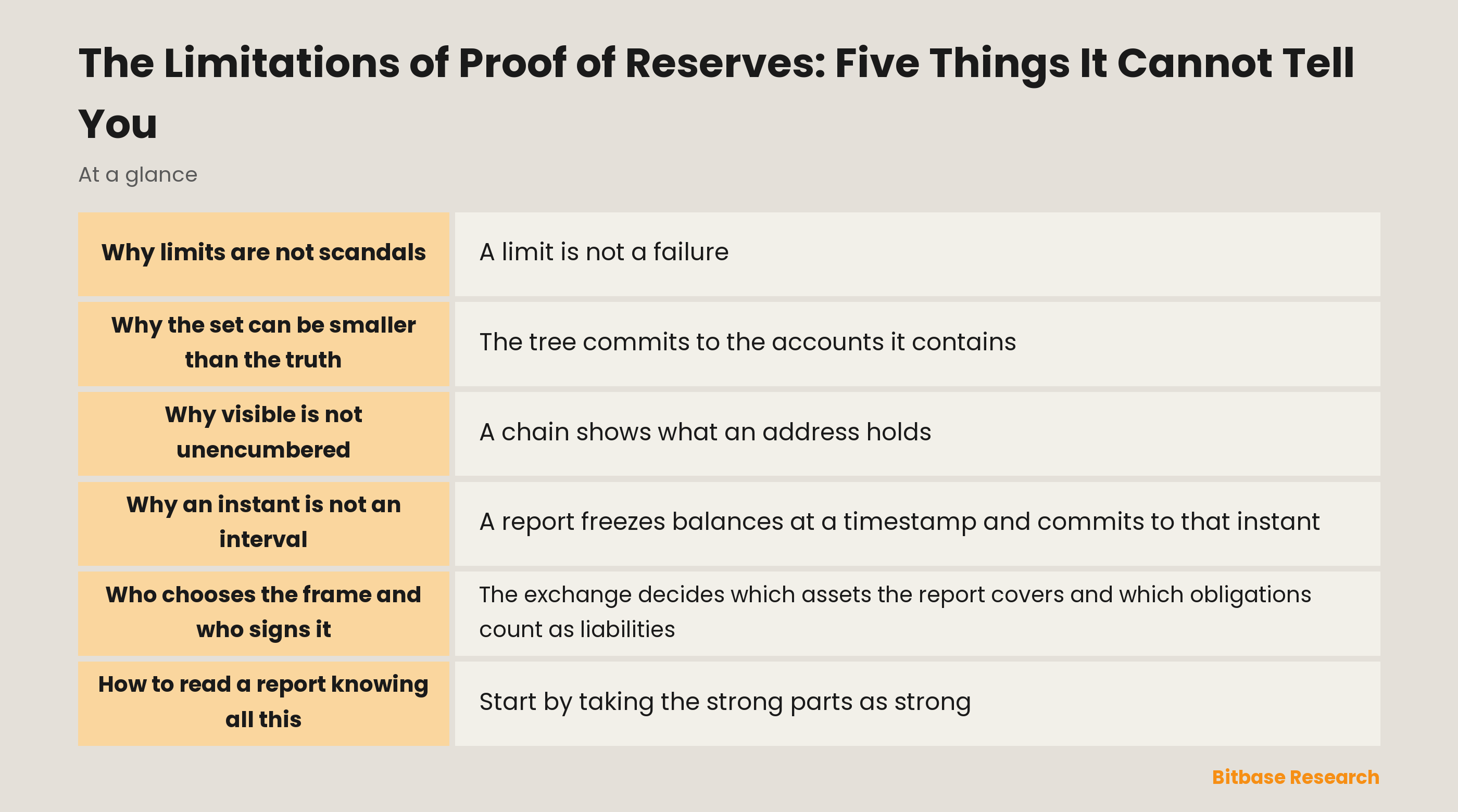
Why limits are not scandals
A limit is not a failure. Every measuring instrument has a range, and the useful question about any of them is what it reads accurately rather than whether it reads everything.
The reason limits matter here is that this particular mechanism is easy to over-read. It produces a cryptographic artefact, and cryptographic artefacts carry an air of completeness they have not earned. A hash is exact about the thing it commits to and silent about everything else. It is that silence which creates the impression that more has been said than was actually said.
So the five limits below are not arguments against reading reports. They are the map of where the instrument stops being precise, and that map is what makes the precise part usable.
The five limits at a glance
| Limit | What it leaves open | Can it be closed |
|---|---|---|
| Completeness | Whether every account was in the tree | Partly, by wide participation |
| Exclusivity | Whether the assets are borrowed or pledged | Only by outside examination |
| Timing | What happened between two snapshots | Reduced by frequency, never removed |
| Scope | Assets and obligations left out of the frame | By publishing a wider frame |
| Accountability | Who is answerable if the report is wrong | Only by a signed engagement |
The third column is the one to read carefully. Two of the five can be materially improved by the exchange alone; the other three need either an outside party or a change in what is published.
Why the set can be smaller than the truth
The tree commits to the accounts it contains, and it says nothing about accounts it does not contain. If an account is left out, every remaining user still verifies successfully, because each proof path is independent of the missing one.
That asymmetry is the core of the completeness problem. The people in a position to notice an omission are exactly the people who were omitted, and they are also the people the report never reaches. No amount of individual checking closes this from the inside, because each check answers for one row only and asserts nothing about the rest of the set.
Wide participation makes deliberate omission risky, because every dropped account belongs to somebody who might check. It converts the problem from impossible-to-detect into expensive-to-attempt, which is progress but is not proof. The structure behind this is described in Merkle trees in proof of reserves.
Why visible is not unencumbered
A chain shows what an address holds. It does not show what claims exist against those holdings, because claims live in agreements rather than in blocks.
Assets that appear at a controlled address may have been borrowed shortly before the snapshot, pledged as collateral somewhere else, or committed under an arrangement that never touches the chain. Every one of those situations produces a perfectly valid signature and a perfectly honest-looking balance. A signature proves control of a key rather than freedom from other people's claims, and the chain simply does not show the difference between those two statements.
This is the limit that cryptography is least able to help with. Encumbrance is a legal fact about a relationship, and no on-chain measurement reveals it; only examination of records by someone with access does.
Why an instant is not an interval
A report freezes balances at a timestamp and commits to that instant. It describes a photograph, not a film, and the gap between photographs is genuinely unobserved.
Increasing frequency shrinks the gap, and shrinking the gap matters, because it reduces how long a problem can exist unseen and how much can be arranged specifically for the moment of the snapshot. Monthly is meaningfully better than annually for exactly this reason, and a schedule announced in advance is better than publication on dates chosen freely.
But no schedule converts a sequence of instants into continuous coverage. This is the ordinary condition of periodic reporting rather than something peculiar to crypto, and readers of any periodic report carry the same assumption without noticing it.
Who chooses the frame and who signs it
The exchange decides which assets the report covers and which obligations count as liabilities. Both decisions are made by the party being examined, and both can be entirely reasonable while still leaving material things outside the frame. A reader is therefore right to look not only at the numbers inside the frame but at how the frame is described and how wide it is.
Customer balances are the natural liability set, and they are not the whole of what is owed. Borrowings, obligations to counterparties, and commitments under agreements that never appear in a customer account are all real and all outside the tree. That gap is the subject of does proof of reserves prove solvency.
Accountability is the quieter limit. A published root is a statement nobody signed in a professional capacity, so if it is wrong, the consequence is reputational rather than personal. Work by a qualified firm attaches a name and a liability to a conclusion, which is a different kind of assurance and is compared directly in proof of reserves versus audit.
How to read a report knowing all this
Start by taking the strong parts as strong. That assets exist and are controlled, and that your own balance was in the committed set, are checkable facts and should be treated as such.
Then hold the rest at the right distance. A high verification rate is evidence about completeness rather than proof of it; frequent publication narrows the timing gap rather than closing it; a wider asset scope is better than a narrow one but is still a scope the publisher chose.
Finally, notice what a platform does about the limits it cannot fix alone. Publishing methodology, offering an open verifier, disclosing the frame explicitly, and adding outside work are all responses to these five, and their presence or absence tells you something the numbers do not.
The bottom line
Proof of reserves has five structural limits: it cannot establish that the set was complete, that the assets were unencumbered, what happened between snapshots, what sits outside the chosen frame, or who is answerable for the conclusion.
None of that makes it worthless. It makes it an instrument with a range, and the range covers exactly the thing that used to be invisible. Read it for that, ask about the rest, and both the mechanism and its gaps stay in proportion. For more from Bitbase Academy, keep reading.
Disclaimer: This article is educational content from Bitbase Academy, provided for information only. It does not constitute investment, trading, tax, or financial advice. Crypto assets are volatile; assess your own risk. Written as of September 2026; refer to the latest official information.
References
[1] Bitbase, Proof of Reserves — monthly disclosure, Merkle root and open-source verifier www.bitbase.com