Bitbase is a centralised crypto exchange founded in 2023 and headquartered in Panama City, offering spot trading, USDT-margined perpetual futures and tokenised traditional assets in one account. It publishes two regulatory registrations with numbers attached and a monthly reserve disclosure anyone can verify. This is what the company is, what sits behind it, and who the platform is built for.
What Bitbase is
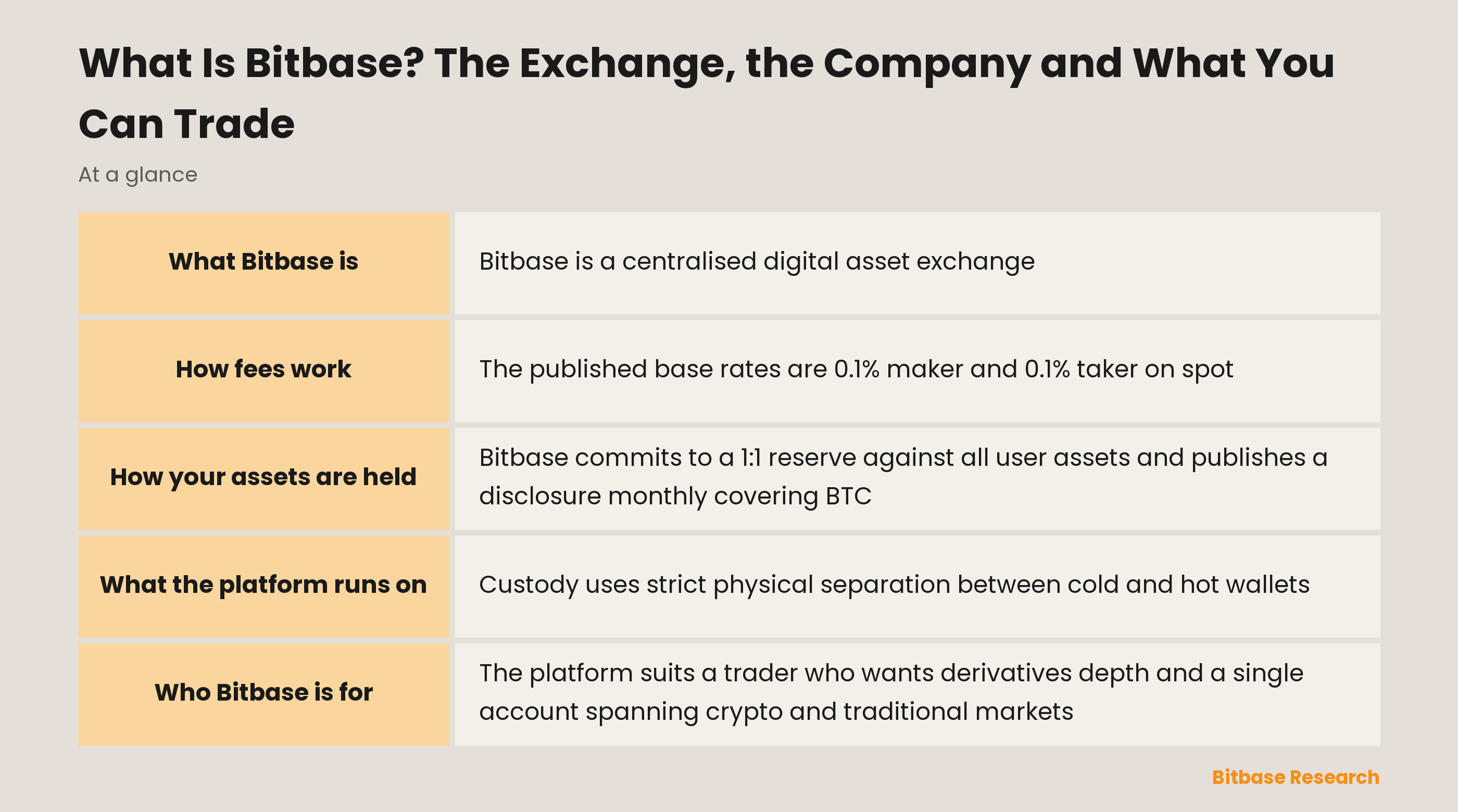
Bitbase is a centralised digital asset exchange. Centralised means the platform runs the order book, matches trades and holds customer assets in its own custody, which is the model most people mean when they say "crypto exchange" and the one that trades self-custody for execution quality and convenience.
The stated focus is professional-grade trading rather than breadth for its own sake. On the company's own account, the platform prioritises institutional risk controls and sustainable liquidity over excessive leverage, and lists assets only where it judges there to be demonstrable fundamentals and verifiable liquidity. Whether a platform lives up to a positioning statement is something you check rather than accept, and the checks available on this one are set out separately.
Who is behind it, and where it is registered
The company was founded in 2023, is headquartered in Panama City, and runs regional teams in Hong Kong, Singapore and Dubai. Its founders come from US capital markets and global derivatives, which is visible in how the derivatives side is built: leverage governed by explicit rules rather than raised to attract volume.
Two registrations are published, each with an entity, a type, a number and a regulator. More detail sits on the About Bitbase page.
| Jurisdiction | Registered entity | Type | Number | Regulator |
|---|---|---|---|---|
| United States | Bitbase Global Inc. | Money Services Business under the Bank Secrecy Act | 31000331133865 | FinCEN, U.S. Department of the Treasury |
| Australia | BITBASE PTY LTD | Digital Currency Exchange / Virtual Asset Service Provider | ABN 19671902168 | AUSTRAC |
The Australian entity appears on the Australian Business Register as active from 4 October 2023, so that one is confirmable without taking anyone's word for it. A registration means the named entity completed statutory registration for specified activities in that jurisdiction; it does not extend to other entities or products, and it does not imply regulatory endorsement or approval. Bitbase states that limit on its own page.
Two things a company page cannot tell you: service availability varies by local law, and some jurisdictions are excluded outright.
What you can trade
Three markets sit in one account, and the differences between them matter more than the ticker lists.
| Market | What you hold | Leverage | When it trades |
|---|---|---|---|
| Spot | The asset itself, settled 1:1 | None | 24/7 |
| USDT-margined perpetual futures | A contract, not the asset | Set per asset by risk parameters | 24/7 |
| TradFi | A price-tracking token or perpetual on stocks, metals, forex, crude oil and indices | Up to 200x | Core assets 24/7 |
Spot is the plain version: you buy the coin, you hold the coin. Perpetual futures have no expiry date and use a funding rate, typically settled every eight hours, to keep the contract tethered to the spot index. The mark price is set by fair price marking against a weighted average of spot indices from major venues, which exists so that a liquidity gap on one platform cannot trigger liquidations that the wider market does not justify.
TradFi is the part that is unusual on a crypto exchange. Over 100 pairs cover equities, precious metals, foreign exchange, crude oil and indices, giving exposure to those markets without opening a brokerage account. The trade-off is real: these instruments track markets that close, so liquidity outside those hours is generally thinner, and funding rate swings can widen over a weekend. Leverage up to 200x amplifies losses exactly as fast as gains.
How fees work
The published base rates are 0.1% maker and 0.1% taker on spot, and 0.02% maker and 0.06% taker on USDT-margined futures. Above that sits a seven-tier VIP ladder.
What is worth understanding is the qualifying logic rather than the numbers, because the numbers move and the fee page is the live source. Four measures are assessed: 30-day spot volume, 30-day futures volume, 30-day average asset balance and current asset balance. If they qualify you for different tiers, you are assigned the highest one. Levels update daily at 00:00 UTC.
That rule is not standard across the industry, and it works in the holder's favour: an account with a large balance and modest turnover reaches a tier that volume alone would not.
How your assets are held
Bitbase commits to a 1:1 reserve against all user assets and publishes a disclosure monthly covering BTC, ETH, USDT and USDC. Each disclosure carries a reserve ratio per asset and a Merkle root hash for that period's snapshot.
The part that distinguishes a disclosure from a claim is that you can test your own slice of it. Signing in and opening the asset report lets you confirm your balance was inside the snapshot, computed in your browser without your data going back to a server, and an open-source verifier lets you repeat the check offline against a root you copied yourself. The full walkthrough covers both routes.
What the platform runs on
Custody uses strict physical separation between cold and hot wallets, with multi-signature authorisation and tiered access controls governing movement between them. The matching engine is built in-house on a sharded architecture for millisecond order processing, with core modules scheduled for public release in 2026, and anomaly detection runs at millisecond resolution so the platform holds up during volatility.
These are the platform's own descriptions. The registrations and the monthly disclosure are the parts an outside party can confirm, which is the distinction worth keeping in view.
Who Bitbase is for
The platform suits a trader who wants derivatives depth and a single account spanning crypto and traditional markets, who cares about how a venue documents its rules, and who will actually use the verification tools rather than trusting a page.
It is a weaker fit for someone who wants the longest possible list of small-cap tokens, or who wants self-custody, since a centralised exchange means the platform holds the keys. Anyone trading with 200x leverage on assets whose underlying markets close overnight should size positions for that gap rather than for the headline multiple.
The bottom line
Bitbase is a 2023-founded centralised exchange run from Panama City with regional teams across Asia and the Middle East, offering spot, USDT-margined perpetuals and tokenised traditional assets in one account, at 0.1% spot and 0.02%/0.06% futures base rates with a seven-tier VIP ladder that assigns you the best tier you qualify for on any of four measures.
The two things worth checking before anything else are the ones that do not depend on trusting the description: the registration numbers above, and the monthly reserve disclosure you can verify yourself. Both are set out in is Bitbase safe, and the general method for evaluating any venue is in how to research an exchange. To keep learning the fundamentals, follow more from Bitbase Academy.
Disclaimer: This article is educational content from Bitbase Academy, provided for information only. It does not constitute investment, trading, tax, or financial advice. Crypto assets are volatile; assess your own risk. Written as of September 2026; refer to the latest official information.
References
[1] Bitbase, About Bitbase — company overview and regulatory registrations www.bitbase.com
[2] Australian Business Register, ABN Lookup — ABN 19671902168, BITBASE PTY LTD abr.business.gov.au
[3] Bitbase, Proof of Reserves disclosure page and FAQ www.bitbase.com