Bitbase TradFi puts traditional markets inside the same account you already trade crypto in. It covers stocks, precious metals, forex, crude oil, indices and digital assets, offers more than a hundred popular pairs with leverage up to 200x, and keeps core assets tradable around the clock. What you hold is an on-chain price-tracking certificate that mirrors the underlying asset, which means no traditional brokerage account is required.
What Bitbase TradFi actually is
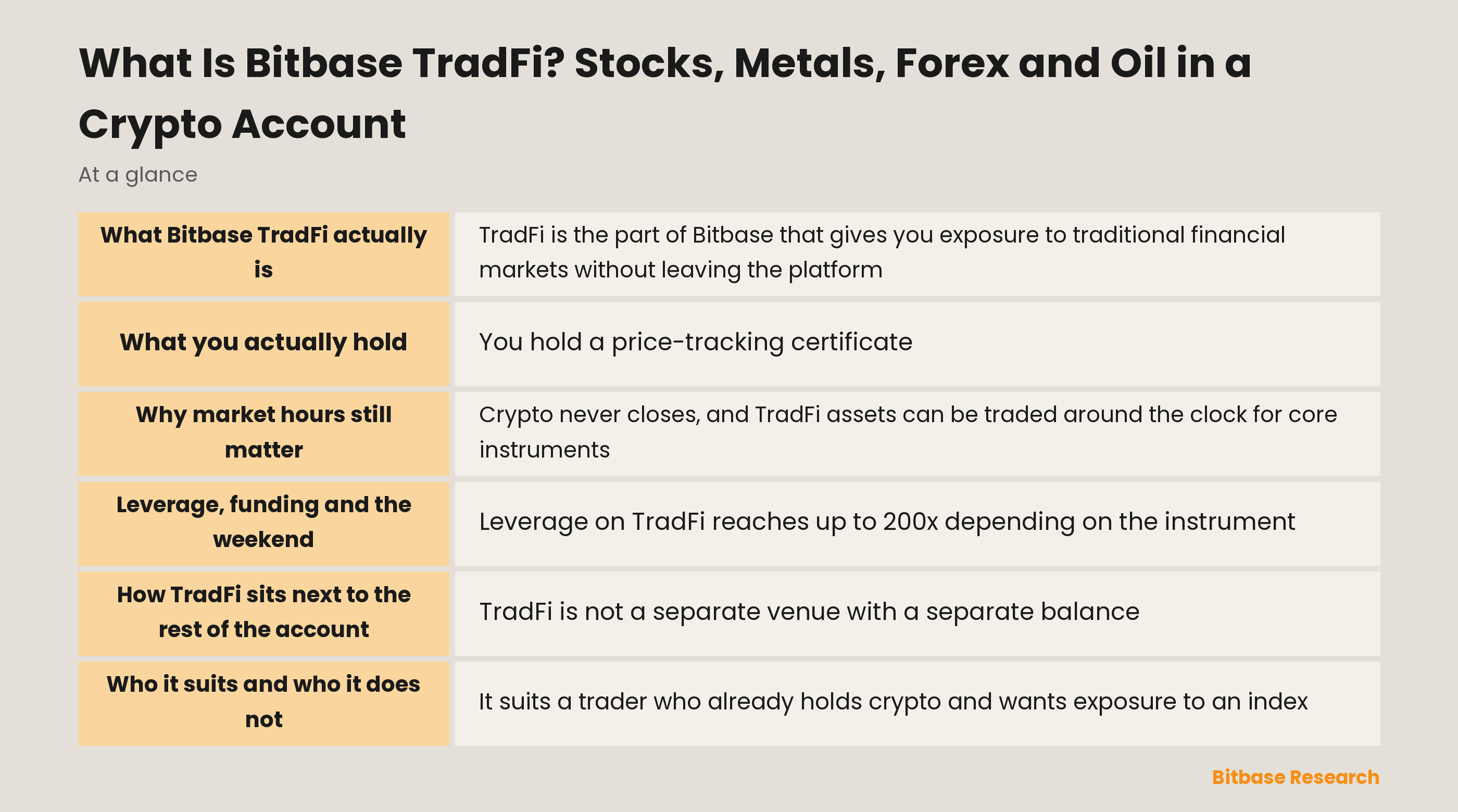
TradFi is the part of Bitbase that gives you exposure to traditional financial markets without leaving the platform. You fund it from the same balance, you trade it in the same interface, and profit and loss settles back into your Bitbase account when you close.
The instrument is the thing to understand first. A TradFi asset on Bitbase is an on-chain price-tracking certificate: it mirrors the price of the underlying instrument so that holding it gives you exposure synchronised with that price. It is not a share certificate and it does not run through a traditional broker. That design is precisely what removes the account-opening step that usually stands between a crypto trader and an equity market.
The practical effect is one account rather than two. Cash that was sitting idle between crypto setups can take a position in gold or an index without moving to another institution first.
What TradFi covers
| Market | What it tracks | What tends to move it |
|---|---|---|
| Stocks | Individual listed companies | Earnings, sector news, index flows |
| Indices | Baskets of listed companies | Macro data, rate expectations |
| Precious metals | Gold, silver and similar | Real rates, currency strength, risk appetite |
| Forex | Major currency pairs | Central bank policy, growth differentials |
| Crude oil | Energy benchmarks | Supply decisions, inventories, demand cycles |
| Digital assets | Crypto | Its own cycle, largely independent of the above |
More than a hundred popular pairs are available across those markets, with leverage of up to 200x depending on the instrument, and core assets remain tradable 24/7. The current list and the parameters that go with it are on the TradFi product page.
What you actually hold
You hold a price-tracking certificate, not the underlying asset. That distinction is not pedantic; it determines what you get and what you do not.
What you get is exposure. If the underlying instrument rises, your position rises with it, and you can be positioned in either direction. What you do not get is the bundle of rights that comes with owning a share directly, because you are not on any share register. Dividends, voting and corporate actions belong to that register, and a price-tracking instrument sits outside it.
The trade is straightforward and worth stating plainly. You give up the ownership rights in exchange for access without a brokerage account, settlement into a balance you already control, and the ability to trade the exposure at hours the underlying market is closed. For the wider category, see what are tokenised stocks.
Why market hours still matter
Crypto never closes, and TradFi assets can be traded around the clock for core instruments. The markets they track, however, do close, and that asymmetry shapes how these positions behave.
Liquidity is generally thinner outside the underlying market's trading hours. Thinner books mean wider spreads and more slippage on the same order size, so an entry that costs very little at the open can cost noticeably more at three in the morning.
Gaps are the other consequence. When an underlying market is closed, information does not stop arriving; it accumulates and expresses itself when the market reopens. A position sized as though price moves continuously is oversized for an instrument that can gap, which is an argument for smaller size rather than for avoiding the hours.
Leverage, funding and the weekend
Leverage on TradFi reaches up to 200x depending on the instrument, and the same arithmetic applies as anywhere else: leverage does not change whether you are right, it shortens the distance between the current price and the price that closes your position.
Funding works as it does on perpetual contracts. It adjusts dynamically with supply and demand and settles on a cycle, transferring between long and short holders rather than going to the platform. The specific point worth remembering is that funding rates can swing more widely when the underlying market is shut, such as over a weekend, because the mechanism that normally anchors the contract has less to anchor against.
Two habits follow from that. Size for the gap rather than for the average day, and check funding before carrying a leveraged TradFi position across a weekend, because the cost of holding is not constant across the week. The mechanics of perpetuals in general are covered in how to trade futures on Bitbase.
How TradFi sits next to the rest of the account
TradFi is not a separate venue with a separate balance. Positions settle into your Bitbase account when closed, and the proceeds can be withdrawn to a bound wallet address like anything else you hold there.
It also sits inside the same fee structure. Your VIP level is a single level across the account, so activity and balances anywhere in it feed the same ladder, and the Bitbase VIP fee guide describes how that calculation runs.
The consolidation is the point. One set of credentials, one balance, one fee tier, and one place to see everything you are exposed to, rather than a crypto account on one side and a brokerage relationship on the other.
Who it suits and who it does not
It suits a trader who already holds crypto and wants exposure to an index, a metal or a currency without opening and funding a separate brokerage account. It suits someone who wants to express a macro view over a weekend when equity markets are shut. And it suits anyone who would rather keep one balance than reconcile two.
It does not suit an investor who wants to own shares outright, collect dividends and vote, because a price-tracking certificate is not a share and does not pretend to be. It also does not suit someone who wants to ignore leverage entirely, since these are leveraged instruments whose risk scales with the multiple chosen.
Being clear about which of those you are is the whole decision. The instrument is well defined; the mismatch happens when someone expects share ownership from something that was never built to provide it.
The bottom line
Bitbase TradFi brings stocks, indices, precious metals, forex, crude oil and digital assets into the account you already use, with more than a hundred popular pairs, leverage up to 200x and 24/7 trading on core assets. What you hold is an on-chain price-tracking certificate that mirrors the underlying, which is why no traditional brokerage account is needed.
Two things decide whether it works for you. Understand that you are buying exposure rather than ownership, and respect the fact that the underlying markets close even when the instrument does not, which shows up as thinner liquidity, wider funding swings and the possibility of gaps. Current instruments and parameters are on the TradFi product page. For more from Bitbase Academy, keep reading.
Disclaimer: This article is educational content from Bitbase Academy, provided for information only. It does not constitute investment, trading, tax, or financial advice. Crypto assets are volatile; assess your own risk. Written as of September 2026; refer to the latest official information.
References
[1] Bitbase, TradFi — product page and FAQ on tokenised traditional assets www.bitbase.com