
A transaction hash, or TxID, is the unique identifier of a transaction on a blockchain. With a TxID you can look the transaction up in a block explorer and check its status, its number of confirmations, the sender address, the recipient address and the fee.
What it is and how it's made
A transaction hash is a cryptographic hash of a transaction's raw data [1]. When a transaction is created, a node encodes the transaction data (inputs, outputs, amounts, signatures, and so on) and runs it through a hash function to produce the TxID. It is typically a 64-character hexadecimal string; on Ethereum, TxIDs are prefixed with 0x [2].
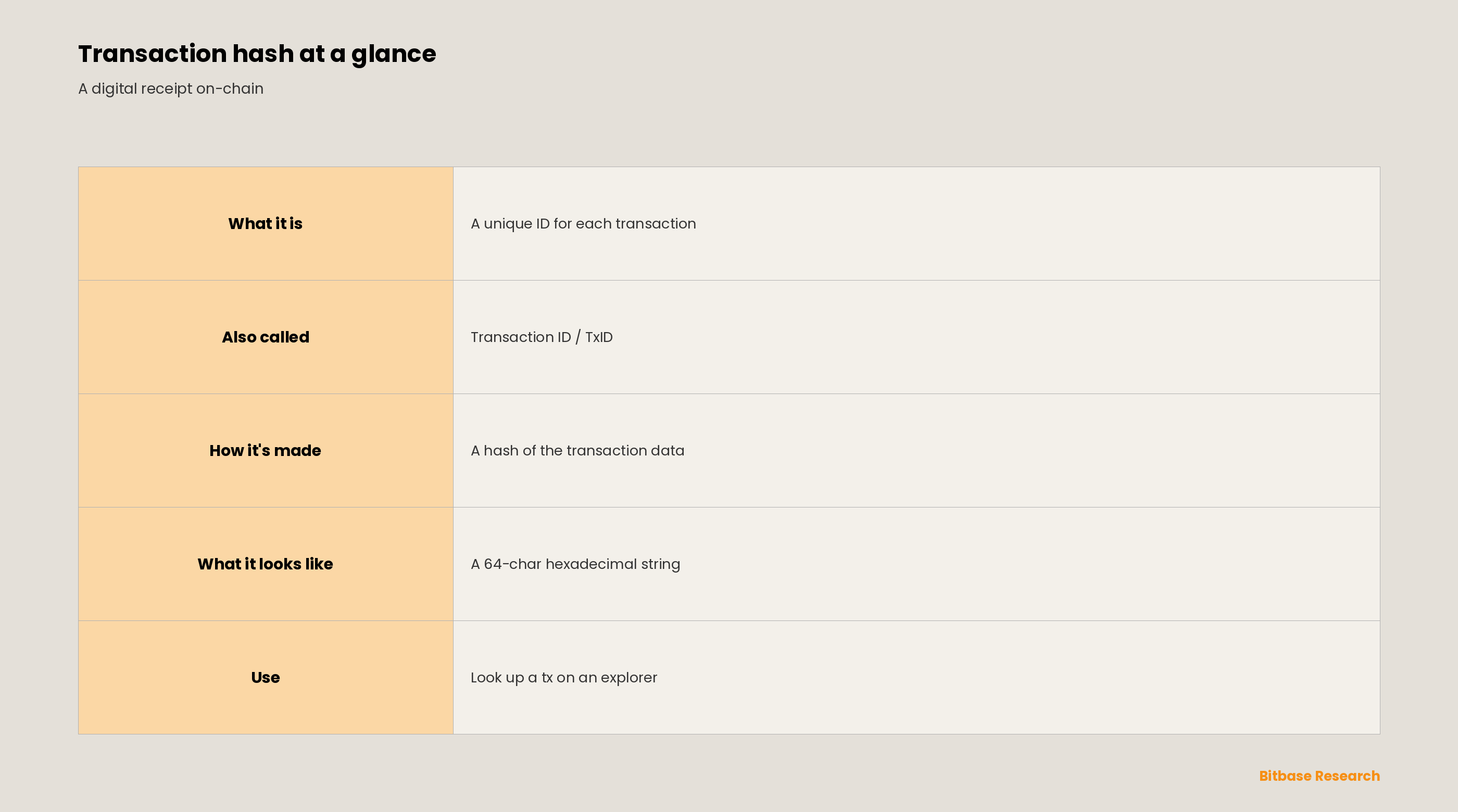
Transaction hash at a glance
A transaction hash is one transaction's unique identifier, also called a TxID, a transaction ID or a hash ID. A node produces it by running the transaction's own data through a hash function, and it comes out as a 64-character hexadecimal string that begins with 0x on Ethereum. That string is what you paste into a block explorer to look the transaction up.
What it's used for
With a TxID, you can paste it into a block explorer to confirm a transaction's status, amount, time, and addresses [1]. When you check a transfer with support or a counterparty, the TxID is often the most direct proof.
The bottom line
A transaction hash is the unique "fingerprint" of each on-chain transaction, used to verify and track it. Knowing where to find it and how to use it lets you check any transfer with confidence. To keep learning the fundamentals, follow more from Bitbase Academy.
Where to Find a TxID
A TxID turns up in three places: in the withdrawal history on an exchange, in the wallet's transaction history, and in a block explorer.
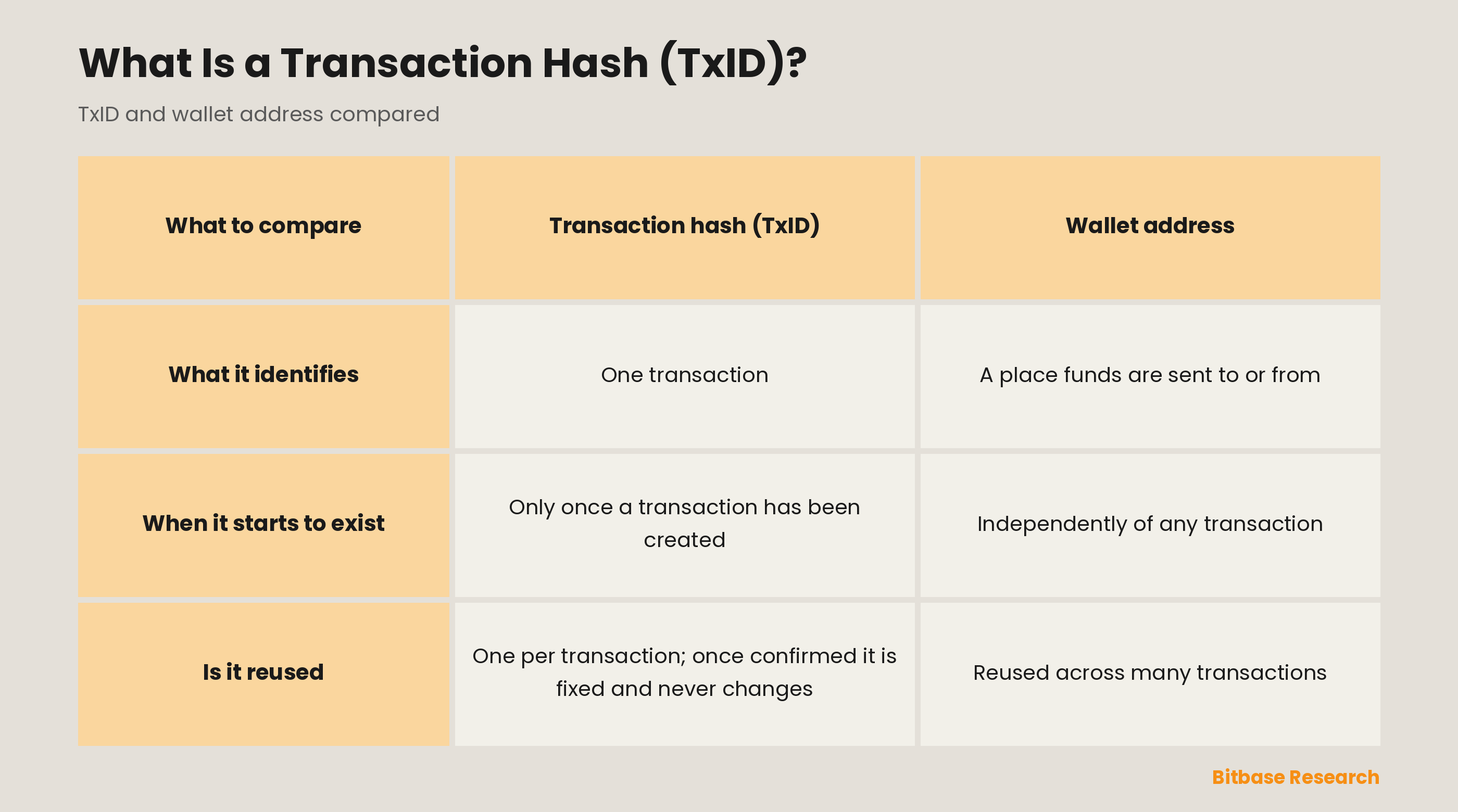
TxID and wallet address compared
| What to compare | Transaction hash (TxID) | Wallet address |
|---|---|---|
| What it identifies | One transaction | A place funds are sent to or from |
| When it starts to exist | Only once a transaction has been created | Independently of any transaction |
| Is it reused | One per transaction; once confirmed it is fixed and never changes | Reused across many transactions |
What a TxID Lets You Check
With the TxID in hand you can look up the status of the transaction, the number of confirmations, the sender address, the recipient address, the amount and the fee.
Pending, confirmed and failed
| Status | What the explorer shows | What to do |
|---|---|---|
| Pending | Broadcast, not yet in a block | Wait; the TxID already exists |
| Confirmed | In a block, confirmations counting up | Nothing; deeper is safer |
| Failed | On chains where a transaction can revert: in a block, reverted, fee still spent | Read the reason given, then retry |
Frequently asked questions
Is a TxID the same as a wallet address?
No. A TxID identifies one transaction, while a wallet address identifies a place funds are sent to or from. A TxID only exists once a transaction has been created; an address exists independently of any transaction and is reused across many of them.
Can a TxID reveal a private key?
No. A TxID is a hash of a transaction's public data, and hashing runs one way only, so no private key can be read back out of it. Handing a TxID to support or to a counterparty is safe; handing over a private key or seed phrase never is.
Why can a transaction not be found by its TxID?
Usually because the TxID was searched on an explorer for the wrong network, or because the transaction has not been broadcast yet. Check that the explorer matches the chain the transfer was sent on, and that the TxID was copied in full.
Can a TxID change?
Once a transaction is confirmed on-chain its TxID is fixed and never changes. A pending transaction that gets replaced — re-sent with a higher fee, for example — is a different transaction, so it carries a different TxID.
Related reading
Other Bitbase articles on this topic:
Disclaimer: This article is educational content from Bitbase Academy, provided for information only. It does not constitute investment, trading, tax, or financial advice. Written as of June 2026; refer to the latest official information.
References
[1] Binance Academy, "Transaction ID (TXID)." academy.binance.com
[2] Coinbase, "What is a transaction hash/hash ID?" help.coinbase.com