A crypto wallet address is a public identifier used to receive cryptocurrency on one blockchain network. It is not a private key and it is not a seed phrase. Every network writes addresses its own way, so before sending anything, check that the address and the selected network match the coin.
Where an address comes from
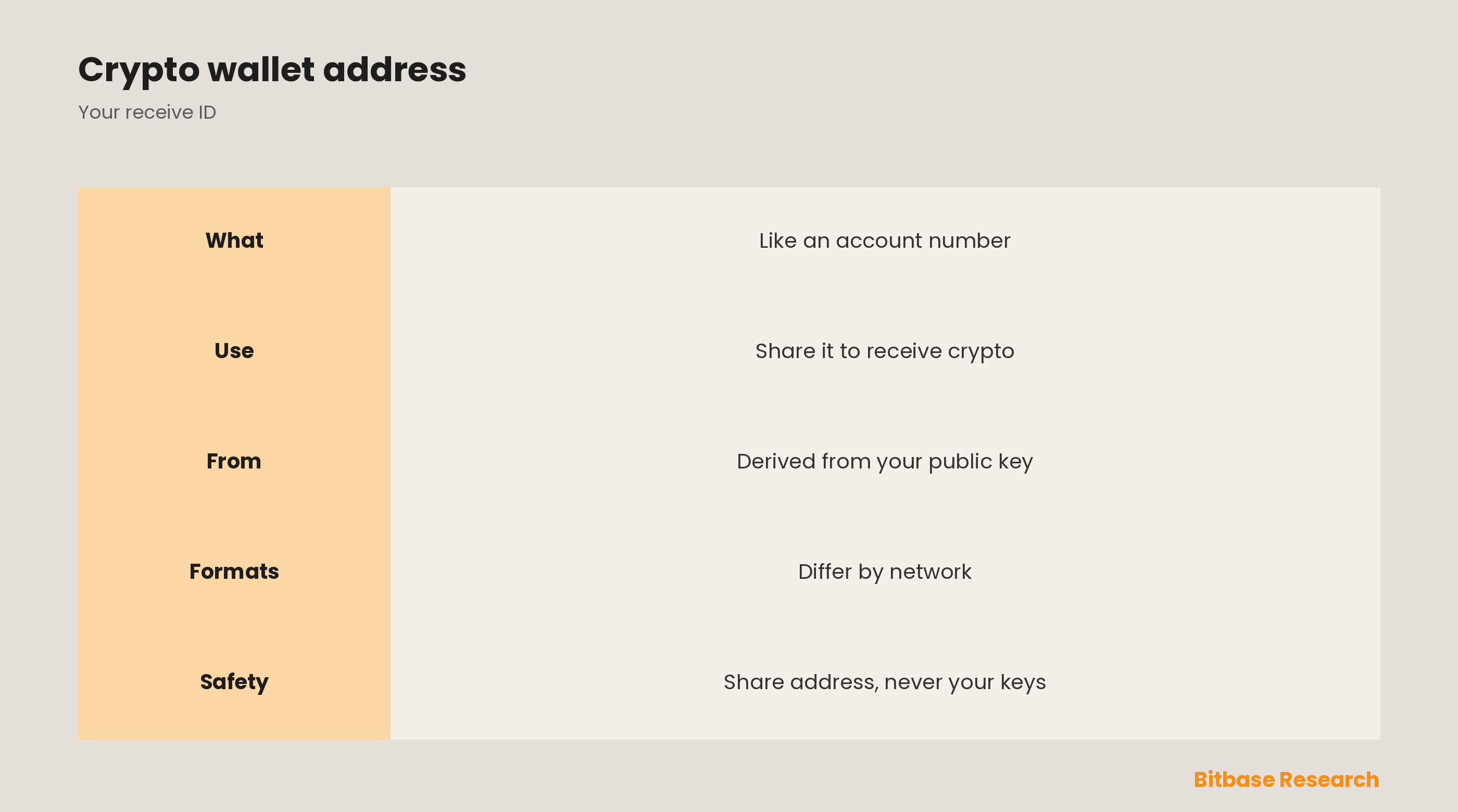
Your wallet address is derived from your public key using cryptography, and it works like the account number you give someone to receive a payment [1]. Each network has its own address format — a Bitcoin address looks different from an Ethereum address (which starts with "0x") — and sending to the wrong network's address can lose funds [2].
Sharing safely
The address is the public side of your wallet, and the private key and the seed phrase are the secret side that stays with you. Share it freely, often as a QR code, since holding it only lets someone send funds to you. Before you use an address, match it to the right coin and network and check the first and last characters, because malware can replace one as soon as you copy it.
How to Find Your Crypto Wallet Address
Open your wallet or exchange deposit page. Select the cryptocurrency you want to receive. Select the correct blockchain network. Copy the deposit or receive address. Check the first and last characters before using it.
Common Wallet Address Mistakes
The mistakes that cost people money are choosing the wrong network, copying an incomplete address, missing a Memo or Tag, malware replacing a copied address, and assuming similar address formats mean networks are compatible.
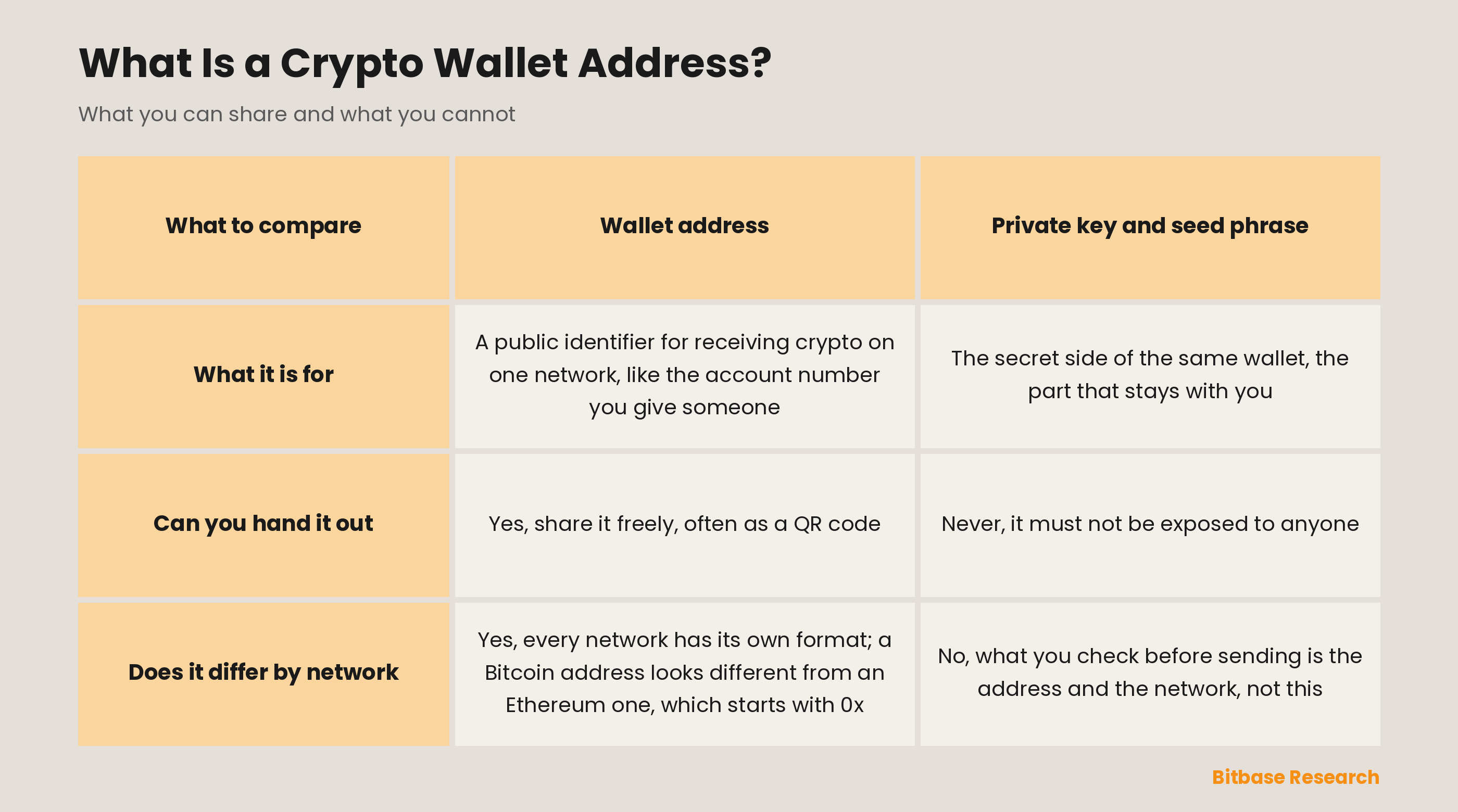
What you can share and what you cannot
| What to compare | Wallet address | Private key and seed phrase |
|---|---|---|
| What it is for | A public identifier for receiving crypto on one network, like the account number you give someone | The secret side of the same wallet, the part that stays with you |
| Can you hand it out | Yes, share it freely, often as a QR code | Never, it must not be exposed to anyone |
| Does it differ by network | Yes, every network has its own format; a Bitcoin address looks different from an Ethereum one, which starts with 0x | No, what you check before sending is the address and the network, not this |
Address Formats by Network
Every network writes addresses its own way, and the shape of the string is the first thing to check against the coin you are sending.
| Network | What the address looks like | Is the format shared | Memo or Tag |
|---|---|---|---|
| Bitcoin | Begins with bc1, or with an older prefix | No, Bitcoin only | Not used |
| Ethereum | Begins with 0x | Yes, many other EVM networks use the same shape | Not used |
| Solana | A base58 string with no fixed prefix | No, Solana only | Not used |
| TRON | Begins with T | No, TRON only | Not used |
| Networks that use a Memo or Tag | The deposit address is shared by many users | Varies | Required, and leaving it out can strand the deposit |
Read the second row twice. Because many networks share the Ethereum address shape, an address that looks correct can still belong to a different chain, and that is the mistake this table exists to prevent.
What Happens If You Pick the Wrong Network
Choosing the wrong network is the single most expensive mistake on this page, and it happens because the address is accepted and the transfer looks normal. The funds leave, the transaction settles on a chain the recipient was not watching, and nothing on either screen says anything went wrong.
What follows depends on who controls the destination. If you sent to an address whose keys you hold, the assets are usually still reachable by adding that network in your wallet. If you sent to an exchange deposit address, recovery depends on whether that platform supports the chain the funds landed on, and it is a support request rather than something you can fix yourself.
The prevention is one habit rather than a rule to memorise. Pick the network first on the deposit screen, then copy the address that appears under it, because an address copied before the network is chosen is an address for the wrong thing.
The bottom line
A wallet address is your public "receive" identifier — share it (often as a QR code) to get paid. It's derived from your public key and differs by network, so always match the address to the right coin and network, and double-check it before sending. Crucially, share your address freely, but never your private key or seed phrase. To keep learning the fundamentals, follow more from Bitbase Academy.
Frequently asked questions
Can I share my crypto wallet address?
Yes. A wallet address is your public receive identifier, and handing it out, often as a QR code, is exactly how you get paid. What must never leave your hands is the private key or the seed phrase, so share the address freely and keep those two to yourself.
Can someone steal crypto with my wallet address?
An address on its own is a public identifier that people send funds to, not a way in. Control of the funds sits with the private key and the seed phrase, which is why the one hard rule is to share the address and never those two.
Is a wallet address the same as a public key?
No. Your wallet address is derived from your public key using cryptography, so the two are linked but they are not the same string. In everyday use the address is the part you hand out to receive a payment, much like the account number you give someone.
Can a crypto wallet address change?
Addresses you already have keep working, but many wallets hand out a fresh receiving address whenever you ask for one, so the address on screen today may not be the one you used last time. What does change from network to network is the format: a Bitcoin address looks different from an Ethereum address, which starts with 0x, so always match the address to the right coin and network before sending.
Related reading
Other Bitbase articles on this topic:
- Passkey and Social-Recovery Wallets: Access and Recovery Under Different Trust Models
- Crypto Inheritance Planning: A Cross-Jurisdiction Educational Framework
- Lost Your Seed Phrase? Real Options and Fake Recovery Services
Disclaimer: This article is educational content from Bitbase Academy, provided for information only. It does not constitute investment, trading, tax, or financial advice. Crypto assets are volatile; assess your own risk. Written as of June 2026; refer to the latest official information.
References
[1] Coinbase, "What is a wallet address?" coinbase.com
[2] Investopedia, "Cryptocurrency Wallet." investopedia.com