Both approaches let an exchange commit to user balances without publishing them, and they draw the privacy line in different places. A Merkle proof shows you your own row and a handful of neighbouring hashes; a zero-knowledge proof can establish a statement about the entire set while revealing nothing about any individual row. The cost of the stronger privacy is computation, complexity, and a new thing you have to trust.
What each approach is trying to hide
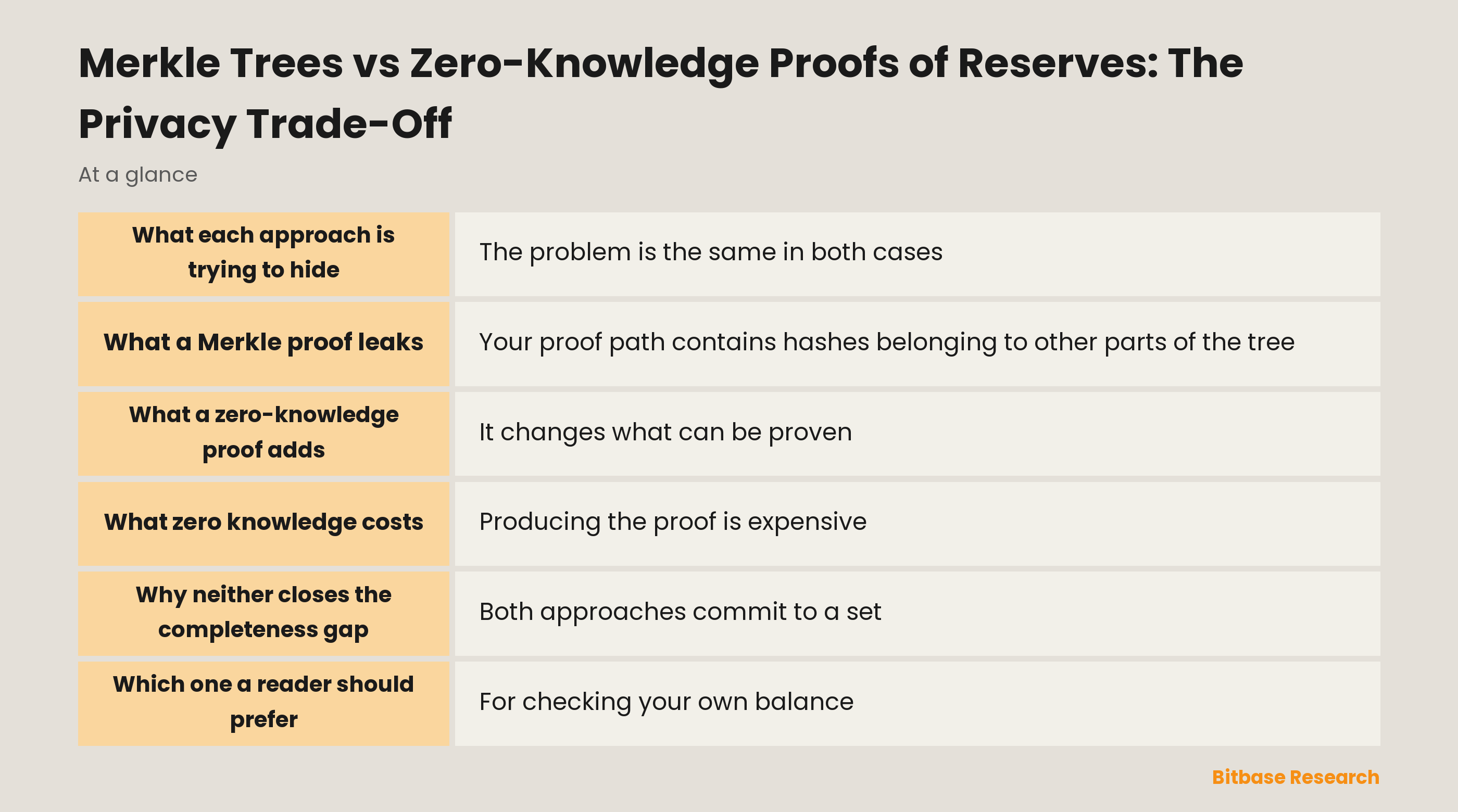
The problem is the same in both cases. An exchange needs to convince users about a set of balances without turning that set into a public document, because publishing it would expose every customer at once.
A Merkle tree solves this by committing to the set and letting each user check only their own membership. Nobody sees the list, and each person sees enough to verify their own row. The structure is described in Merkle trees in proof of reserves.
A zero-knowledge proof attacks a harder version of the same problem. Instead of letting each user check one row, it produces a single proof that a statement about the whole set is true, without revealing the data the statement is about. What that class of proof is and how it works in general is covered in zero-knowledge proofs, SNARKs and STARKs.
The two approaches compared
| Dimension | Merkle tree | Zero-knowledge proof |
|---|---|---|
| What the user checks | Their own row against the root | A statement about the whole set |
| What a proof reveals | Sibling hashes along your path | Nothing beyond the statement itself |
| Negative or offsetting balances | Not detectable | Can be excluded by the statement |
| Cost to produce | Trivial | Substantial computation |
| Cost to verify | A few dozen hash operations | One small proof, checked quickly |
| What you must trust | The root and the leaf format | The circuit and how it was set up |
Read the rows in pairs rather than down a column, because the interesting thing is where the two approaches diverge and not how each performs on its own. The last row is the one that changes the shape of the question rather than just the numbers, and it is the reason the newer approach is not simply better.
What a Merkle proof leaks
Your proof path contains hashes belonging to other parts of the tree. A hash is not reversible, so you learn nothing about the balances underneath them, and in that sense the leak is close to nothing.
But it is not exactly nothing. You learn that the tree has a certain shape, roughly how many accounts sit in it, and that particular sibling values exist. Somebody collecting many proofs over time can learn more about the structure than any single user does.
None of that is dangerous on its own, and it is worth keeping in proportion: structural information about a tree is a long way from information about a person. The more practical gap is different. Because each user checks only their own row, a Merkle scheme cannot rule out balances that offset each other inside the set, and a total assembled from rows nobody cross-checks is a weaker figure than it appears.
What a zero-knowledge proof adds
It changes what can be proven. Instead of proving one membership at a time, the exchange can prove a property of the whole set, such as that the sum of all balances equals a stated figure and that no balance was negative.
That second clause matters more than it sounds. Under a plain Merkle scheme nothing prevents a negative entry from cancelling a positive one, and the tree verifies happily either way, because it commits to whatever it was given. A zero-knowledge statement can make that impossible by construction.
It is a good example of a general pattern in cryptography, where moving from proving instances to proving properties changes what can be guaranteed rather than only how efficiently it is checked. The privacy improvement is real too. A verifier learns that the statement holds and learns nothing else, including nothing about the tree's shape, so repeated proofs do not accumulate into a picture of the customer base. Similar reasoning drives its use elsewhere, described in where zero knowledge is used.
What zero knowledge costs
Producing the proof is expensive. Building a statement over millions of accounts requires substantial computation, and that cost falls on the exchange each period rather than on the reader.
The bigger cost is conceptual. A Merkle check is a few dozen hashes and can be reimplemented by anyone who understands hashing; a zero-knowledge system rests on a circuit that encodes the statement and on the parameters that circuit was set up with. Verifying that the circuit says what it claims is not something most users can do.
There is also an operational cost that rarely gets mentioned: a circuit has versions, and a change to the statement being proven is a change every independent reviewer has to look at again. That relocates trust rather than removing it. You no longer have to trust the exchange's arithmetic, and you now have to trust that the circuit was written and configured correctly, usually on the word of people who reviewed it.
Why neither closes the completeness gap
Both approaches commit to a set. Neither can establish that the set contained every account, because an omitted account leaves no trace in either construction, and no property proven about a set says anything about what was left outside it.
That is worth stating plainly because the sophistication of zero-knowledge proofs invites the assumption that they solve everything. They make stronger statements about the data that went in; they say nothing about data that never went in.
The same applies to the asset side and to obligations beyond customer balances. Cryptography settles what can be settled about a committed set, and the rest sits outside, as set out in the limitations of proof of reserves.
Which one a reader should prefer
For checking your own balance, a Merkle proof is entirely adequate and has the advantage of being verifiable with tools you can read. Simplicity is a genuine security property when the reader is the one doing the checking.
For statements about the whole set, zero knowledge is strictly more capable, and the ability to exclude negative balances is the clearest concrete gain. If a disclosure offers it, that is a signal about how seriously the publisher takes the harder half of the problem.
The choice is therefore less about which technology is superior and more about which question a given disclosure is trying to answer. In practice the two coexist rather than compete. A scheme can commit with a tree, give users individual proofs, and add a zero-knowledge statement about aggregate properties, which is a reasonable design and not a contradiction.
The bottom line
A Merkle tree gives each user a cheap, readable proof of their own inclusion and leaks a small amount of structural information. A zero-knowledge proof can establish properties of the entire set, including the absence of negative balances, while revealing nothing.
The stronger tool costs computation and shifts trust onto a circuit most people cannot inspect. Neither one proves the set was complete, which remains the question no cryptography answers. For more from Bitbase Academy, keep reading.
Disclaimer: This article is educational content from Bitbase Academy, provided for information only. It does not constitute investment, trading, tax, or financial advice. Crypto assets are volatile; assess your own risk. Written as of September 2026; refer to the latest official information.
References
[1] Bitbase, Proof of Reserves — monthly disclosure, Merkle root and open-source verifier www.bitbase.com