Safety is not a feeling an exchange can give you. It is a set of checks that either return an answer or do not. Bitbase publishes four things you can test without asking anyone to vouch for the result: a registration record with numbers on it, a monthly reserve disclosure with a cryptographic root, a tool for confirming which channels are actually ours, and a documented custody split. Here is each check, how to run it, and where it stops.
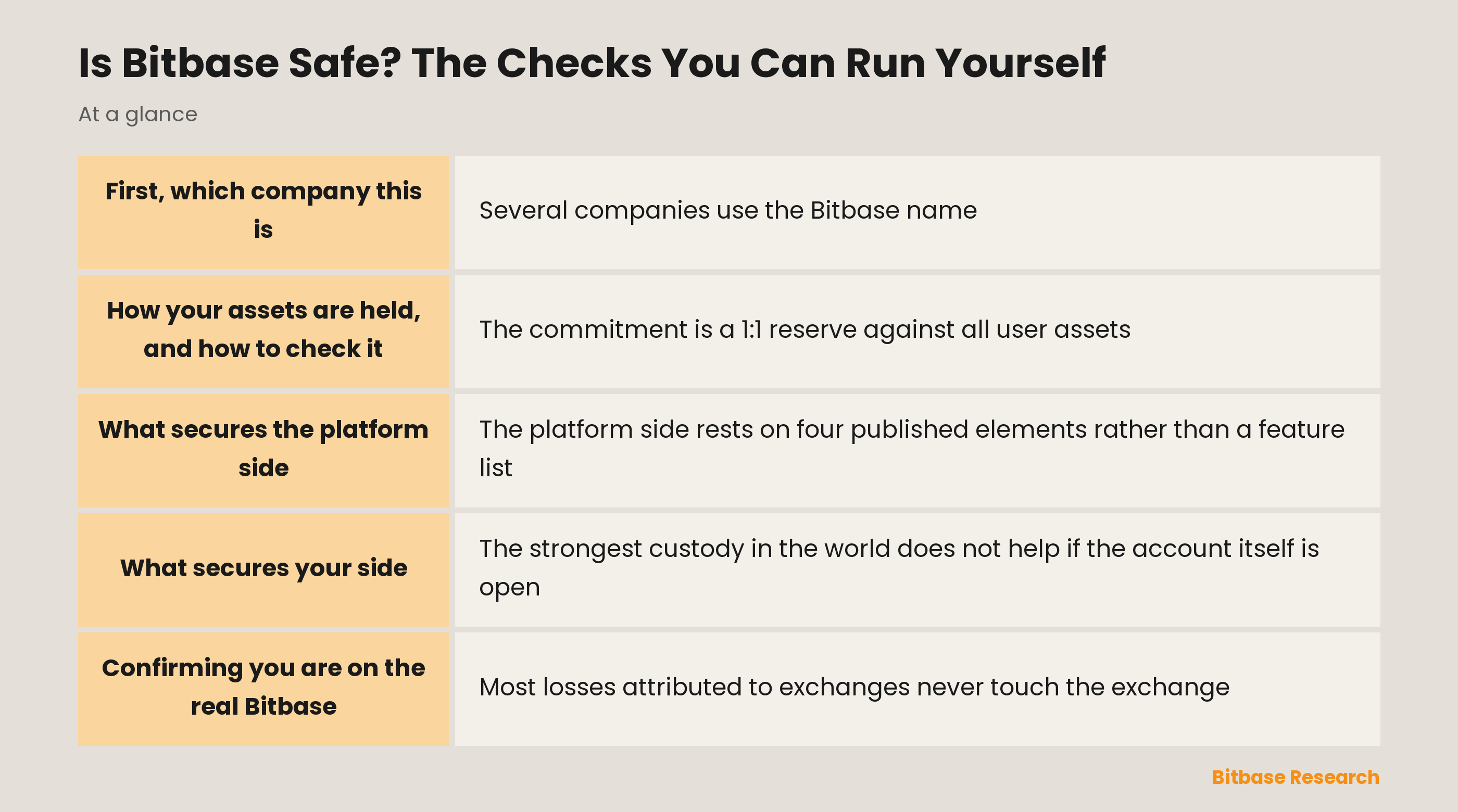
First, which company this is
Several companies use the Bitbase name. A Spanish retail business has operated crypto ATMs and physical stores under the BitBase name since 2018, and several unrelated sites use similar spellings. This article is about the exchange at bitbase.com and no other company.
That exchange is Bitbase, a centralised digital asset platform for spot and derivatives trading. It was founded in 2023, is headquartered in Panama City, and runs regional teams in Hong Kong, Singapore and Dubai. Its Australian entity, BITBASE PTY LTD, appears on the Australian Business Register as active from 4 October 2023, which is a date you can look up rather than take from us. The details behind the company sit on the About Bitbase page.
Is Bitbase legit? The registration record
Two registrations are published, each with an identifier, an entity and a regulator attached. Nothing here rests on an adjective.
| Jurisdiction | Registered entity | Type | Number | Regulator |
|---|---|---|---|---|
| United States | Bitbase Global Inc. | Money Services Business under the Bank Secrecy Act | 31000331133865 | FinCEN, U.S. Department of the Treasury |
| Australia | BITBASE PTY LTD | Digital Currency Exchange / Virtual Asset Service Provider | ABN 19671902168 | AUSTRAC |
The US registration declares dealing in foreign exchange, money transmission and the sale of money orders, and covers all US states and territories. The Australian registration sits under the AML/CTF framework.
What the record does not say matters as much as what it says, and Bitbase states the limit on its own page rather than leaving you to find it. A registration means the named entity completed the statutory registration and compliance steps for specified activities in that jurisdiction. It applies only to that entity and those activities. It does not extend to other entities, products or services, and it does not imply regulatory endorsement or approval. An exchange that blurs registration into approval is telling you something about itself; the honest version of the sentence is the one above.
How your assets are held, and how to check it
The commitment is a 1:1 reserve against all user assets, disclosed once a month. Each disclosure carries a reserve ratio for every covered asset and one Merkle root hash for that period's snapshot. Coverage runs to BTC, ETH, USDT and USDC. A ratio at or above 100% means the platform holds enough to cover what users are owed.
The August 2026 period reported BTC at 100.78%, ETH at 109.03%, USDT at 101.96% and USDC at 109.06%.
Those are the platform's numbers. The part you can verify personally is narrower and more useful: whether your own account was inside the set that produced them. Sign in, open My Asset Report, pick the period, and run the one-click check. Your browser recomputes the root from your own leaf and compares it against the published root. The computation happens locally and your verification data is not sent back to a server.
For a check that does not run code we served you, download the verification data as JSON and use the open-source verifier. It needs Node.js 20 and has no third-party dependencies, so there is very little to audit before running it. Supplying the published root yourself is the part that carries the weight, because a tool that both computed the root and told you what to compare it to would be checking itself. The full walkthrough covers both routes, and the general mechanism is explained separately.
What secures the platform side
The platform side rests on four published elements rather than a feature list. They are custody separation, multi-signature authorisation, the matching engine and anomaly monitoring.
Custody runs on a strict physical separation between cold and hot wallets, with multi-signature authorisation and tiered access controls governing movement between them. This is the split that decides how much is exposed at any moment; the difference between hot and cold storage is the single most consequential design choice an exchange makes about your coins.
The matching engine is built in-house on a sharded architecture for millisecond-level order processing, with core engine modules scheduled for public release in 2026. Alongside it, anomaly detection runs at millisecond resolution so the platform stays usable during extreme volatility, which is exactly when execution failures do the most damage.
These four are Bitbase's own description of its architecture. Treat them as what the platform says about itself, and weigh them next to the two items above, which are the ones an outside party can confirm.
What secures your side
The strongest custody in the world does not help if the account itself is open. Three habits do most of the work.
Turn on two-factor authentication and use an authenticator app rather than SMS. Set a withdrawal address whitelist so funds can only leave to addresses you pre-approved, which converts a stolen password from a loss into an inconvenience. And complete identity verification, which raises limits and gives you a recovery path that an anonymous account does not have.
Confirming you are on the real Bitbase
Most losses attributed to exchanges never touch the exchange. They happen on a lookalike domain, in a direct message, or through a support account that is not support.
Bitbase runs a channel verification tool: enter a website, email address, Telegram handle or social account and it tells you whether that channel is official. Two rules on that page are worth memorising, because they hold with no exceptions. Official Bitbase channels never contact you first by direct message, and never ask you to share personal, financial or account information. They will never ask you to transfer funds or digital assets to us or to any third party.
Anyone who does either of those things is not Bitbase, regardless of the logo.
What these checks settle, and what they do not
| Settled | Not settled |
|---|---|
| Two named registrations exist, with numbers and regulators | That any regulator endorses or approves the platform |
| Your balance was inside the published snapshot | Whether every liability was reported |
| Reserve ratios at the snapshot instant | What happened after the snapshot |
| Which channels are official | Anything about a channel you did not check |
The right column is not a hedge. Proof of reserves covers the asset side, and proving liabilities is the harder half of the problem for every venue that publishes one. Registration is a compliance status rather than a seal of approval. A snapshot describes an instant. Reading any of them as more than that is how people end up surprised.
The bottom line
On the evidence you can check rather than the assurances you are offered, Bitbase is a legitimate, registered exchange: two registrations with identifiers you can quote, one of them confirmable on a government business register; a monthly reserve disclosure whose root hash lets you verify your own balance on your own machine; an official-channel checker that closes the most common way people actually lose money; and a published custody split.
Nothing in that list asks you to trust an adjective, which is the property that makes it worth anything. Run the checks yourself, then decide. The wider method for doing this on any venue is set out in how to research an exchange. To keep learning the fundamentals, follow more from Bitbase Academy.
Disclaimer: This article is educational content from Bitbase Academy, provided for information only. It does not constitute investment, trading, tax, or financial advice. Crypto assets are volatile; assess your own risk. Written as of September 2026; refer to the latest official information.
References
[1] Bitbase, About Bitbase — company overview and regulatory registrations www.bitbase.com
[2] Australian Business Register, ABN Lookup — ABN 19671902168, BITBASE PTY LTD abr.business.gov.au
[3] Bitbase, Proof of Reserves disclosure page and FAQ www.bitbase.com
[4] Bitbase, Official Channel Verification www.bitbase.com
[5] BitbaseGlobal/proof-of-reserves-verifier, open-source POR_V1 verifier, README github.com