
A crypto wallet doesn't actually store your coins — they live on the blockchain. What the wallet stores are your keys: a private key that authorizes transactions and a public address that lets others pay you. This guide explains how that works.
Keys, not coins
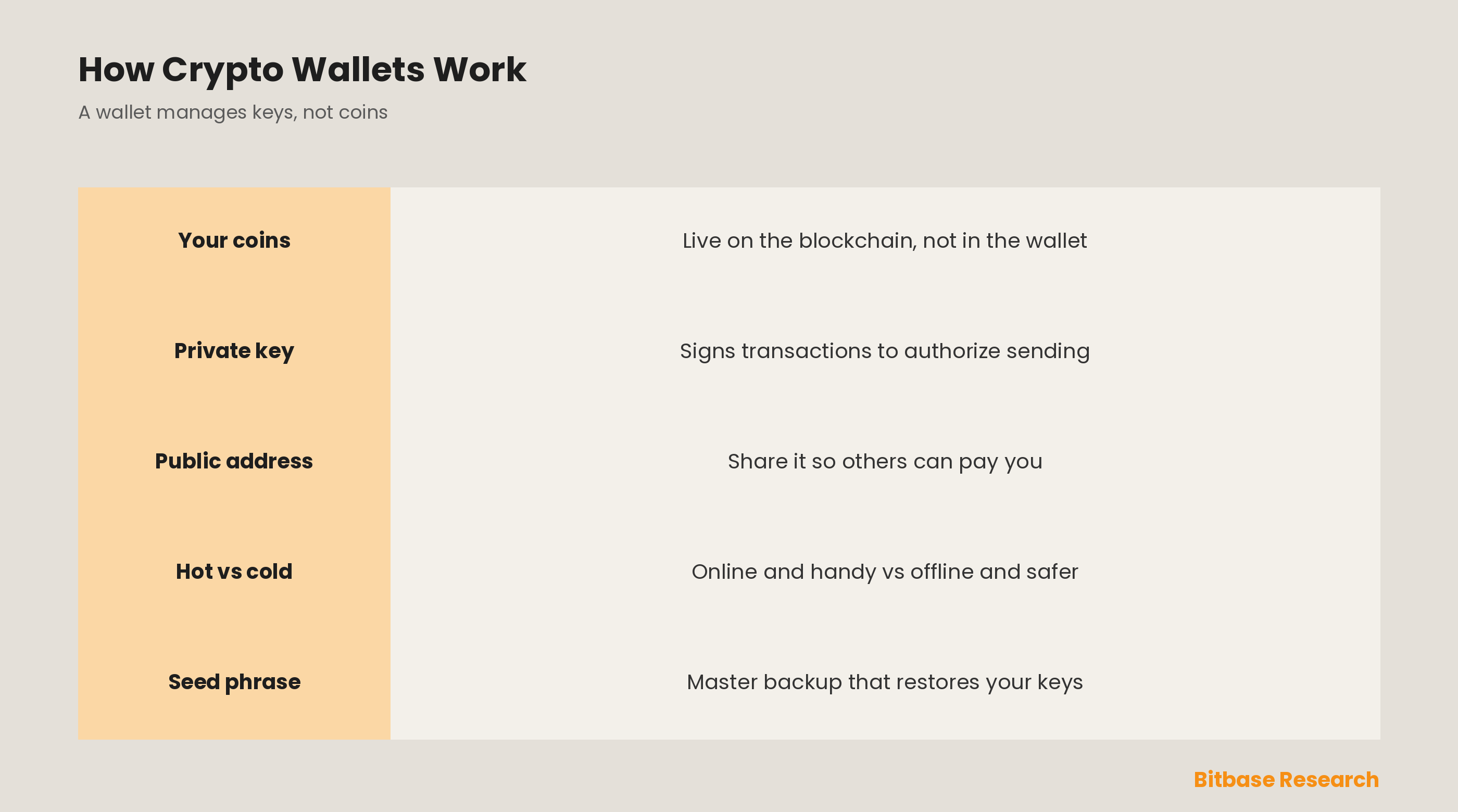
Your coins are recorded on the blockchain, not inside the wallet. The wallet holds a private key, which only you should know, and a public address derived from it [1]. To send crypto, the wallet uses your private key to sign the transaction, proving it's authorized; to receive, you simply share your address [2].
Hot, cold and backups
A wallet is called hot when it is online and cold when it is offline. The hot one is convenient, the cold one is more secure. The master backup is the seed phrase, and what it can restore is the keys, not the coins — the coins are not inside the wallet, they are recorded on the blockchain. The seed phrase and the private key are therefore the two things to guard above all.
The bottom line
A wallet is really a key manager: it signs transactions with your private key and shows your address for receiving. Wallets can be "hot" (online and convenient) or "cold" (offline and more secure), and a seed phrase is the master backup that can restore your keys. Guard your private key and seed phrase above all. To keep learning the fundamentals, follow more from Bitbase Academy.
Related reading
Other Bitbase articles on this topic:
- Multisig and Smart Contract Wallets
- Wallet Types Compared
- Hot Wallet vs Cold Wallet: What's the Difference?
Disclaimer: This article is educational content from Bitbase Academy, provided for information only. It does not constitute investment, trading, tax, or financial advice. Crypto assets are volatile; assess your own risk. Written as of June 2026; refer to the latest official information.
References
[1] Coinbase, "What is a crypto wallet?" coinbase.com
[2] Ledger, "How do crypto wallets work?" ledger.com