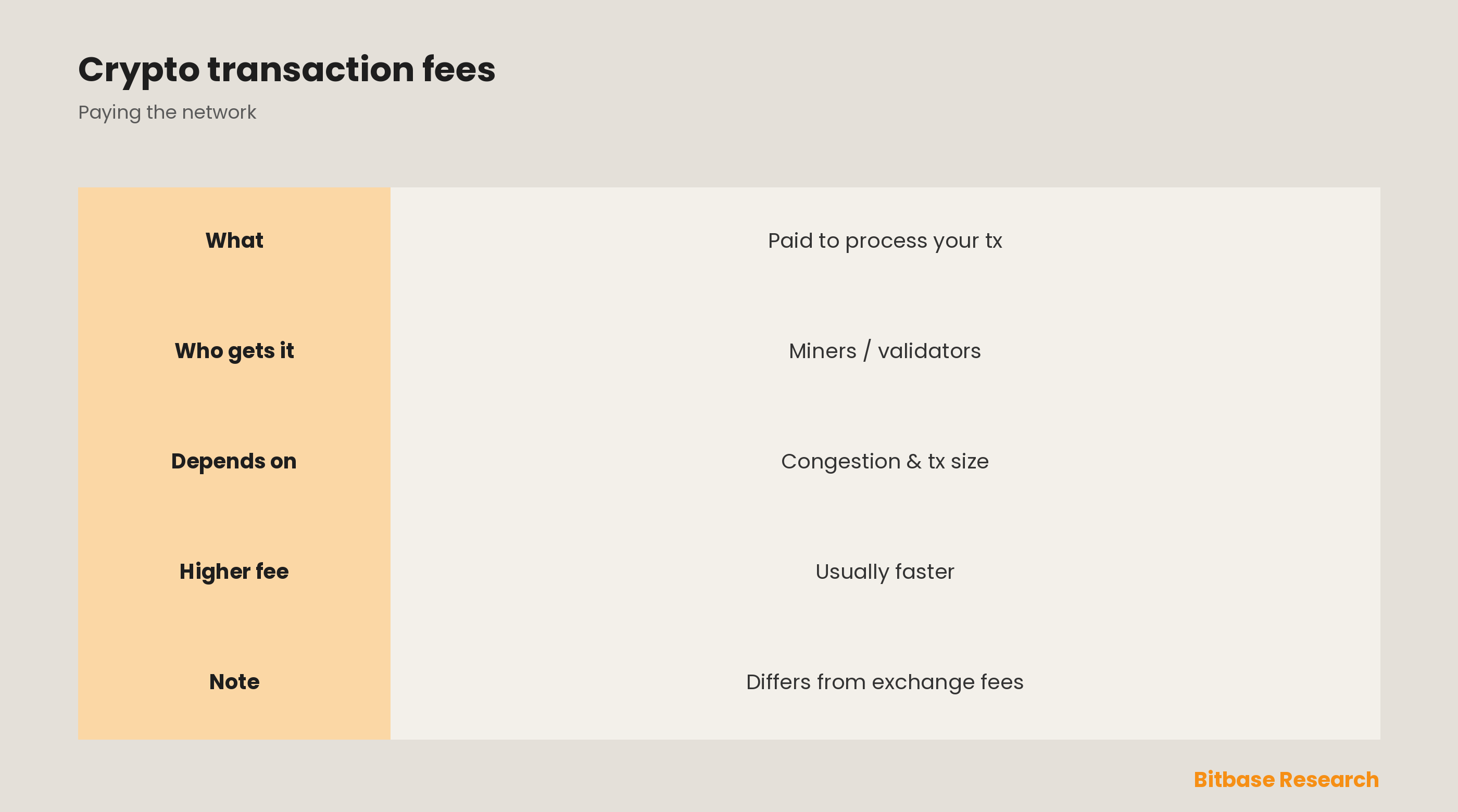
A crypto transaction fee is a small amount you pay the network to process and record your transaction. It goes to the miners or validators who secure the blockchain, and it changes with demand. This guide explains what you're paying for and why fees vary.
Who gets the fee and why
When you send crypto, the fee rewards the miners (Proof of Work) or validators (Proof of Stake) who include your transaction in a block [1]. On Ethereum this network fee is called "gas". Fees exist to compensate that work and to prevent spam — without a cost, the network could be flooded with junk transactions [2].
Why fees go up and down
Fees rise when the network is busy and fall when it quiets down. Complexity is the second factor: a transaction that asks the network for more work costs more than a plain transfer. Because the fee decides how soon a block picks up your transaction, paying above the going rate usually means faster inclusion, and paying below it means waiting.
The bottom line
A transaction fee is the price of getting your transfer processed on the blockchain. It depends mainly on how busy the network is and how complex your transaction is; paying more usually means faster inclusion. Note this is the network fee — separate from any trading fee an exchange charges. To keep learning the fundamentals, follow more from Bitbase Academy.
Related reading
Other Bitbase articles on this topic:
- What Is Transaction Malleability? A Bug SegWit Fixed
- Gas Fee Mechanics
- What Is Crypto Transaction Batching? Saving on Fees
Disclaimer: This article is educational content from Bitbase Academy, provided for information only. It does not constitute investment, trading, tax, or financial advice. Crypto assets are volatile; assess your own risk. Written as of June 2026; refer to the latest official information.
References
[1] Coinbase, "What are gas fees?" coinbase.com
[2] Investopedia, "Transaction Fees." investopedia.com