
People use "cryptocurrency" and "digital asset" as if they mean the same thing, but they do not. One is a specific type; the other is a broad umbrella that includes it. As tokens spread far beyond simple coins — into stablecoins, NFTs, and tokenized bonds — knowing the difference has become genuinely useful, especially because regulators and institutions increasingly prefer the wider term. Here is the distinction, made clear.
Why the terms get confused
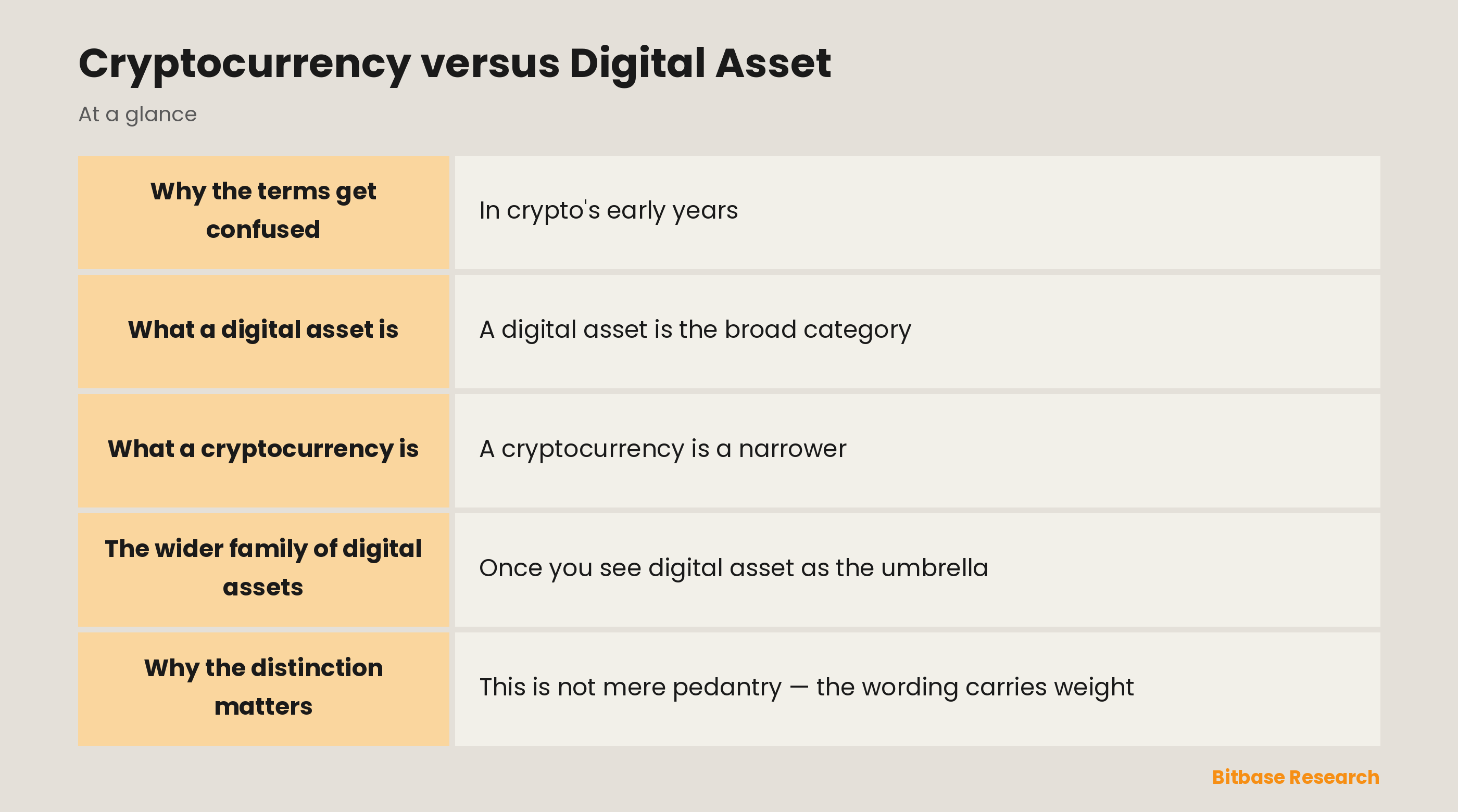
In crypto's early years, there was essentially one thing: Bitcoin, a cryptocurrency. So "cryptocurrency" became shorthand for the entire field, and the habit stuck even as the field exploded into dozens of different kinds of tokens. Today many of those tokens are not currencies at all, yet people still call everything "crypto." Untangling the vocabulary matters because the words now carry different technical and legal meanings, and using the precise one avoids real confusion.
What a digital asset is
A digital asset is the broad category: any asset that exists in digital form and can be owned or transferred, especially one recorded on a blockchain. This umbrella covers cryptocurrencies, but also tokens that represent something else entirely — a share in a fund, a piece of art, a claim on a dollar, a unit of computing power. If it is a token you can hold and move on-chain, it is a digital asset, regardless of whether it behaves like money. The term describes the format, not the function.
What a cryptocurrency is
A cryptocurrency is a narrower, specific type of digital asset: one designed to function as money or as the native currency of a blockchain network. Bitcoin and the native coins that pay transaction fees on their networks are the clearest examples — assets whose primary purpose is to store or transfer value. Every cryptocurrency is a digital asset, but not every digital asset is a cryptocurrency. The distinction is like the difference between "cash" and "financial assets": one is a specific member of a much larger family.
The wider family of digital assets
Once you see digital asset as the umbrella, the whole ecosystem organises neatly. Cryptocurrencies are one branch. Stablecoins are digital assets pegged to a currency. Utility and governance tokens grant access or voting rather than acting as money. Non-fungible tokens represent unique items. Tokenized real-world assets are digital claims on off-chain property, and central bank digital currencies are state-issued digital money. All are digital assets; only some are cryptocurrencies in the strict sense.
Why the distinction matters
This is not mere pedantry — the wording carries weight. Regulators and financial institutions increasingly favour "digital asset" precisely because it is broad and neutral, covering everything from tokenized bonds to stablecoins without implying they are all currencies. How a specific token is classified can determine which laws apply to it and which agency oversees it. For an ordinary user, using the right term signals real understanding and helps you follow debates about regulation that hinge on exactly these categories.
The bottom line
Cryptocurrency and digital asset are not synonyms: a cryptocurrency is a digital asset designed to work as money, while a digital asset is the wide umbrella covering coins, stablecoins, tokens, NFTs, tokenized real-world assets, and more. As the space matures beyond simple coins, the broader term is becoming the standard in regulation and finance. Use "cryptocurrency" for money-like tokens and "digital asset" for the whole family, and you will speak — and think — about crypto more precisely.
Disclaimer: This article is educational content from Bitbase Academy, provided for informational purposes only. It is not investment, trading, tax, or financial advice. Written as of July 2026; rely on the latest official information.
References
[1] Coinbase, "Cryptocurrency versus digital assets" coinbase.com
[2] Cointelegraph, "Digital assets explained" cointelegraph.com