
Behind every blockchain is a founding story, and crypto's are unusually dramatic — one built by a person nobody has ever identified, another by a teenager who reshaped the industry. Understanding who creates crypto projects, and how much we know about them, is both a fascinating history and a practical tool for judging a project. Here is a factual look at crypto's founders and why they matter.
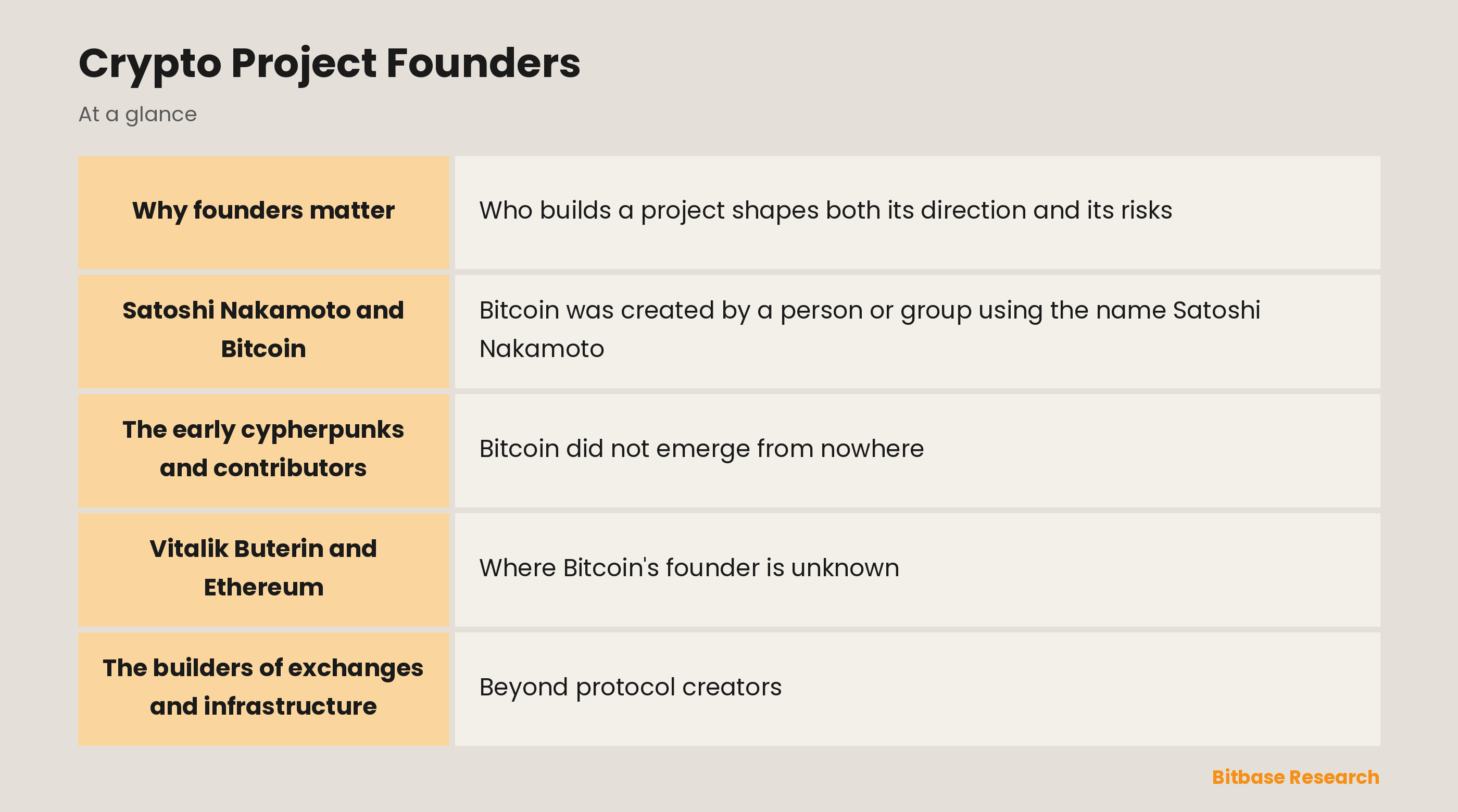
Why founders matter
Who builds a project shapes both its direction and its risks. A credible, public founding team with a track record signals accountability and expertise, while a fully anonymous team behind a new token is a factor to weigh carefully. Crypto is unusual in that some of its most important creations came from anonymous or pseudonymous figures, yet the space still runs largely on the reputations of known builders. Knowing who is behind a project is a basic part of understanding it.
Satoshi Nakamoto and Bitcoin
Bitcoin was created by a person or group using the name Satoshi Nakamoto, whose true identity has never been confirmed. Nakamoto published the Bitcoin whitepaper, launched the network, and helped develop it in its earliest years before gradually stepping back and disappearing from public communication around 2011. This deliberate anonymity is central to Bitcoin's story: with no identifiable founder to control, pressure, or take credit, the network became genuinely ownerless — a feature many see as essential to its neutrality.
The early cypherpunks and contributors
Bitcoin did not emerge from nowhere. It drew on decades of work by cryptographers and the cypherpunk movement, who had long pursued digital cash and privacy tools. Among the earliest contributors was Hal Finney, a respected cryptographer who received the first Bitcoin transaction and helped test the software. These early figures, both named and pseudonymous, formed the intellectual lineage from which Bitcoin sprang, a reminder that even a revolutionary launch stood on a great deal of prior research.
Vitalik Buterin and Ethereum
Where Bitcoin's founder is unknown, Ethereum's most prominent creator is very public. Vitalik Buterin proposed Ethereum as a young programmer, arguing that a blockchain could run general programs, not just move money, and he co-founded it alongside a group of others who launched the network in the mid-2010s. As an openly identified figure who remains active in the ecosystem, he represents the opposite model to Satoshi — a public founder whose ideas and presence continue to shape a major network.
The builders of exchanges and infrastructure
Beyond protocol creators, crypto has been shaped by the founders of the companies that made it usable — the exchanges, wallets, and infrastructure providers that connect ordinary users to blockchains. These are typically named individuals running regulated or high-profile businesses, whose track records, successes, and failures are matters of public record. Their identifiability is part of why users can hold them accountable, in sharp contrast to the anonymity that defined crypto's earliest protocol layer.
The bottom line
Crypto's founders span a striking range: an unidentified creator behind Bitcoin, a lineage of cypherpunk cryptographers, a very public co-founder behind Ethereum, and named entrepreneurs behind the exchanges and tools most people actually use. For a curious reader it is rich history; for a careful participant it is also due diligence. When evaluating any project, ask who built it and what is known about them, because a founding team's transparency and track record are among the most telling signals you have.
Disclaimer: This article is educational content from Bitbase Academy, provided for informational purposes only. It is not investment, trading, tax, or financial advice. Written as of July 2026; rely on the latest official information.
References
[1] Bitcoin.org, "The Bitcoin whitepaper and Satoshi Nakamoto" bitcoin.org
[2] Ethereum.org, "About Ethereum and its origins" ethereum.org