
In under two decades, crypto went from a nine-page paper to a multitrillion-dollar global market that governments legislate and asset managers embrace. Its history is a chain of firsts — the first block, the first purchase, the first crash — each one shaping what came next. Here are the milestones that turned a cryptographic idea into a financial force, and what each one meant.
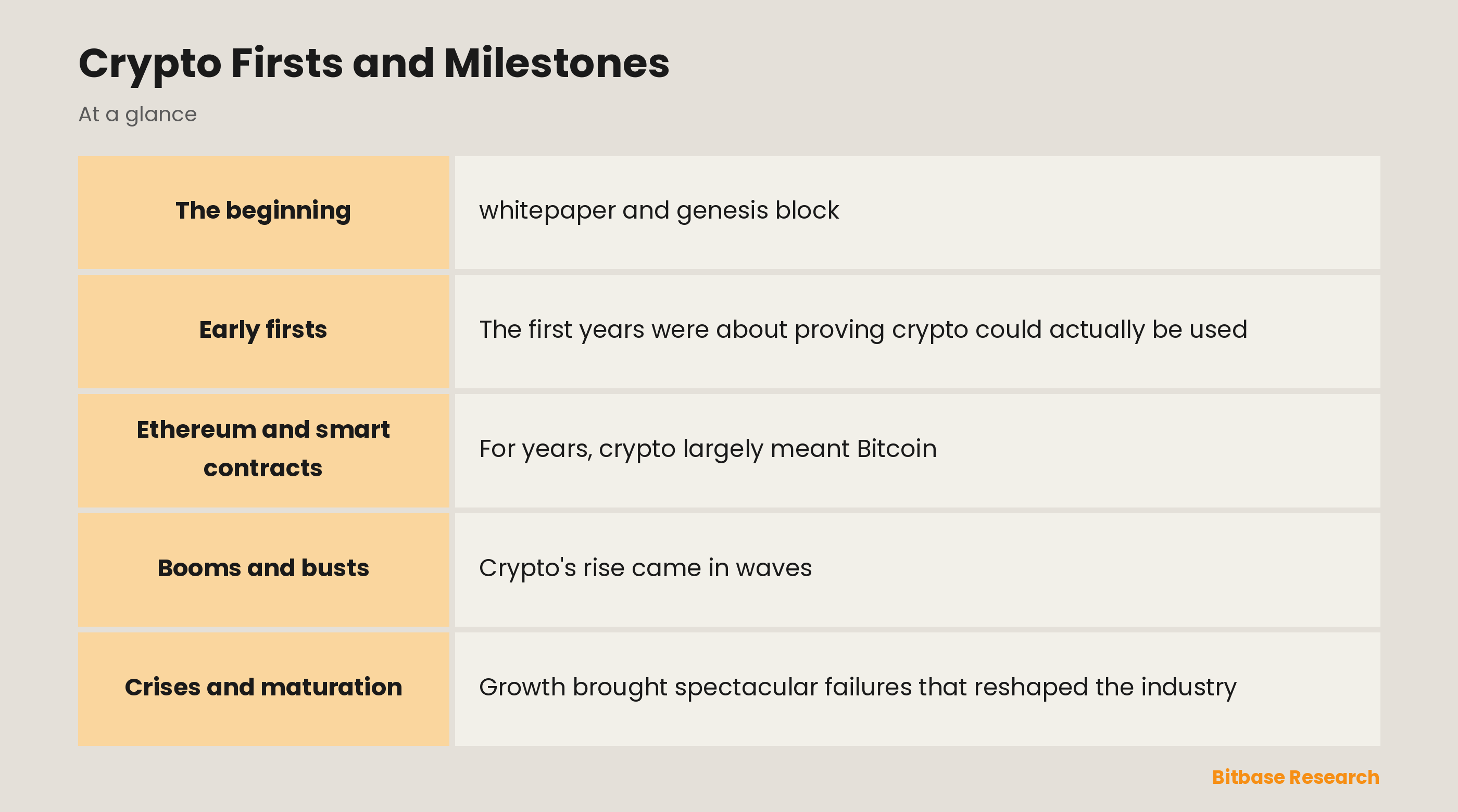
The beginning: whitepaper and genesis block
Crypto's origin is precise. In late 2008, a paper published under the name Satoshi Nakamoto described a peer-to-peer electronic cash system that needed no bank. In early 2009 the Bitcoin network went live with its first-ever block, the genesis block, famously embedding a newspaper headline about bank bailouts — a pointed statement of purpose. These two events, a document and a first block, are the true birth of cryptocurrency and the moment a decade of cryptographic research became a working system.
Early firsts
The first years were about proving crypto could actually be used. The first Bitcoin transaction sent coins between early developers, showing peer-to-peer value transfer worked. The most legendary milestone came when someone paid ten thousand bitcoin for two pizzas — the first real-world purchase, still commemorated each year and a humbling reminder of how value can change. Early exchanges then appeared, giving Bitcoin a market price for the first time and letting ordinary people buy and sell.
Ethereum and smart contracts
For years, crypto largely meant Bitcoin. That changed with the launch of Ethereum in the mid-2010s, which added programmable smart contracts, letting developers build applications on a blockchain rather than just move a currency. This turned blockchains from a payment network into a general-purpose platform and seeded almost everything that followed — tokens, decentralised finance, NFTs, and more. If Bitcoin proved digital money, Ethereum proved a decentralised computer.
Booms and busts
Crypto's rise came in waves, each a milestone and a cautionary tale. An initial-coin-offering boom saw thousands of projects raise money by issuing tokens, minting fortunes and countless failures. Later, a wave of decentralised finance turned smart contracts into lending, trading, and yield without intermediaries, while a surge in non-fungible tokens brought digital ownership of art and collectibles into the mainstream. Each cycle expanded what crypto could do and drew a new audience — followed each time by a sharp correction.
Crises and maturation
Growth brought spectacular failures that reshaped the industry. The collapse of a major algorithmic stablecoin ecosystem erased enormous value in days, and later the implosion of one of the largest exchanges shattered trust and triggered a wave of regulation. Yet the sector kept maturing. A landmark moment arrived when regulated spot Bitcoin exchange-traded funds were approved in major markets, opening crypto to mainstream investors through familiar channels and marking its arrival in traditional finance.
The bottom line
Crypto's milestones trace a clear arc: a whitepaper and genesis block created it, early transactions proved it worked, Ethereum made it programmable, successive booms in tokens, DeFi, and NFTs expanded it, and crises followed by regulation and mainstream products matured it. Each first was a step from experiment toward infrastructure. Knowing these landmarks is the best way to understand not just where crypto has been, but the pattern of innovation and excess that keeps repeating.
Disclaimer: This article is educational content from Bitbase Academy, provided for informational purposes only. It is not investment, trading, tax, or financial advice. Written as of July 2026; rely on the latest official information.
References
[1] Bitcoin Magazine, "The genesis block and Bitcoin's early history" bitcoinmagazine.com
[2] Investopedia, "A brief history of cryptocurrency" investopedia.com