A token's supply is not always a fixed number — it can be capped forever, grow without limit, or even expand and contract automatically. These supply mechanics are the engine underneath a token's economics, and they shape whether it behaves like digital gold, like a currency, or like something stranger. Here is how they work.
Why supply mechanics matter
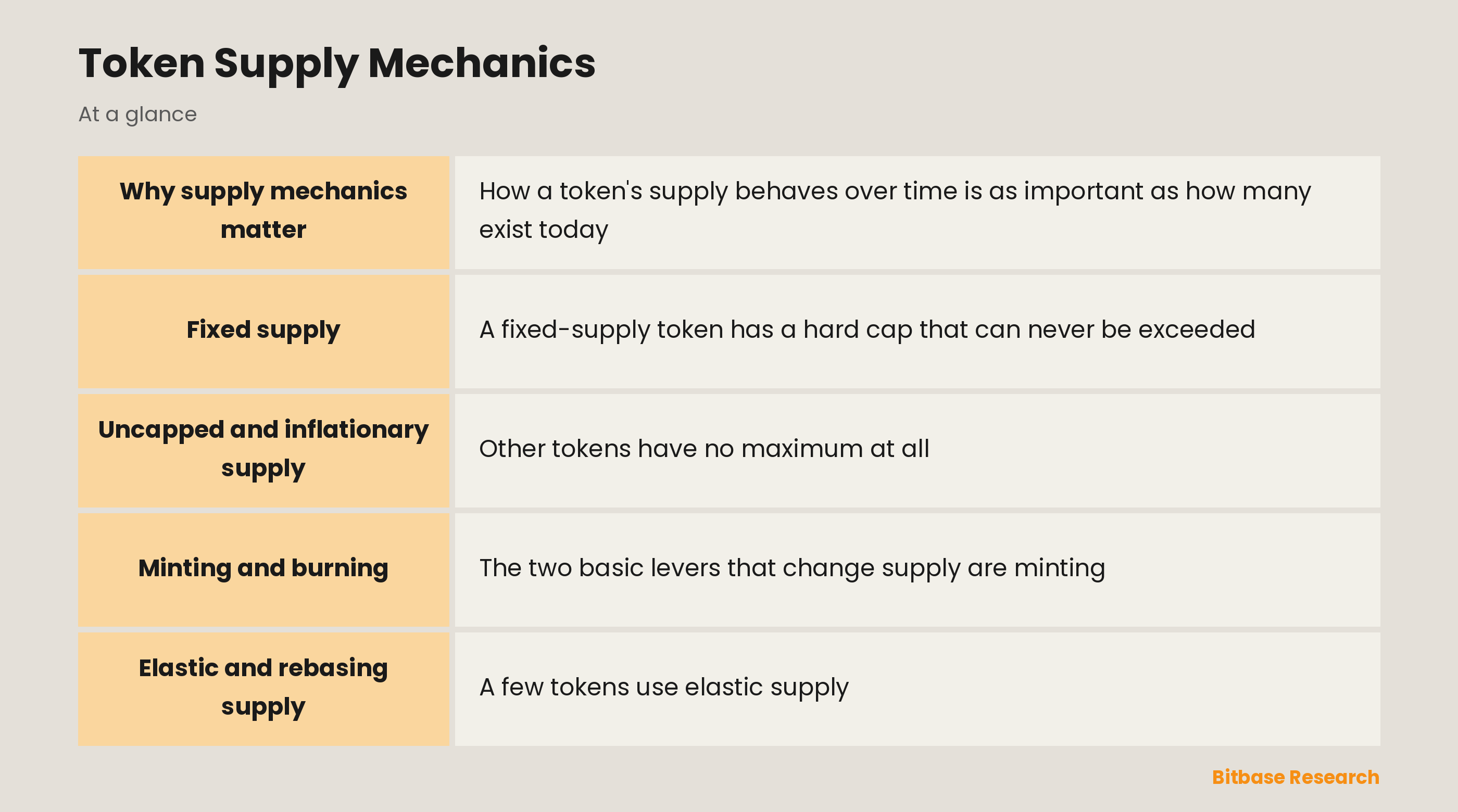
How a token's supply behaves over time is as important as how many exist today. Supply mechanics determine whether a token gets scarcer, stays flat, or inflates, and that trajectory shapes its long-term value far more than short-term price. Two tokens with the same price can have completely opposite futures depending on how their supply moves.
Fixed supply
A fixed-supply token has a hard cap that can never be exceeded. Bitcoin is the classic example, capped at 21 million coins, which gives it a predictable, scarce quality often compared to digital gold. Fixed supply is simple and credible: no one can print more, so value depends purely on demand against a known, unchanging ceiling.
Uncapped and inflationary supply
Other tokens have no maximum at all, issuing new units indefinitely to pay for security or rewards. This is not inherently bad — many productive networks work this way — but it means the supply grows over time, and holders rely on demand and usage rising faster than issuance. Ethereum, for instance, has no hard cap and manages its supply through issuance and fee burning rather than a fixed limit.
Minting and burning
The two basic levers that change supply are minting, which creates new tokens, and burning, which destroys them. A protocol's rules decide who can mint and when, and whether burns are automatic or discretionary. Together, mint and burn are how most tokens actively manage their supply — expanding to fund growth, contracting to tighten scarcity.
Elastic and rebasing supply
A few tokens use elastic supply, automatically expanding or shrinking the number of tokens in every wallet to target a price or peg. In a "rebase," your token balance can go up or down overnight while your share of the network stays the same. These designs are clever but confusing and risky, and they behave very differently from a normal token — something to understand fully before touching one.
The bottom line
Supply mechanics — fixed, uncapped, or elastic, driven by minting and burning — are the rules that decide whether a token grows scarcer or more abundant over time. A hard cap offers predictable scarcity; uncapped issuance funds a network but dilutes; elastic supply rewrites the rules entirely. Before valuing any token, understand how its supply is designed to move, because that trajectory is its economic destiny.
Disclaimer: This article is educational content from Bitbase Academy, provided for informational purposes only. It is not investment, trading, tax, or financial advice. Written as of July 2026; rely on the latest official information.
References
[1] Bitcoin.org, "Controlled supply and the 21 million cap" bitcoin.org
[2] Ethereum.org, "Monetary policy, issuance and burning" ethereum.org