Two questions decide much of a token's risk: how many exist, and who holds them. Supply and concentration metrics answer both, turning a token's raw numbers into a picture of scarcity and control. Reading them is basic hygiene before trusting any token with your money.
The three supply numbers
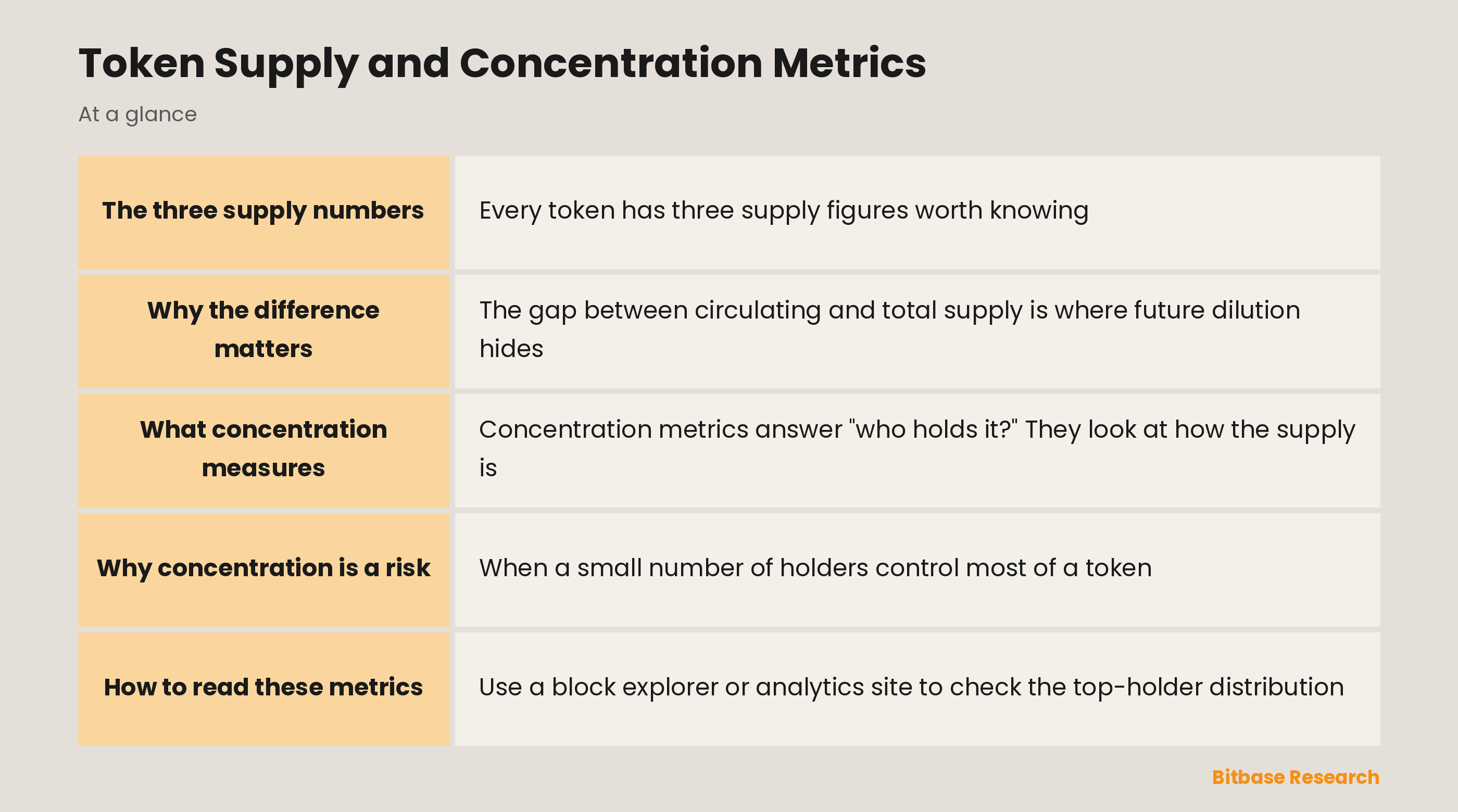
Every token has three supply figures worth knowing. Circulating supply is how many tokens are actually available and trading now. Total supply is how many exist, including locked or reserved ones. Max supply is the absolute cap, the most that can ever exist — some tokens have one, others do not. Confusing these is how people misjudge a token's real scale.
Why the difference matters
The gap between circulating and total supply is where future dilution hides. A token with a small circulating supply but a huge total supply has many tokens waiting to be released, which can weigh on the price as they unlock. Judging a token only by its current, circulating figure — while ignoring what is still to come — is one of the most common and costly mistakes.
What concentration measures
Concentration metrics answer "who holds it?" They look at how the supply is spread across wallets: how much the top ten or top hundred addresses control, and how much sits with the team, insiders, or a handful of whales. A token can have a healthy total supply and still be dangerous if a few wallets own most of it.
Why concentration is a risk
When a small number of holders control most of a token, they control its price. A single whale deciding to sell can crash a thinly-held token, and concentrated ownership makes manipulation, coordinated dumps, and governance capture far easier. Wide, even distribution is a sign of resilience; heavy concentration is a sign that a few people hold your downside in their hands.
How to read these metrics
Use a block explorer or analytics site to check the top-holder distribution before buying, and compare circulating to total and max supply to gauge future dilution. Be wary of tokens where a tiny float props up a big price while most supply is concentrated and waiting to unlock. Healthy tokens tend to show broad distribution and a circulating supply that is a real share of the total.
The bottom line
Supply metrics tell you how scarce a token really is, and concentration metrics tell you who controls it — together they reveal risks no price chart shows. A low float hiding a huge total supply, or a handful of wallets owning the majority, are warnings worth more than any roadmap. Check who holds a token and how much is yet to come before you decide it is worth holding yourself.
Disclaimer: This article is educational content from Bitbase Academy, provided for informational purposes only. It is not investment, trading, tax, or financial advice. Written as of July 2026; rely on the latest official information.
References
[1] Etherscan, "Token holder distribution" etherscan.io
[2] CoinGecko, "Circulating, total and max supply explained" coingecko.com