Staking pays you to help secure a proof-of-stake blockchain, but the yield is not free money. It comes from specific, understandable sources, and knowing them tells you which rewards are sustainable and which are not.
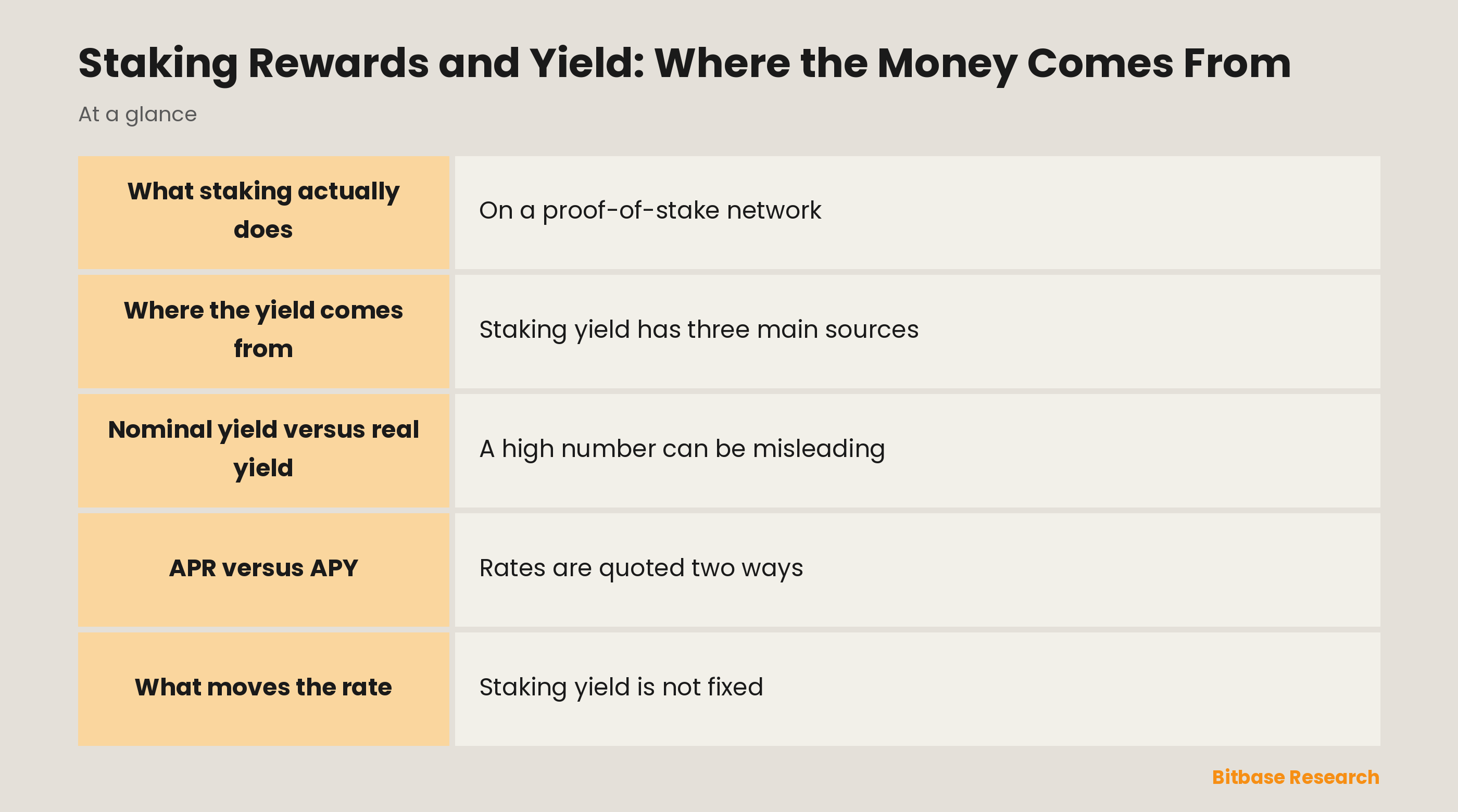
What staking actually does
On a proof-of-stake network, validators lock up the chain's token as a security deposit and take turns proposing and confirming blocks. Honest work earns rewards; cheating risks losing the deposit. When you stake, you are supplying that security, either by running a validator or by delegating your tokens to one, and the rewards are your pay for it.
Where the yield comes from
Staking yield has three main sources. The largest is usually issuance: the protocol mints new tokens and hands them to validators, funded by mild inflation. The second is transaction fees paid by users, which flow partly or wholly to validators. The third, on some chains, is MEV, the extra value captured from ordering transactions within a block. Add them up and you get the headline yield.
Nominal yield versus real yield
A high number can be misleading. If a chain pays 8% in new tokens but its supply is inflating 6%, your real gain in ownership is closer to 2%. Nominal yield is what you are paid; real yield is what you keep after inflation dilutes everyone. Always ask whether a quoted rate is before or after the token's own inflation.
APR versus APY
Rates are quoted two ways. APR is the simple annual rate. APY assumes you compound, restaking your rewards so they earn more rewards. On chains where rewards auto-compound, APY is higher than APR; where they do not, the two are the same. It is small print, but it changes the true return.
What moves the rate
Staking yield is not fixed. As more of a token's supply gets staked, the same reward pool is split among more validators, so the per-staker rate falls. Fees and MEV rise and fall with network activity. So a yield you see today can drift, and unusually high rates often signal either heavy inflation or added risk.
The bottom line
Staking yield is real pay for real work: securing a network in exchange for issuance, fees, and sometimes MEV. Judge any rate by its source and by inflation, not by the headline number, and treat yields far above a chain's peers as a question to investigate, not a gift to grab.
Disclaimer: This article is educational content from Bitbase Academy, provided for information only. It does not constitute investment, trading, tax, or financial advice. Written as of July 2026; refer to the latest official information.
References
[1] Ethereum.org, "Staking" ethereum.org
[2] Solana, "Staking" solana.com