When a stablecoin moves, it travels on a blockchain that acts as its settlement rail. Which rail you choose decides how fast the payment finishes, how much it costs, and how final it really is. For anyone moving dollars onchain, the rail matters as much as the coin.
What a payment rail is
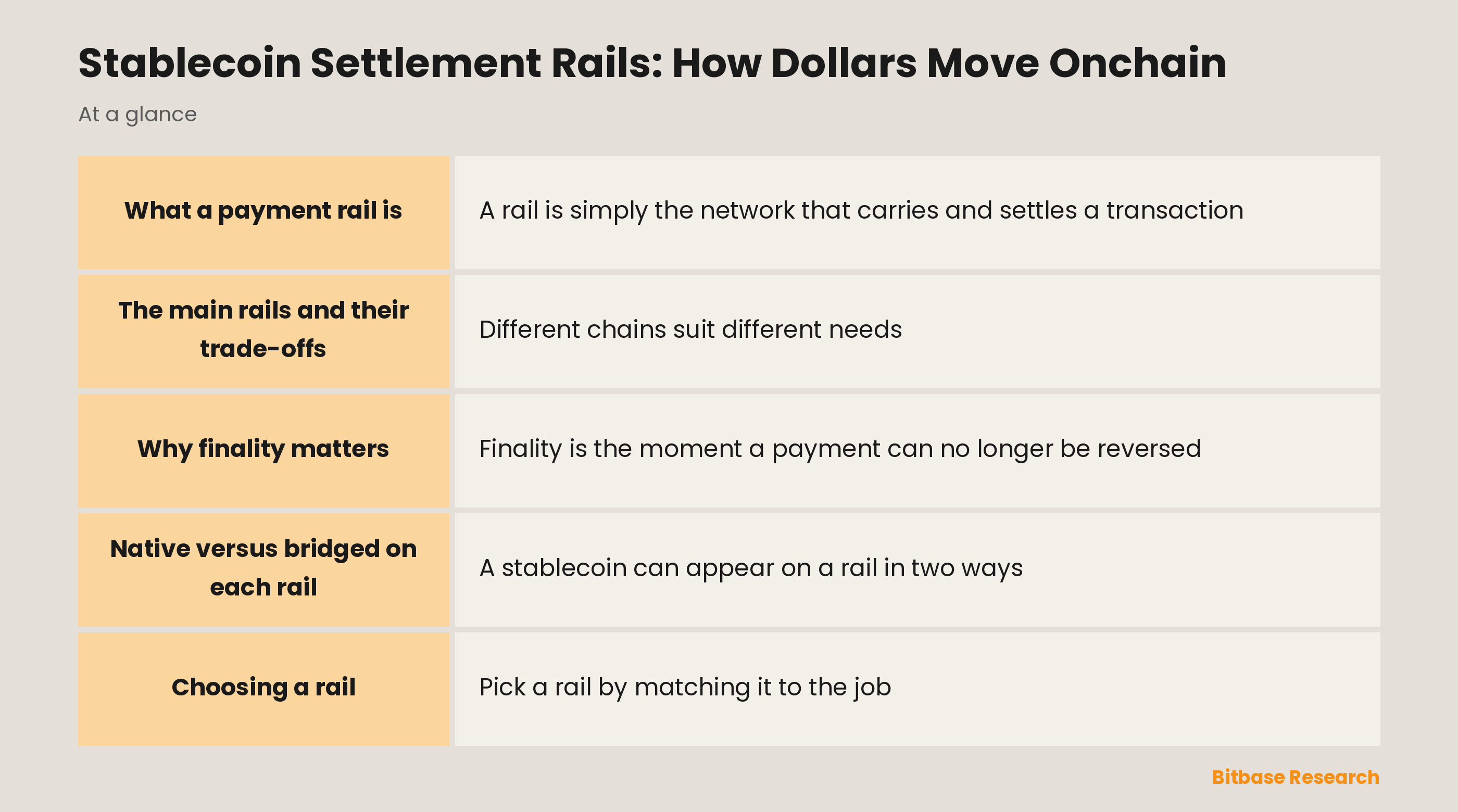
A rail is simply the network that carries and settles a transaction. In traditional finance, card networks and bank wires are rails. Onchain, the blockchain itself is the rail: it records the transfer, confirms it, and makes it final. The same stablecoin can ride different rails, and each one has its own speed, cost, and reliability.
The main rails and their trade-offs
Different chains suit different needs. Tron carries a huge share of USDT transfers because fees are low and confirmation is quick, which is why it is popular for remittances. Ethereum is the most established and secure but can be costlier when busy. Solana settles in well under a second at very low cost, which appeals to high-volume payments. Ethereum layer-2 networks aim to combine low fees with Ethereum-grade security. There is no single best rail, only the right one for a given payment.
Why finality matters
Finality is the moment a payment can no longer be reversed. For settlement this is critical: a merchant should not release goods until the transfer is truly final. Some rails reach finality in a second or two, others take longer. Faster is not automatically better, because very fast chains can trade some robustness for speed. What matters is knowing when a payment is genuinely done before you act on it.
Native versus bridged on each rail
A stablecoin can appear on a rail in two ways: natively issued by the company, or bridged over from another chain. Native coins are the genuine article and are safest. Bridged versions depend on the bridge that created them. Before receiving a large payment, confirm the coin on that rail is the native version, not a wrapped substitute.
Choosing a rail
Pick a rail by matching it to the job. For small, frequent transfers, favor low fees and speed. For large or institutional settlement, favor security and clear finality. Always make sure both sides support the same coin on the same chain, and send a small test transfer first when using a new rail.
The bottom line
The stablecoin is the money; the rail is the road it travels. Understanding the trade-offs between chains lets you settle payments that are fast, cheap, and final, and avoids the costly mistakes that come from sending dollars down the wrong road.
Disclaimer: This article is educational content from Bitbase Academy, provided for information only. It does not constitute investment, trading, tax, or financial advice. Written as of July 2026; refer to the latest official information.
References
[1] AlphaPoint, "Cross-Border Payments with Stablecoins: 2026 Guide" alphapoint.com
[2] Ryder, "Stablecoin Payment Rails: Stripe and PayPal 2026" ryder.id