Most big stablecoins can be frozen by the company that issues them. It is one of the most important and least understood facts about holding digital dollars, and it changes what "your" money really means.
The freeze function
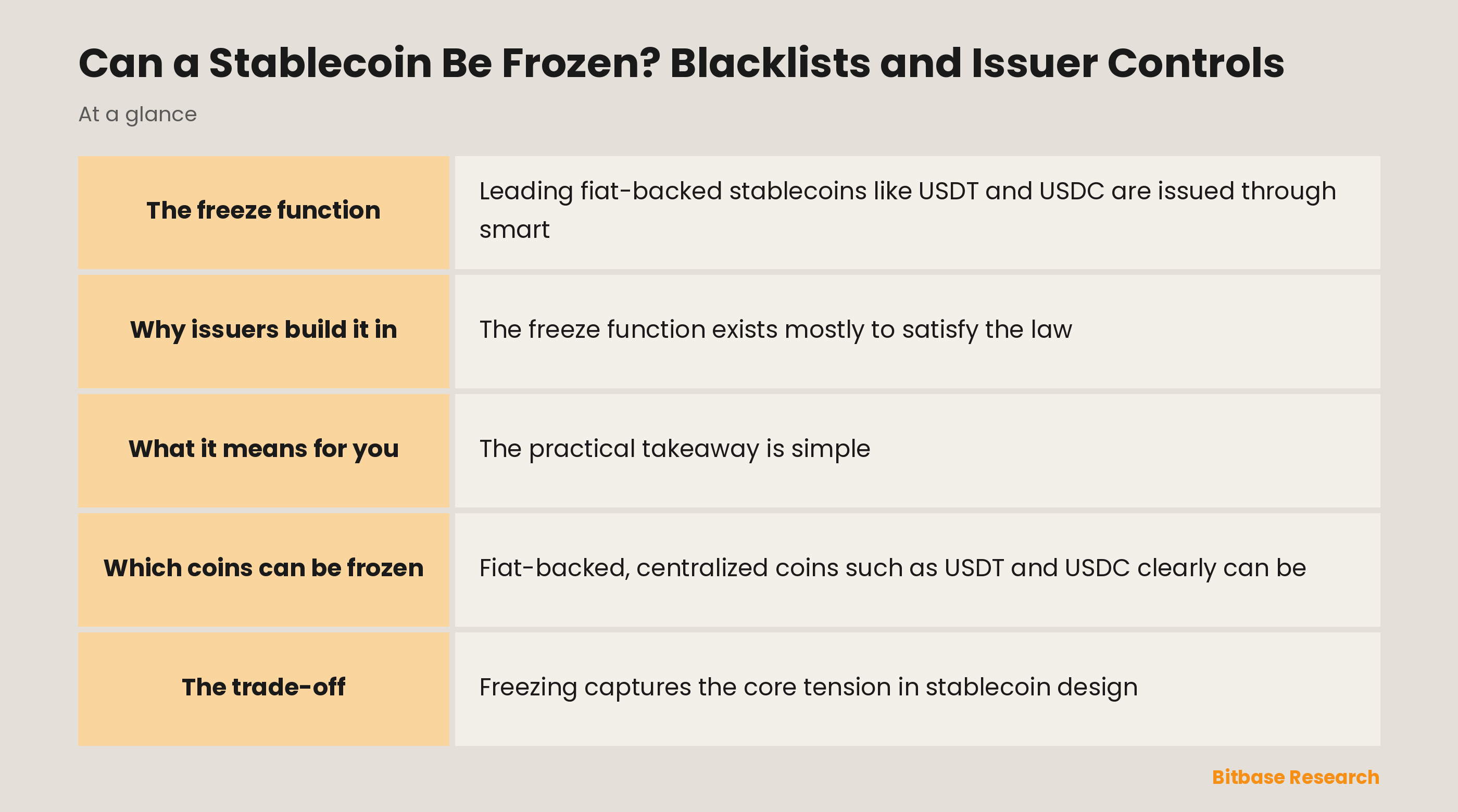
Leading fiat-backed stablecoins like USDT and USDC are issued through smart contracts that include a blacklist. With a single transaction, the issuer can freeze a specific address, making the tokens in it impossible to send or redeem. The coins still exist, but they are locked in place. This power sits with the issuer alone, not with any user.
Why issuers build it in
The freeze function exists mostly to satisfy the law. Issuers that hold real bank reserves must comply with sanctions, respond to court orders, and cooperate with investigations into theft, fraud, and hacks. Freezing has been used to lock stolen funds after major exploits and to enforce government sanctions lists. For a regulated dollar token, the ability to freeze is a feature regulators expect, not a bug.
What it means for you
The practical takeaway is simple: a centrally issued stablecoin is not censorship-resistant in the way Bitcoin is. If your address is flagged, correctly or not, your balance can be frozen without your consent. For ordinary users this almost never happens, but it is a real difference from holding a coin whose rules no single company controls.
Which coins can be frozen
Fiat-backed, centralized coins such as USDT and USDC clearly can be. Decentralized, crypto-backed coins like DAI are harder to freeze at the base layer, because no single company mints them, though even they can inherit some controls when they hold centralized assets as collateral. As a rule, the more a coin depends on a company's bank reserves, the more freeze power that company holds.
The trade-off
Freezing captures the core tension in stablecoin design. Central control makes a coin safer for institutions and easier to regulate, and it lets stolen funds be recovered. It also means you are trusting the issuer not to freeze you unfairly. Neither choice is strictly better; they suit different users. Knowing which kind of coin you hold tells you who ultimately controls it.
Disclaimer: This article is educational content from Bitbase Academy, provided for information only. It does not constitute investment, trading, tax, or financial advice. Written as of July 2026; refer to the latest official information.
References
[1] Tether, "Transparency" tether.to
[2] Circle, "USDC" circle.com