
A stablecoin is supposed to stay at one dollar, but sometimes it slips. A depeg is what happens when it does, and how far it falls and how fast it comes back tells you a lot about what stands behind the coin.
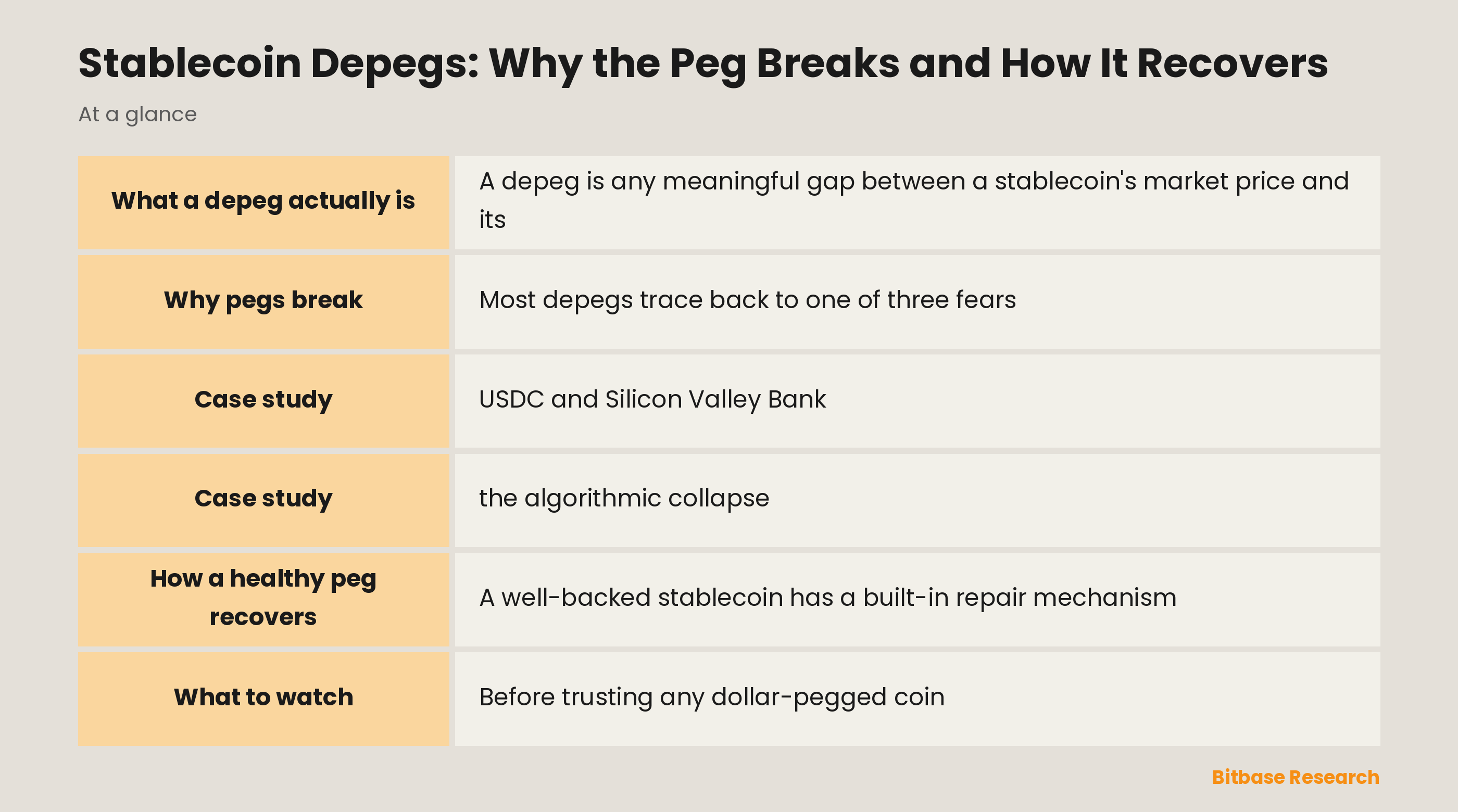
What a depeg actually is
A depeg is any meaningful gap between a stablecoin's market price and its one-dollar target. Tiny wobbles of a fraction of a cent happen all the time and mean little. A depeg that matters is a sustained move, say to 98 cents or below, driven by people doubting that the coin can be redeemed for a full dollar.
Why pegs break
Most depegs trace back to one of three fears. The first is reserve risk: holders worry the assets backing the coin are not really there or not really worth a dollar. The second is liquidity: even a fully backed coin can dip if everyone tries to sell at once and there are not enough buyers. The third is collateral collapse, which mostly hits crypto-backed or algorithmic coins when the assets behind them fall faster than the system can respond.
Case study: USDC and Silicon Valley Bank
In March 2023, Circle revealed that about 3.3 billion dollars of USDC reserves, roughly 8% of its cash, were stuck at the failed Silicon Valley Bank. USDC fell below 87 cents within hours as holders rushed to exit. The recovery was just as instructive: once US regulators guaranteed the bank's deposits and Circle pledged to cover any shortfall, USDC climbed back to one dollar within about three days. The reserves were real; the fear was about access to them.
Case study: the algorithmic collapse
The opposite outcome came in May 2022, when TerraUSD, an algorithmic stablecoin with no hard reserves, lost its peg and never recovered. Instead of arbitrage pulling it back, a feedback loop drove it toward zero and erased tens of billions of dollars. It remains the clearest warning of how differently a depeg can end depending on the backing model.
How a healthy peg recovers
A well-backed stablecoin has a built-in repair mechanism: redemption. If the coin trades below a dollar, arbitrageurs can buy it cheap and redeem it with the issuer for a full dollar, pocketing the difference and pushing the price back up. That loop only works if redemption is open, fast, and trusted. When it is, depegs are brief; when it is blocked or doubted, they can spiral.
What to watch
Before trusting any dollar-pegged coin, check three things: whether reserves are real and disclosed, whether redemption is genuinely available, and how deep the coin's trading liquidity is. A coin that scores well on all three can still wobble in a panic, but it is far more likely to snap back than one that does not.
Disclaimer: This article is educational content from Bitbase Academy, provided for information only. It does not constitute investment, trading, tax, or financial advice. Written as of July 2026; refer to the latest official information.
References
[1] CNBC, "Stablecoin USDC breaks dollar peg after firm reveals $3.3 billion in SVB exposure" cnbc.com
[2] CoinDesk, "USDC Stablecoin Regains Dollar Peg After Silicon Valley Bank-Induced Chaos" coindesk.com