
The same stablecoin often lives on a dozen blockchains at once, and moving it between them is not as simple as sending it. Bridges make it possible, but they are also one of the riskiest parts of crypto. Knowing how they work protects your dollars.
Why one coin lives on many chains
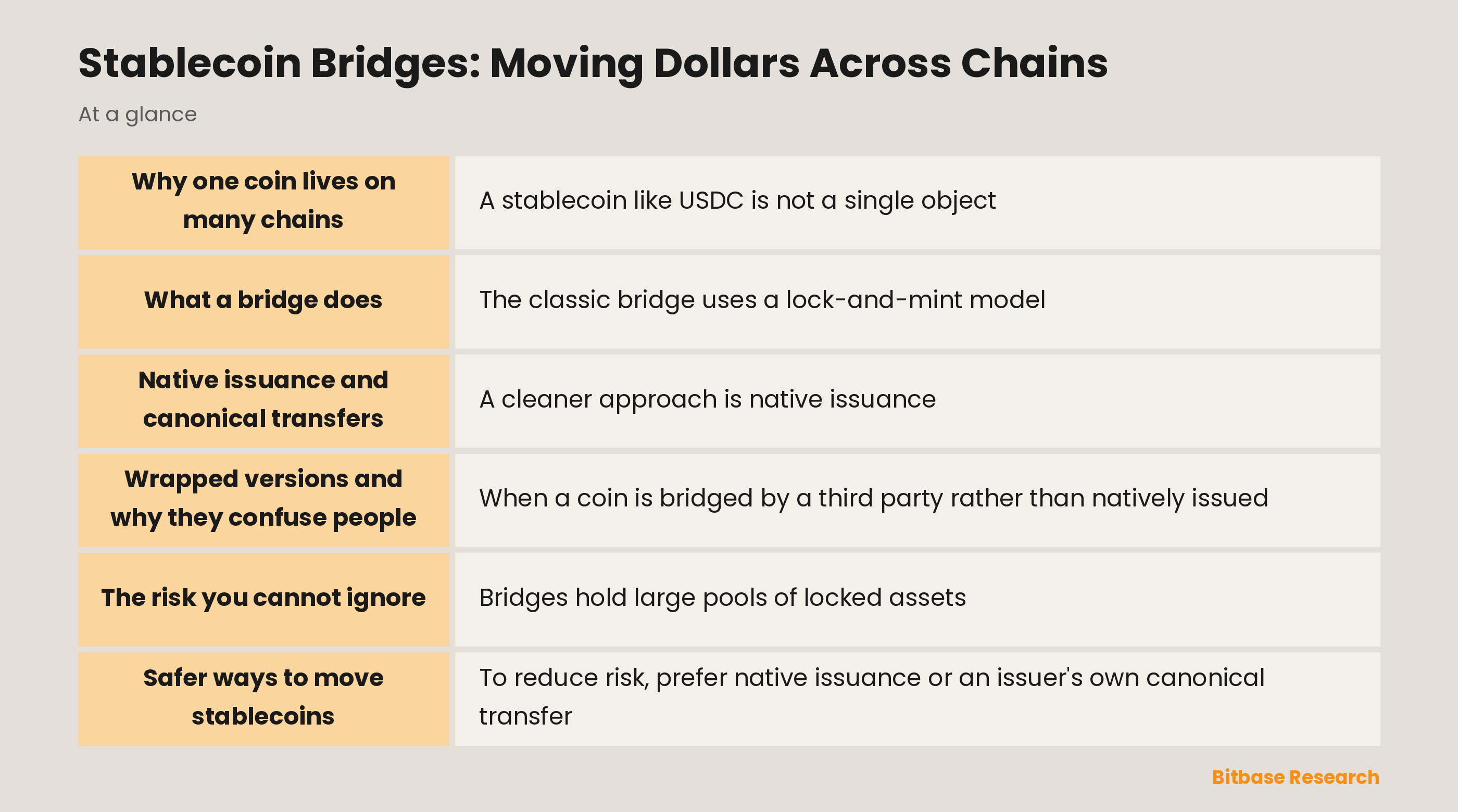
A stablecoin like USDC is not a single object. It exists as separate tokens on Ethereum, Solana, and many other chains, each usable only on its own network. To move value from one chain to another, you cannot just send the token across; the two networks do not talk directly. Something has to connect them, and that something is a bridge.
What a bridge does
The classic bridge uses a lock-and-mint model. You send your stablecoin to the bridge on the source chain, where it is locked, and the bridge mints an equivalent token for you on the destination chain. To come back, the process reverses: the destination token is burned and the original is unlocked. The total supply stays constant; the dollars simply move representation from one chain to another.
Native issuance and canonical transfers
A cleaner approach is native issuance, where the issuer itself mints the coin on each chain. Circle's Cross-Chain Transfer Protocol works this way: it burns real USDC on the source chain and mints real USDC on the destination, so you always hold the genuine article rather than a bridge's IOU. Coins moved this way are called canonical, and they avoid much of the risk that comes with third-party bridges.
Wrapped versions and why they confuse people
When a coin is bridged by a third party rather than natively issued, you can end up holding a wrapped version, sometimes written with a suffix like USDC.e. It tracks the real coin but is technically a separate token backed by whatever is locked in the bridge. If that bridge fails, the wrapped version can lose its value even though the original is fine. Always check whether you hold the native coin or a bridged wrapper.
The risk you cannot ignore
Bridges hold large pools of locked assets, which makes them prime targets. Several of the biggest thefts in crypto history have been bridge hacks, draining hundreds of millions of dollars at once. A bridge is only as safe as its code and its operators, and unlike a bank there is rarely anyone to make you whole.
Safer ways to move stablecoins
To reduce risk, prefer native issuance or an issuer's own canonical transfer protocol over unknown third-party bridges. For many people the simplest route is to use a trusted exchange: deposit on one chain and withdraw on another, letting the exchange handle the movement. Whatever the method, move a small test amount first and confirm you received the native coin on the other side.
Disclaimer: This article is educational content from Bitbase Academy, provided for information only. It does not constitute investment, trading, tax, or financial advice. Written as of July 2026; refer to the latest official information.
References
[1] Circle, "Cross-Chain Transfer Protocol" circle.com
[2] Chainalysis, "Cross-Chain Bridge Hacks" chainalysis.com