Every time you trade on a blockchain, someone may be trying to profit from the order in which your transaction lands. That hidden game is called MEV, and on a fast chain like Solana it powers sandwich attacks, front-running, and bot wars. Understanding it explains why your trade sometimes fills at a worse price than you expected.
What MEV is
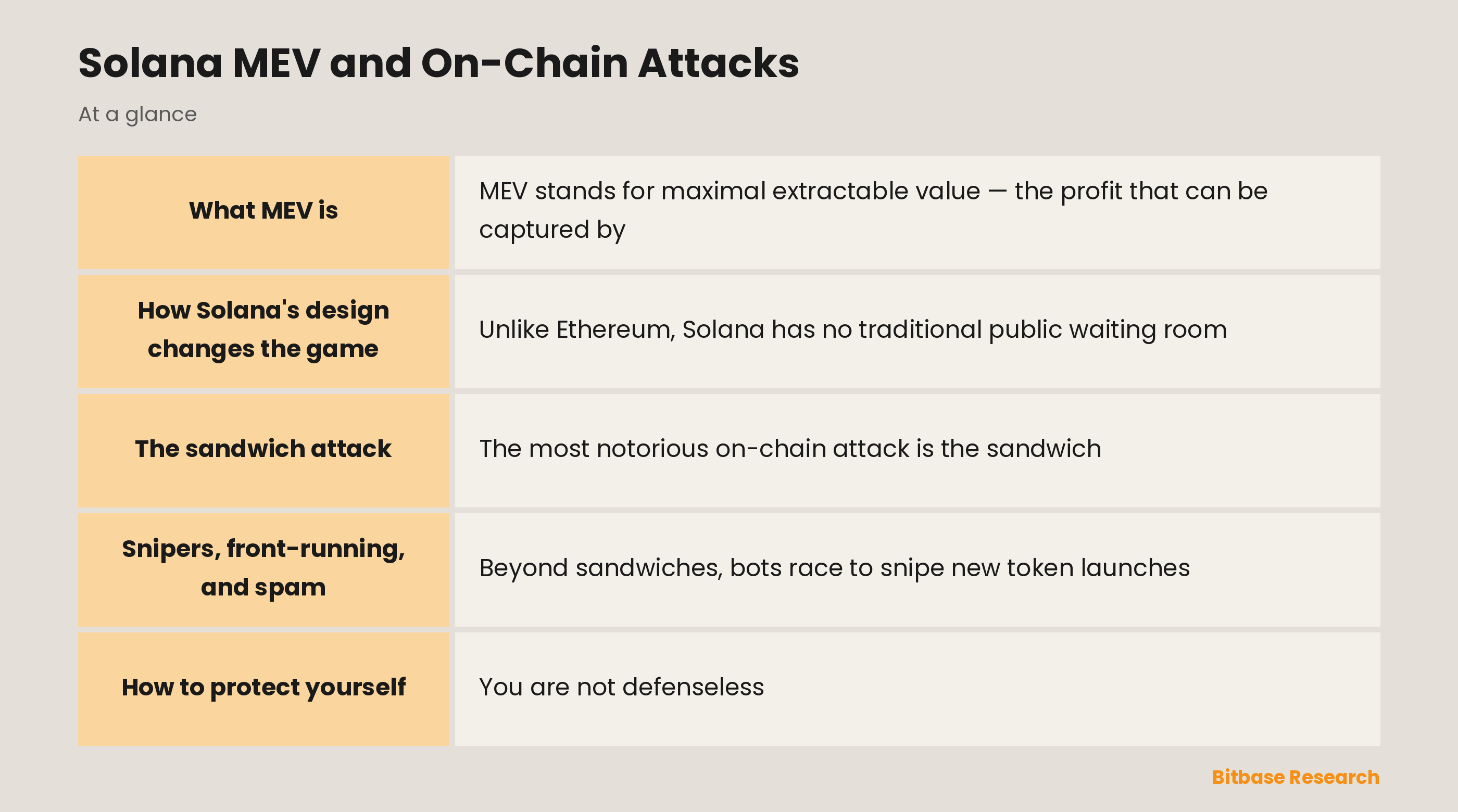
MEV stands for maximal extractable value — the profit that can be captured by choosing which transactions go into a block and in what order. Whoever controls that ordering can insert, delay, or reorder trades to their own benefit. It exists on every blockchain, but the details differ sharply depending on how each network handles incoming transactions.
How Solana's design changes the game
Unlike Ethereum, Solana has no traditional public waiting room, or mempool, where pending transactions sit in the open. Transactions are forwarded straight to the current block producer. This removes some classic attacks but does not remove MEV — instead, extraction moves to specialized infrastructure, and much of it now flows through a system called Jito that auctions priority placement in a block.
The sandwich attack
The most notorious on-chain attack is the sandwich. A bot spots your pending buy, quickly buys the same token just before you and pushes the price up, lets your order fill at that worse price, then sells right after for a profit skimmed from you. You still get your tokens, but you quietly pay more than you should. Large trades with loose slippage settings are the prime targets.
Snipers, front-running, and spam
Beyond sandwiches, bots race to snipe new token launches, jump ahead of big pending orders, and flood the network with attempts to win favorable ordering. Because Solana's fees are tiny, bots can afford to spam thousands of transactions to land the profitable one, which both drives extraction and adds to congestion. It is an arms race run by well-funded professionals.
How to protect yourself
You are not defenseless. Setting a tight slippage tolerance limits how much a sandwich can steal, since a trade that would move the price too far simply fails. Using MEV-aware wallets, routers, or RPC endpoints that offer sandwich protection helps, as does splitting very large orders. The core habit is simple: never send a big market order with wide slippage into a hot, volatile token.
The bottom line
MEV is an unavoidable feature of public blockchains, and on Solana it shows up as sandwiches, snipers, and relentless bot competition routed through systems like Jito. It is both a real cost to ordinary traders and a formalized part of how the network runs. You cannot eliminate it, but with tight slippage and protective tools, you can make yourself a much harder target.
Disclaimer: This article is educational content from Bitbase Academy, provided for informational purposes only. It is not investment, trading, tax, or financial advice. Written as of July 2026; rely on the latest official information.
References
[1] Jito, "MEV on Solana" jito.network
[2] Helius, "Solana MEV: An Introduction" helius.dev