Not every scaling answer is a rollup. Sidechains, appchains, and subnets are all ways to run activity on a separate chain — but unlike rollups, they provide their own security rather than borrowing Ethereum's. Knowing the difference tells you exactly what you are trusting when you use one.
The shared idea: your own chain
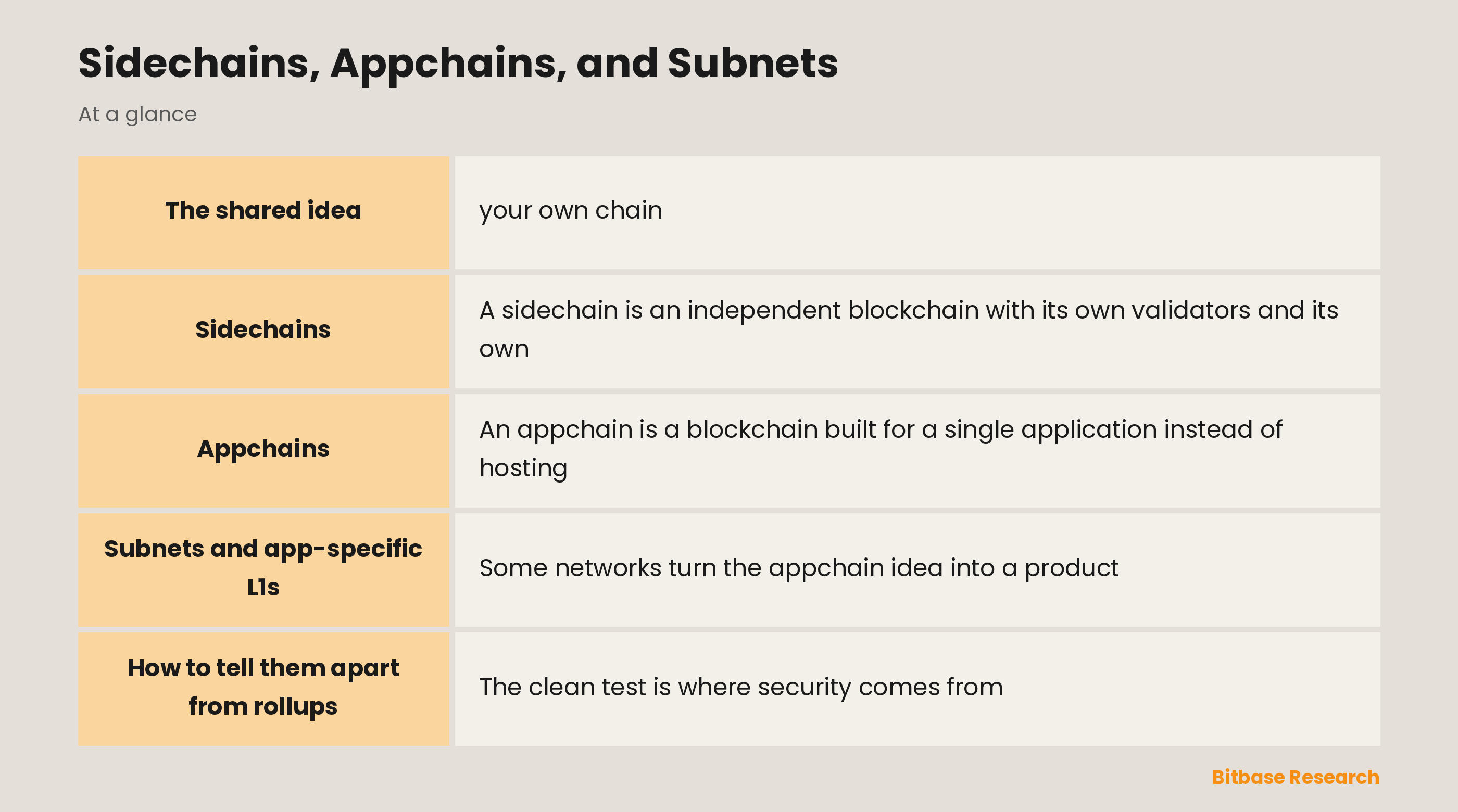
Sidechains, appchains, and subnets are all variations on one theme: move off a crowded main chain onto a separate one you control more directly. That buys cheaper fees, higher throughput, and room to customize. The catch, in every case, is the same — a separate chain has to secure itself, so it does not inherit the safety of a big base layer the way a rollup does.
Sidechains
A sidechain is an independent blockchain with its own validators and its own consensus, connected to a main chain by a bridge. Polygon PoS is the classic example alongside Ethereum. Because a sidechain secures itself, it is only as safe as its own validator set — and the bridge that links it becomes a prime target, since bridge hacks have caused some of crypto's largest losses. You trade Ethereum-grade security for speed and low cost.
Appchains
An appchain is a blockchain built for a single application instead of hosting many. A trading protocol or a game might launch its own chain so it can tune fees, control block space, and avoid competing with unrelated apps for room. Frameworks like the Cosmos SDK make this practical, and dYdX famously moved to its own chain. The benefit is total control; the burden is that the app must now bootstrap and maintain its own security and validators.
Subnets and app-specific L1s
Some networks turn the appchain idea into a product. Avalanche lets teams spin up their own sovereign chains — historically called subnets, and renamed Avalanche L1s in the Avalanche9000 upgrade of December 2024, which sharply cut the cost of launching one. These chains run their own validators and set their own rules, from fees to compliance, while plugging into a shared ecosystem. It is customization as a service, with sovereignty as both the feature and the responsibility.
How to tell them apart from rollups
The clean test is where security comes from. A rollup posts its data and proofs to a base layer like Ethereum and inherits that layer's security; a sidechain, appchain, or subnet runs its own validators and stands on its own. That difference is not academic: with a rollup, the base layer can protect your funds even if the operator misbehaves, while with a self-secured chain, your safety rests entirely on that chain and its bridge.
The bottom line
Sidechains, appchains, and subnets all offer the freedom of your own chain — cheaper, faster, customizable — in exchange for providing your own security. That can be the right call for a high-volume app that wants control, but it is a genuinely different trust model from a rollup. Before you move assets onto one, ask who is validating it and how the bridge is secured.
Disclaimer: This article is educational content from Bitbase Academy, provided for informational purposes only. It is not investment, trading, tax, or financial advice. Written as of July 2026; rely on the latest official information.
References
[1] Avalanche, "Avalanche L1s (formerly Subnets)" avax.network
[2] Polygon, "What is Polygon PoS" polygon.technology