What if you could turn a question about the future — who wins an election, whether inflation cools, if a team lifts the trophy — into a tradable price that reflects the crowd's best estimate of the odds? That is a prediction market. Once a niche academic idea, they have become one of crypto's most talked-about applications. Here is how they actually work.
What a prediction market is
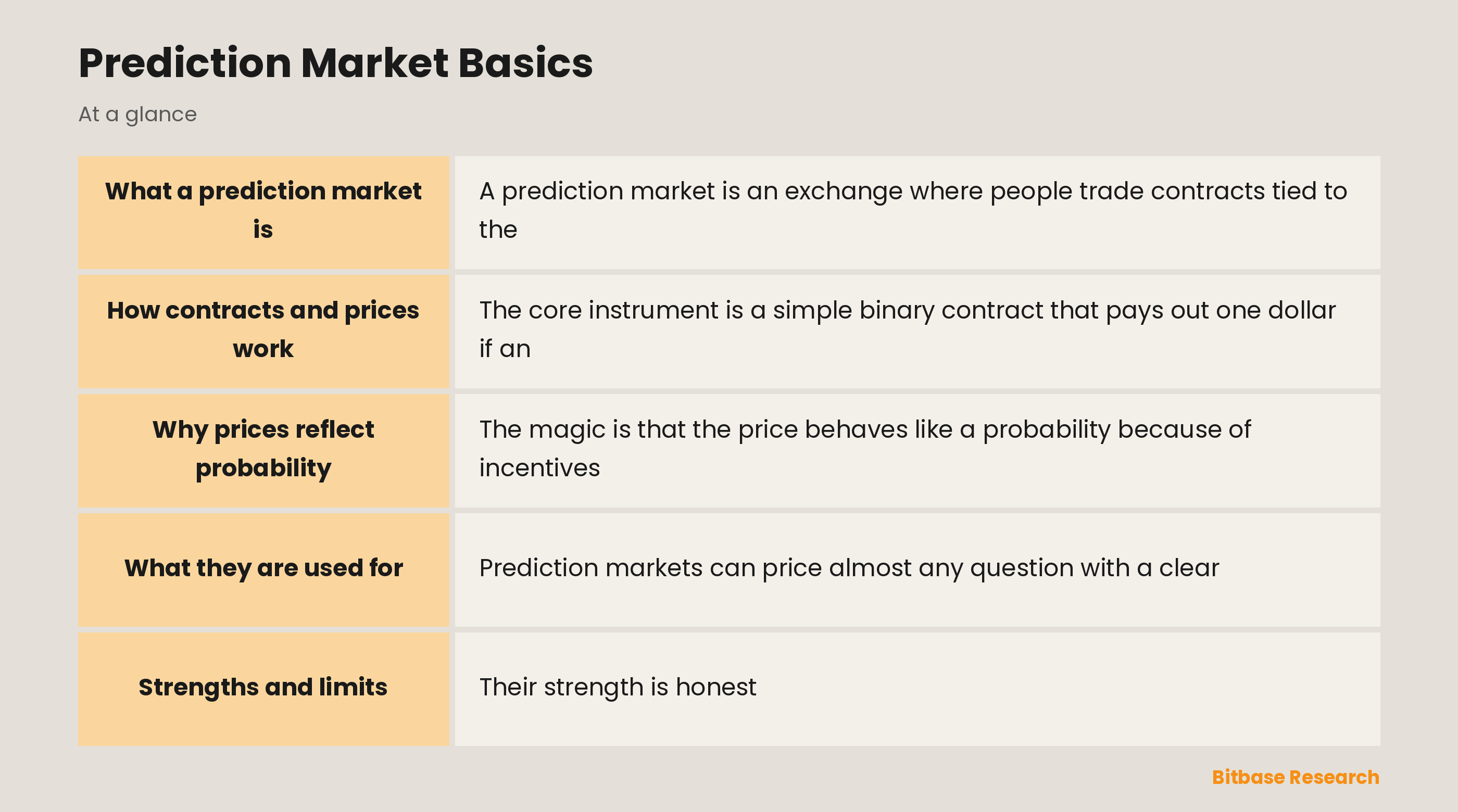
A prediction market is an exchange where people trade contracts tied to the outcome of a future event. Instead of betting against a house, participants buy and sell shares in "yes" or "no" among themselves, and the market price settles the question. Because real money is on the line, traders are motivated to price in everything they know. The result is a live, self-correcting forecast that updates the moment new information appears — a number that means far more than an opinion poll.
How contracts and prices work
The core instrument is a simple binary contract that pays out one dollar if an event happens and nothing if it does not. Its price therefore floats between zero and one dollar, or equivalently one and ninety-nine cents. If a "yes" share trades at sixty cents, the market is effectively saying there is roughly a sixty percent chance the event occurs. You profit by buying below what you believe the true probability is, and either holding to settlement or selling as the price moves your way.
Why prices reflect probability
The magic is that the price behaves like a probability because of incentives. Anyone who thinks the market is wrong can buy the underpriced side and profit if they are right, which pushes the price toward the true likelihood. This is the wisdom of crowds with skin in the game: it aggregates the scattered knowledge of many people, weighted by their conviction and their willingness to back it with money. Well-traded prediction markets have often forecast events more accurately than pundits or polls.
What they are used for
Prediction markets can price almost any question with a clear, verifiable outcome. Common categories include elections and politics, economic data such as interest-rate decisions, corporate events like earnings or product launches, sports results, and even scientific or cultural milestones. Beyond speculation, they serve as forecasting tools: journalists, researchers, and businesses increasingly read market-implied odds as a fast, quantified signal of what is likely to happen, distilled from thousands of participants.
Strengths and limits
Their strength is honest, real-time probability, resistant to spin because being wrong costs money. But they have real limits. Thinly traded markets can be noisy or manipulated by a single large player, prices can overreact to rumours, and the whole thing depends on a clear, trusted way to settle the outcome. They also raise legal and regulatory questions that differ sharply by country. Treat market odds as a strong signal, not an oracle, and understand the rules of any venue you use.
The bottom line
A prediction market turns a yes-or-no question about the future into a price between zero and one dollar that reads directly as a probability, kept honest by traders risking real money. They aggregate dispersed knowledge into a single, updating forecast that often beats traditional methods, while remaining vulnerable to thin liquidity, manipulation, and settlement disputes. Understood carefully, they are a genuinely new way to measure what the world expects to happen.
Disclaimer: This article is educational content from Bitbase Academy, provided for informational purposes only. It is not investment, trading, tax, or financial advice. Written as of July 2026; rely on the latest official information.
References
[1] Investopedia, "Prediction market" investopedia.com
[2] Brookings, "What prediction markets tell us" brookings.edu