Polymarket became a household name during the 2024 US election, when millions watched its odds move in real time. It is the largest crypto-native prediction market, and its journey — from offshore platform to a regulated US return — captures both the promise and the friction of putting forecasting on a blockchain. Here is what Polymarket is and how it actually works.
What Polymarket is
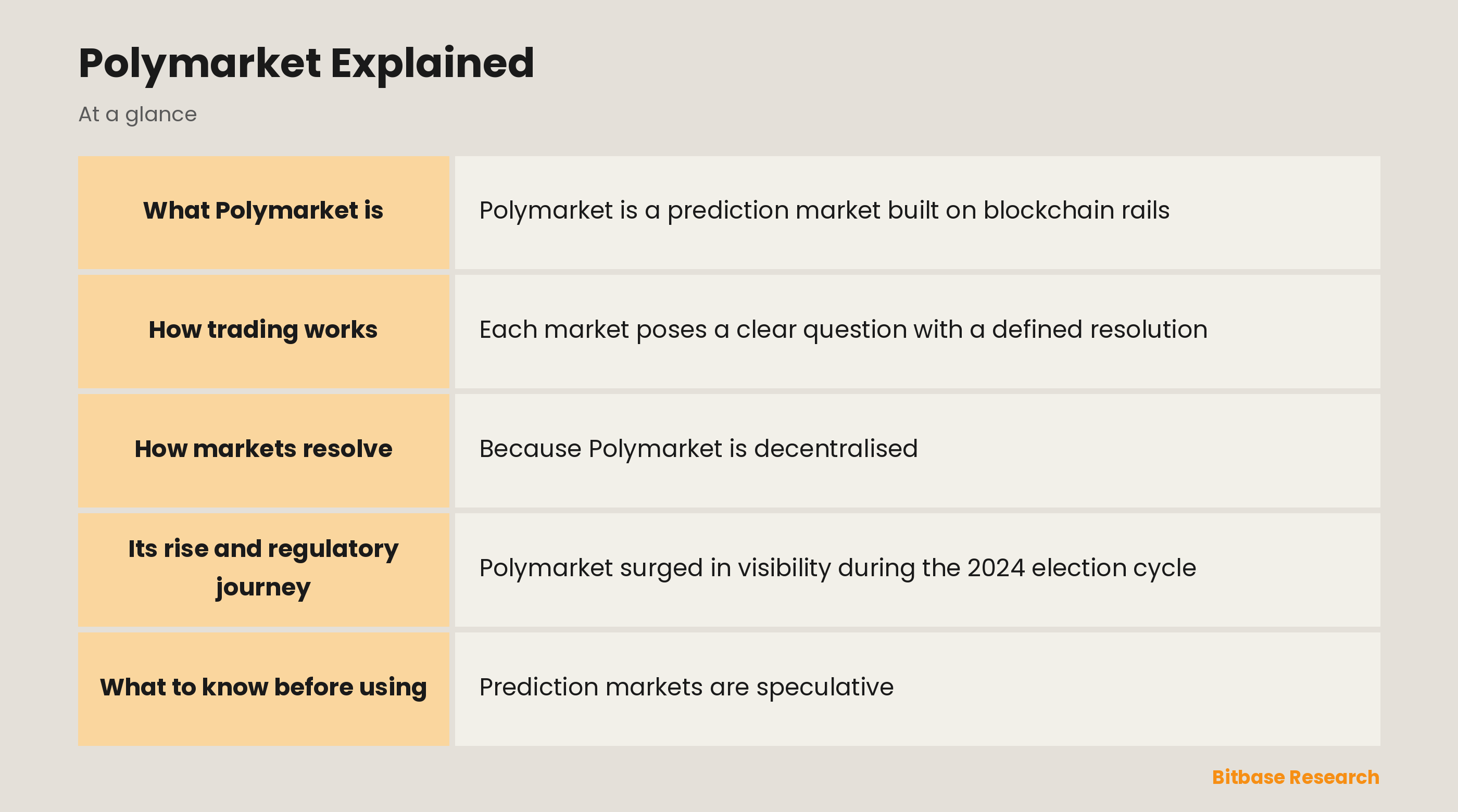
Polymarket is a prediction market built on blockchain rails, where users trade shares in the outcomes of real-world events. It settles in the stablecoin USDC and runs on a low-cost network, so positions and payouts are recorded on-chain rather than on a company ledger. Users trade against each other, not against the platform, and Polymarket earns from the market rather than by taking the other side of your bet. Its scale and liquidity have made its odds a widely cited public signal.
How trading works
Each market poses a clear question with a defined resolution, and offers "yes" and "no" shares that pay one dollar if correct and nothing if not. Their prices sit between zero and one and read directly as the market's probability, so a share priced at seventy cents implies a seventy percent chance. You buy the side you think is underpriced and can hold it to resolution or sell any time the price moves, closing your position early to lock in profit or cut a loss.
How markets resolve
Because Polymarket is decentralised, it cannot simply declare winners itself; it needs a trustworthy way to settle outcomes on-chain. It relies on an optimistic oracle, where a proposed result is posted with a financial bond and accepted if no one disputes it within a window. If someone challenges it, the dispute escalates to a decentralised vote that decides the truth, and dishonest proposers lose their bond. This mechanism secures settlement without a single company acting as final judge.
Its rise and regulatory journey
Polymarket surged in visibility during the 2024 election cycle, but for years it was closed to US users following a settlement with American regulators. That changed as it pursued a compliant path back: through acquiring a regulated exchange, it launched a US offering supervised by the commodities regulator, operating with fully collateralised contracts and no leverage. Its international platform and new US arm have both posted record volumes, though its regulatory status continues to evolve and should be checked directly.
What to know before using
Prediction markets are speculative, and Polymarket carries specific risks worth understanding. Outcomes can hinge on how a market's resolution rules are written, so ambiguous wording can lead to contested settlements. Access depends heavily on your jurisdiction, and the rules differ between its regulated US service and its international platform. As always in crypto, using it means interacting with wallets and stablecoins, so the usual security and self-custody cautions apply.
The bottom line
Polymarket is the leading crypto-native prediction market: trade "yes" or "no" shares that read as probabilities, settled in USDC on-chain and resolved through an optimistic oracle rather than a central referee. Its path from offshore platform to a regulated US return shows prediction markets maturing into the mainstream. Treat it as a genuine forecasting and speculation tool, mind the resolution rules and your local regulations, and never stake more than you can afford to lose.
Disclaimer: This article is educational content from Bitbase Academy, provided for informational purposes only. It is not investment, trading, tax, or financial advice. Written as of July 2026; rely on the latest official information.
References
[1] Polymarket, "How it works" polymarket.com
[2] CoinDesk, "Polymarket's US return" coindesk.com