
Some of the more reliable candlestick signals use three candles instead of one or two, telling a small story of trend, pause, and reversal. The morning star and evening star are the classic examples, marking potential bottoms and tops. Their three-part shape makes them harder to fake than a single candle, which is part of why traders respect them. Here is how each one forms and what the middle candle is really doing.
What a morning star is
A morning star is a bottom reversal made of three candles. The first is a large red candle continuing a downtrend. The second is a small candle that gaps lower and shows the selling losing force, a pause. The third is a large green candle that pushes firmly back up, closing well into the first candle's body. Together they trace a shift from selling, to hesitation, to buying, hinting the downtrend may be reversing into an uptrend.
What an evening star is
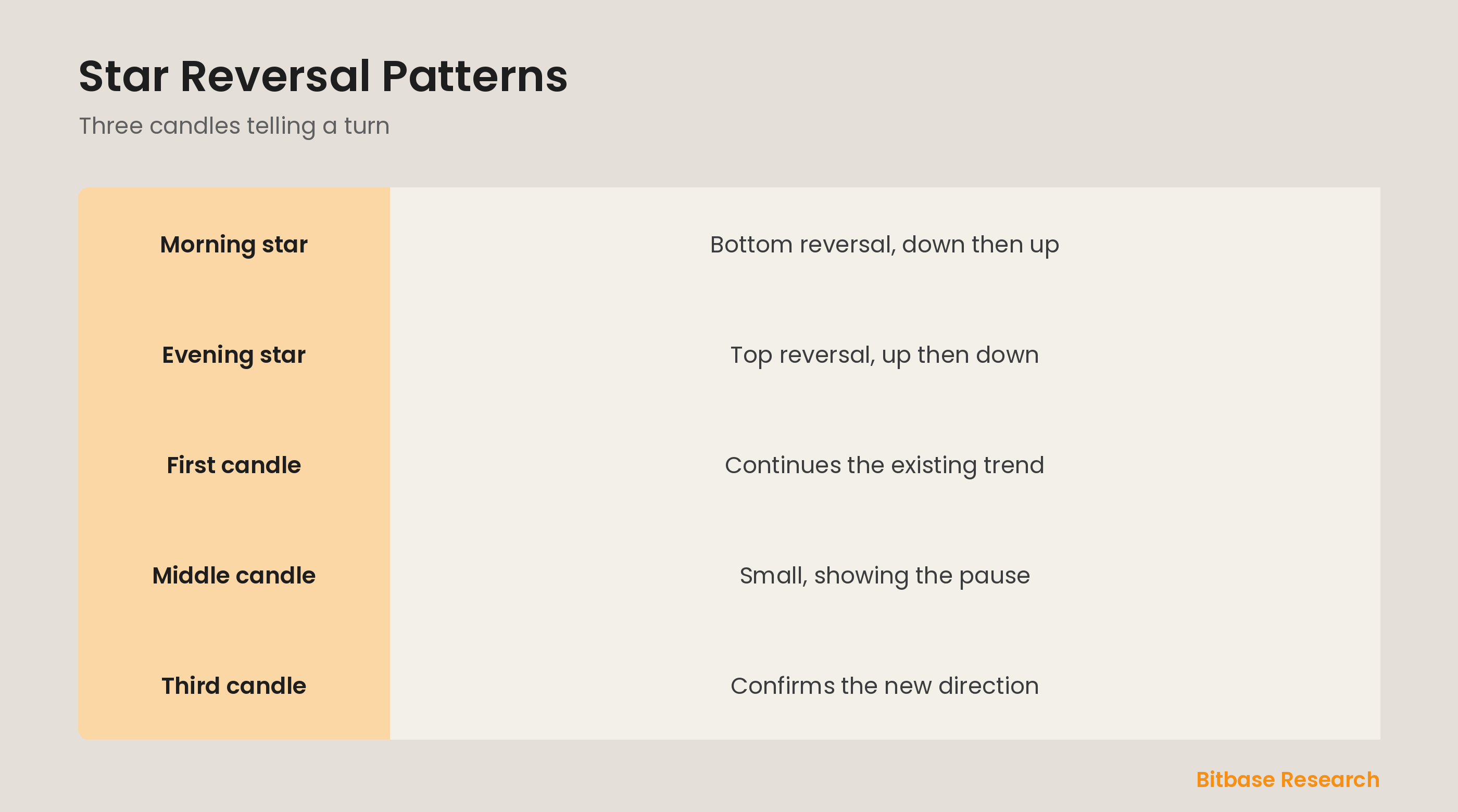
An evening star is the mirror image, a top reversal made of three candles. The first is a large green candle continuing an uptrend. The second is a small candle that gaps higher and shows the buying losing force. The third is a large red candle that pushes firmly back down, closing well into the first candle's body. The sequence traces a shift from buying, to hesitation, to selling, hinting the uptrend may be reversing into a downtrend.
The role of the middle candle
The small middle candle is the heart of both patterns. It is where the prevailing trend runs out of momentum and buyers and sellers reach a brief balance, much like a doji. That pause is the hinge on which the reversal turns. Without the small middle candle showing the trend stalling, the pattern would just be two opposing candles; it is the stall in the middle, followed by a decisive third candle, that gives the star its reversal meaning.
Reading a star in context
Like all candlestick patterns, a star means most at the end of a clear trend, precisely where a reversal would matter. A morning star deep in a downtrend or an evening star at the top of a rally is far more significant than the same shape in choppy, directionless trading. Even then, the third candle is the confirmation: a strong close in the new direction is what validates the pattern, so traders wait for it rather than anticipating.
The bottom line
A morning star is a three-candle bottom reversal, a big down candle, a small pausing candle, then a big up candle, hinting a downtrend may turn up. An evening star is its mirror at a top, a big up candle, a small pause, then a big down candle. The small middle candle is the key, showing momentum stalling before the reversal. Both mean most at the end of a clear trend, and the third candle is what confirms the turn. To keep learning the fundamentals, follow more from Bitbase Academy.
Disclaimer: This article is educational content from Bitbase Academy, provided for information only. It does not constitute investment, trading, tax, or financial advice. Crypto assets are volatile; assess your own risk. Written as of June 2026; refer to the latest official information.
References
[1] Investopedia, "Morning Star: Definition, Meaning, and Example" investopedia.com
[2] Investopedia, "Evening Star: Definition, Meaning, and Example" investopedia.com
[3] Investopedia, "Candlestick: What It Is, What It Tells Investors" investopedia.com