
Every blockchain has to do four jobs: execute transactions, agree on their order, settle disputes, and keep data available. A monolithic chain does all four itself; a modular one splits them across specialized layers. That single design choice shapes how a network scales, and it is one of the biggest debates in crypto architecture.
The four jobs of a blockchain
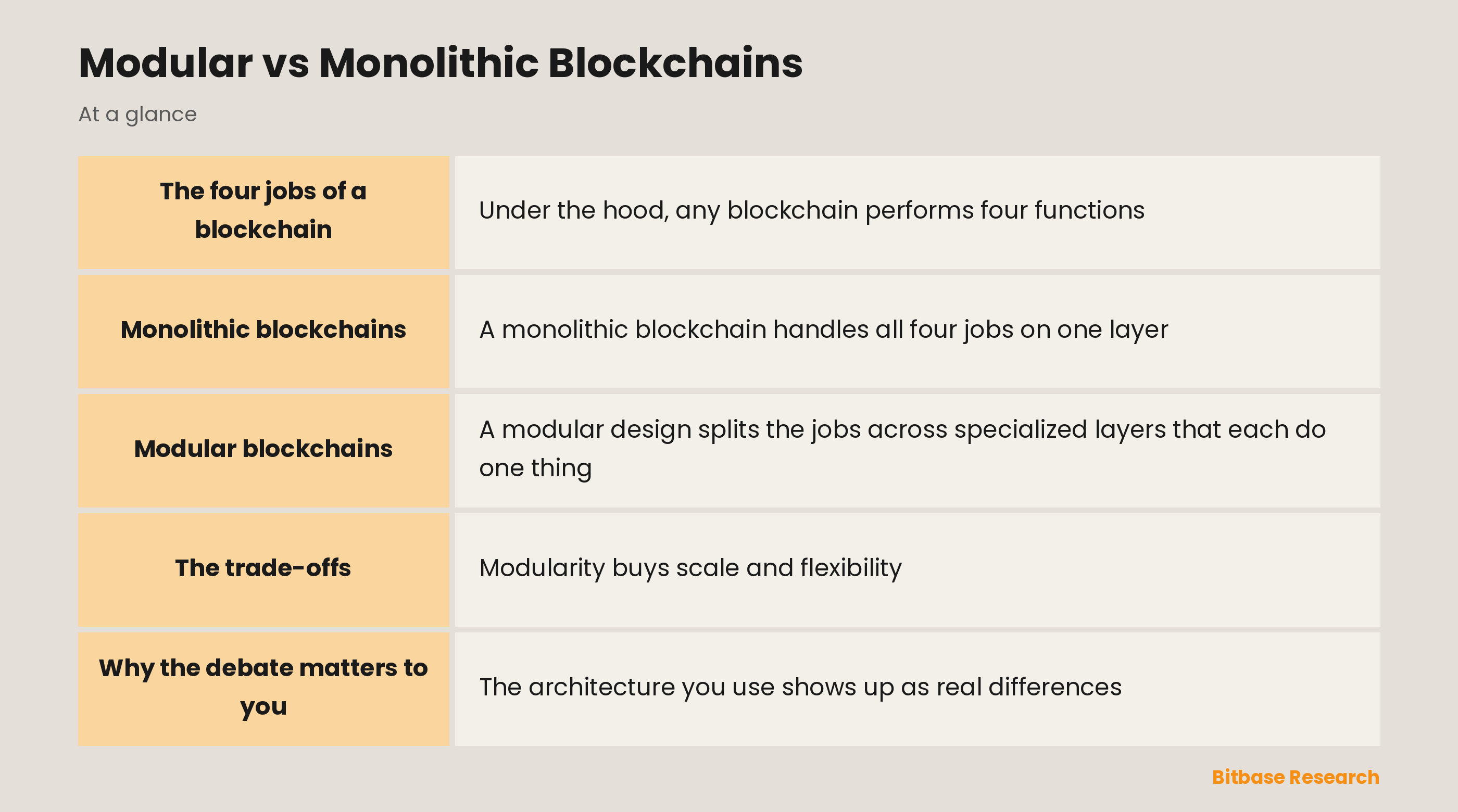
Under the hood, any blockchain performs four functions: execution, meaning running the transactions; consensus, meaning agreeing on their order; settlement, meaning finalizing results and resolving disputes; and data availability, meaning making sure the data can be checked. How a network divides these jobs is what the modular-versus-monolithic debate is really about.
Monolithic blockchains
A monolithic blockchain handles all four jobs on one layer. Bitcoin and Solana are examples: every full node executes, orders, settles, and stores everything. The upside is simplicity and tight integration — apps on the same chain interact seamlessly, with no bridges in between. The downside is that scaling one job means asking every node to do more of everything, which eventually strains hardware and pushes out smaller participants.
Modular blockchains
A modular design splits the jobs across specialized layers that each do one thing well. Ethereum with rollups is the clearest case: rollups handle execution, while Ethereum provides settlement and data availability. Dedicated data-availability networks like Celestia take this further, offering just the data layer so that many chains can plug in. The bet is that specialists scale better than a generalist.
The trade-offs
Modularity buys scale and flexibility, but at a cost: more moving parts, bridges between layers, and a rougher experience when funds and apps are spread across many chains. Monolithic chains keep everything in one place and composable, but hit a ceiling because every node carries the full load. Neither is simply "better" — they optimize for different things.
Why the debate matters to you
The architecture you use shows up as real differences: fees, speed, how easily apps talk to each other, and where your assets actually live. A modular world means cheaper execution but more chains to bridge between; a monolithic one means smoother composability but heavier pressure on the base chain. Knowing which model a network follows helps you predict its costs and its limits.
The bottom line
Monolithic chains do everything themselves and stay simple but eventually crowded; modular chains divide the work to scale, at the price of complexity. The industry is not crowning one winner — Ethereum leans modular, Solana leans monolithic, and both keep growing. Understanding the split is the fastest way to make sense of why different chains feel so different to use.
Disclaimer: This article is educational content from Bitbase Academy, provided for informational purposes only. It is not investment, trading, tax, or financial advice. Written as of July 2026; rely on the latest official information.
References
[1] Celestia, "What is a modular blockchain" celestia.org
[2] Coinbase, "Unpacking Celestia: An Introduction to Modular Blockchains" coinbase.com