For every meme coin that mints overnight millionaires, thousands quietly drain their buyers to zero — many by design. Beyond the ordinary volatility, meme coins attract specific scams engineered to separate you from your money. Knowing the traps and the warning signs is the difference between gambling with your eyes open and being someone else's exit liquidity.
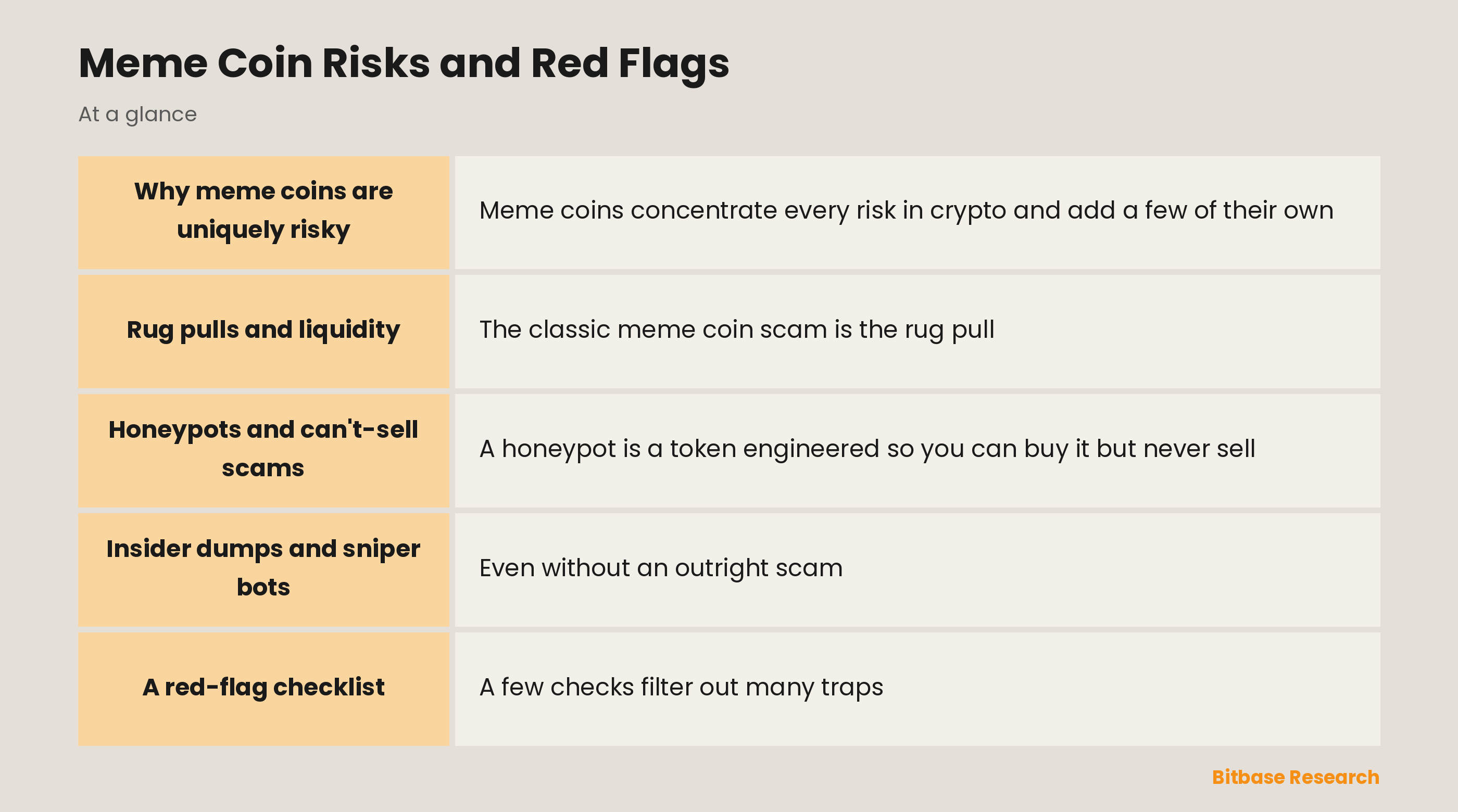
Why meme coins are uniquely risky
Meme coins concentrate every risk in crypto and add a few of their own. They have no revenue or product to anchor value, so a price can go to zero with nothing to break the fall. They are trivially easy to create, which floods the market with disposable tokens. And because they run on hype, they attract bad actors who profit precisely by manufacturing and then abandoning that hype. The result is an arena where losing money is the default outcome and scams are common, not rare.
Rug pulls and liquidity
The classic meme coin scam is the rug pull, where creators drain the liquidity that lets people sell, leaving holders with worthless tokens they cannot exit. Newer launchpad models reduce one version of this by locking liquidity into an automated curve that no one can withdraw by hand. But that is not full protection: once a coin graduates to an open market, liquidity and price can still be manipulated, and "soft rugs," where the team simply abandons a project after cashing out, remain common.
Honeypots and can't-sell scams
A honeypot is a token engineered so you can buy it but never sell. The contract contains hidden rules that block or tax outgoing trades for ordinary holders while letting the creator sell freely. The chart looks like it is only going up, precisely because no one else is allowed to take profit. These traps are invisible to the naked eye and require checking the token's contract behaviour or a reputable scanner before buying, never trusting a rising price alone.
Insider dumps and sniper bots
Even without an outright scam, the game is often rigged toward insiders. Creators and connected wallets frequently hold large hidden allocations and dump them onto retail buyers at the peak. Automated sniper bots buy new launches in the first instant and sell into the first wave of human FOMO, extracting value before an ordinary trader can react. The predictable mechanics of launches and graduations make this especially profitable for those with speed and information you do not have.
A red-flag checklist
A few checks filter out many traps. Be wary when a handful of wallets hold most of the supply, when liquidity is not locked, or when the creator retains the power to mint unlimited new tokens. Treat anonymous teams making guaranteed-return promises, aggressive influencer campaigns, and pressure to buy immediately as danger signs. Verify the contract with a trusted scanner, confirm you can actually sell a tiny test amount, and remember that a coin looking too good to be true almost always is.
The bottom line
Meme coins carry every normal crypto risk plus engineered scams — rug pulls, honeypots, insider dumps, and bots hunting late buyers. Protect yourself by checking holder concentration, liquidity locks, and mint authority, verifying you can sell before you buy, and distrusting hype and guaranteed returns. Most meme coins go to zero, so only ever commit money you can fully afford to lose. Treated as high-stakes gambling with clear eyes, they are survivable; treated as investing, they are ruinous.
Disclaimer: This article is educational content from Bitbase Academy, provided for informational purposes only. It is not investment, trading, tax, or financial advice. Written as of July 2026; rely on the latest official information.
References
[1] Chainalysis, "Rug pulls and token scams" chainalysis.com
[2] Investopedia, "Rug pull and honeypot scams" investopedia.com