Meme coins are the wildest corner of crypto: tokens with no product, no revenue, and often no purpose beyond a joke, yet capable of minting fortunes and vaporising them within hours. To understand them you have to understand their lifecycle — how they are born, hyped, and almost always die. Here is how the meme coin machine really works.
What a meme coin is
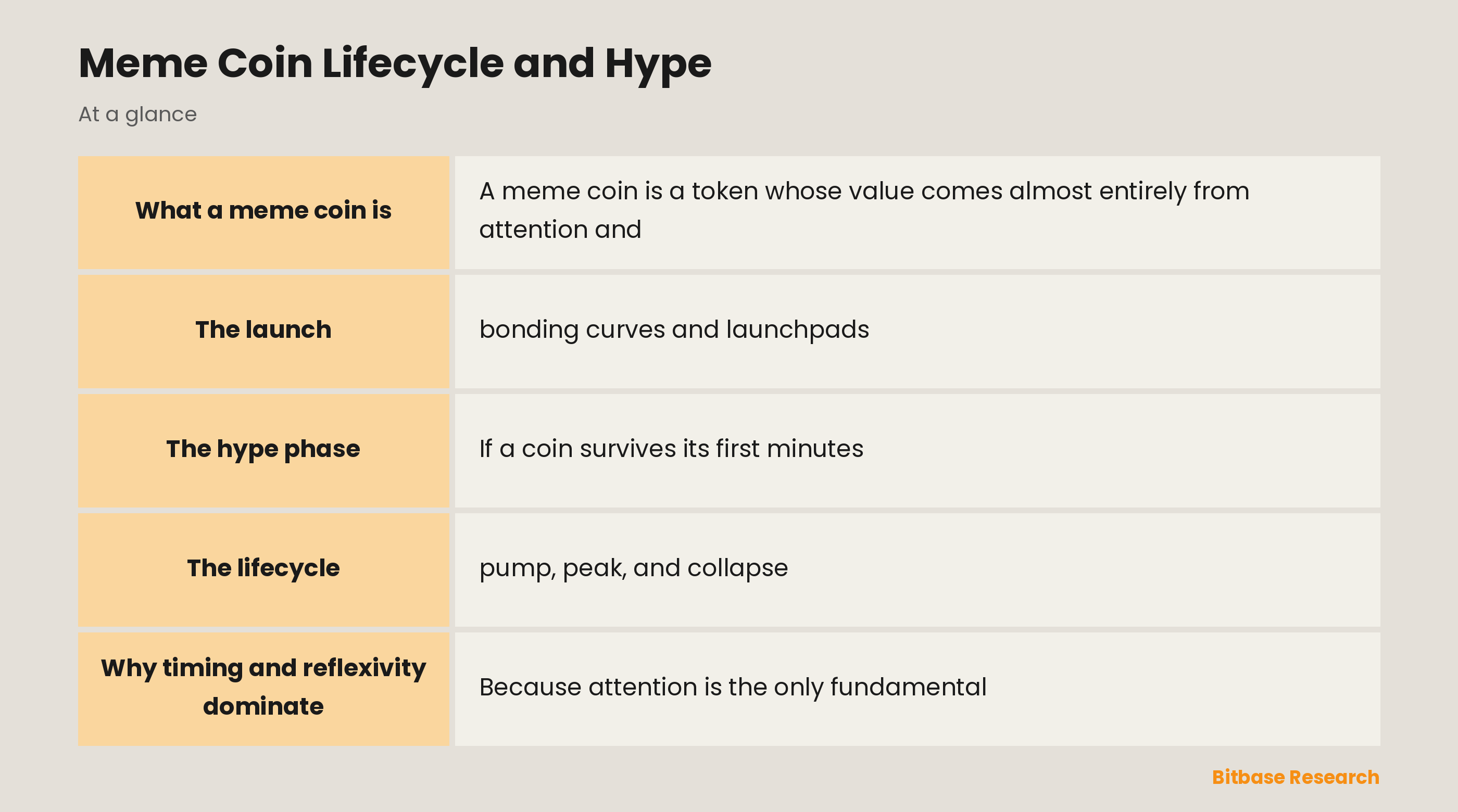
A meme coin is a token whose value comes almost entirely from attention and community rather than technology or cash flow. Where a typical project pitches a use case, a meme coin openly runs on culture, humour, and collective belief. This is not a hidden flaw but the entire design: the "fundamental" being traded is how much attention the coin can capture. That makes meme coins less like investments and more like a fast, brutal market for viral moments.
The launch: bonding curves and launchpads
Modern meme coins are often born on launchpads that make creating a token trivial, using a mechanism called a bonding curve. Instead of a separate liquidity pool, the curve itself is the liquidity: every purchase adds funds and pushes the price up along a fixed formula, and every sale does the reverse. Once a coin's market value crosses a set threshold, it "graduates" to a decentralised exchange with real liquidity. This design made launching frictionless and removed one classic scam, but it also industrialised the churn of new coins.
The hype phase
If a coin survives its first minutes, hype takes over. Momentum builds through social media, group chats, and influencers who amplify a coin to their followers, turning attention into buying pressure and buying pressure into a rising price. Fear of missing out pulls in latecomers, and narratives rotate quickly from one theme to the next. In this phase the price is driven purely by the flow of new attention and money, not by anything the coin does or owns.
The lifecycle: pump, peak, and collapse
Almost every meme coin follows the same arc. A launch and early accumulation give way to a parabolic pump as hype peaks, then early buyers and insiders distribute their holdings into the excitement. When new buyers run out, the price collapses, often as fast as it rose, and most coins fade toward zero. A tiny minority survive to become lasting "blue-chip" memes with real communities, but they are the rare exception, not the rule.
Why timing and reflexivity dominate
Because attention is the only fundamental, meme coins are intensely reflexive: a rising price attracts attention, which raises the price further, until the loop reverses just as violently. This makes timing everything and makes late buyers structurally vulnerable, since the mechanics reward those who arrived early and punish those chasing a chart that has already moved. Treating a meme coin like a long-term hold usually ends badly, because there is rarely anything underneath to hold onto.
The bottom line
A meme coin's lifecycle is a compressed cycle of birth, hype, and collapse, powered entirely by attention rather than fundamentals. Launchpads and bonding curves have made creating them effortless, hype amplifies them through social momentum, and reflexivity ensures that most round-trip to nothing. They can be traded, but they are speculation on virality, not investment. If you engage at all, understand the machine, size positions as money you can fully afford to lose, and never mistake a moving price for lasting value.
Disclaimer: This article is educational content from Bitbase Academy, provided for informational purposes only. It is not investment, trading, tax, or financial advice. Written as of July 2026; rely on the latest official information.
References
[1] CoinGecko, "What are meme coins?" coingecko.com
[2] Cointelegraph, "How meme coin launchpads and bonding curves work" cointelegraph.com