
Crypto rarely moves in a straight line. Instead it breathes — long climbs, sharp crashes, quiet stretches, and money sloshing from one corner of the market to another. These patterns are not random; they follow rhythms shaped by incentives and psychology. Understanding market cycles and rotation will not predict the future, but it will help you read where you might be.
Why crypto moves in cycles
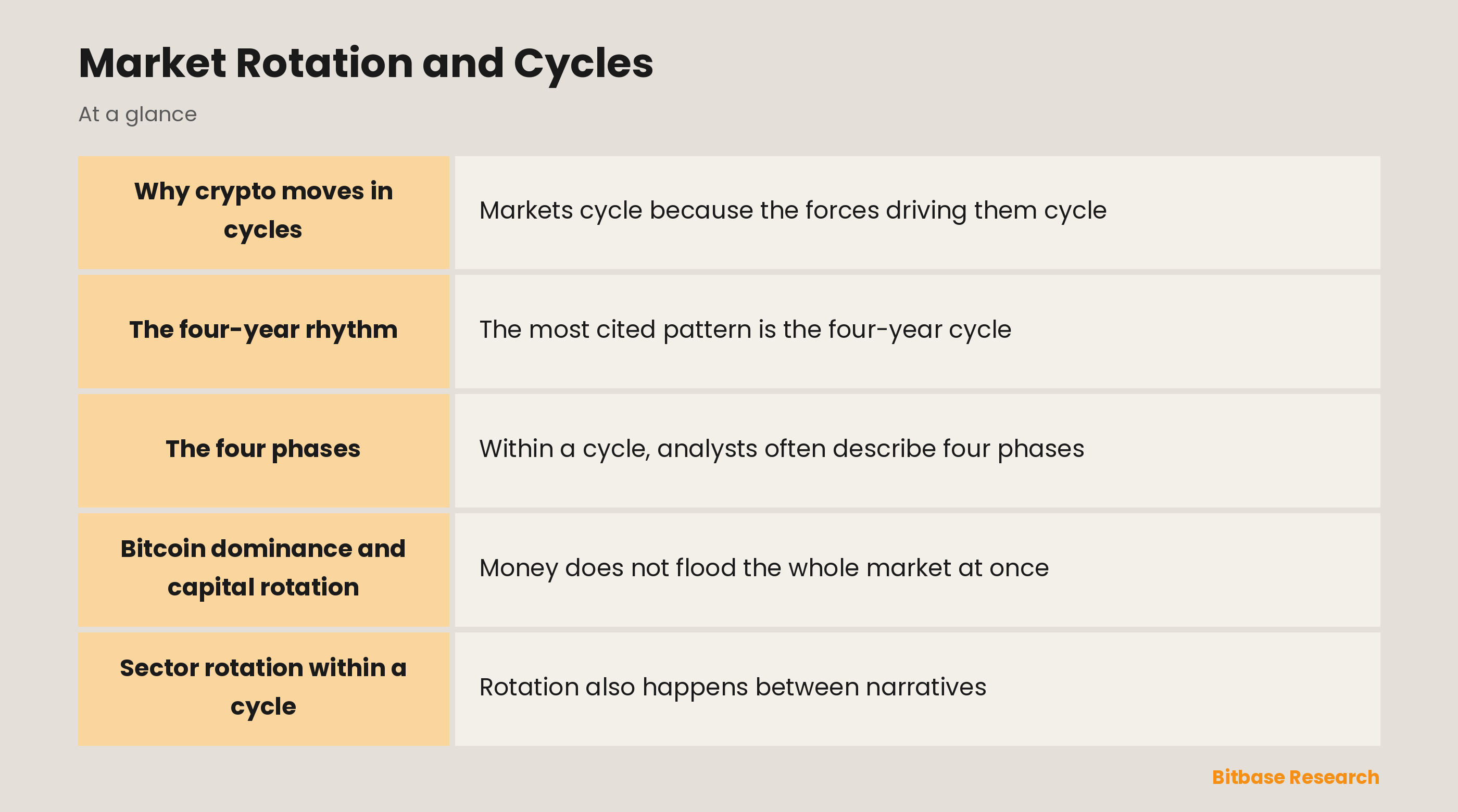
Markets cycle because the forces driving them cycle. In crypto, three engines dominate: Bitcoin's roughly four-year halving that periodically cuts new supply, the ebb and flow of global liquidity and risk appetite, and the raw psychology of greed and fear amplified by a young, retail-heavy market. When these align, prices can rise far faster than fundamentals; when they reverse, the fall is just as violent. Cycles are the visible result of these forces breathing in and out.
The four-year rhythm
The most cited pattern is the four-year cycle, loosely anchored to Bitcoin's halving. Historically, the year of and after a halving saw strong rallies, followed by a sharp bear market and a long recovery. It is a useful lens, but it is a tendency, not a law: each cycle has been weaker in percentage terms than the last, institutional flows now distort the old pattern, and treating the calendar as destiny is how people get hurt. The rhythm rhymes; it does not repeat exactly.
The four phases
Within a cycle, analysts often describe four phases. In accumulation, prices are flat and sentiment is dead, while patient buyers quietly build positions. In markup, price rises and belief returns, drawing in the crowd. In distribution, early buyers sell into euphoria as prices stall at highs. In markdown, reality sets in and prices fall until exhaustion resets the board. Knowing which phase you are likely in matters more than any single price prediction.
Bitcoin dominance and capital rotation
Money does not flood the whole market at once; it rotates. Capital typically flows first into Bitcoin, then into large-cap altcoins, then into smaller and riskier tokens, and finally into the most speculative memes — before retreating back to Bitcoin or cash when fear returns. Traders watch Bitcoin dominance, its share of total market value, to gauge this flow: a falling dominance during a rally often signals the classic rotation into altcoins that people call "altseason."
Sector rotation within a cycle
Rotation also happens between narratives. Within a single bull market, attention can move from layer-1 platforms to DeFi, to real-world assets, to AI-themed tokens, to memes, each having its moment before capital shifts on. This is why a coin can lag for months and then suddenly surge — its narrative's turn arrived. Recognising narrative rotation helps explain otherwise baffling moves, though chasing each hot sector late is a reliable way to buy tops.
The bottom line
Cycles and rotation are frameworks for orientation, not crystal balls. The four-year rhythm, the four phases, the flow from Bitcoin out to alts and back, and the rotation between narratives all describe how crypto markets tend to breathe. Use them to understand context and manage risk, not to time tops and bottoms precisely. Every cycle also brings something genuinely new, so hold these patterns firmly but never treat them as guarantees.
Disclaimer: This article is educational content from Bitbase Academy, provided for informational purposes only. It is not investment, trading, tax, or financial advice. Written as of July 2026; rely on the latest official information.
References
[1] CoinMarketCap, "Crypto market cycles explained" coinmarketcap.com
[2] Bitcoin Magazine, "The halving cycle and market rhythm" bitcoinmagazine.com