While Polymarket grew up offshore on crypto rails, Kalshi took the opposite path: a US company that spent years securing federal approval to run prediction markets legally onshore. The result is a regulated event exchange that feels more like a brokerage than a betting site. Here is what Kalshi is, how it works, and what its regulated status really means.
What Kalshi is
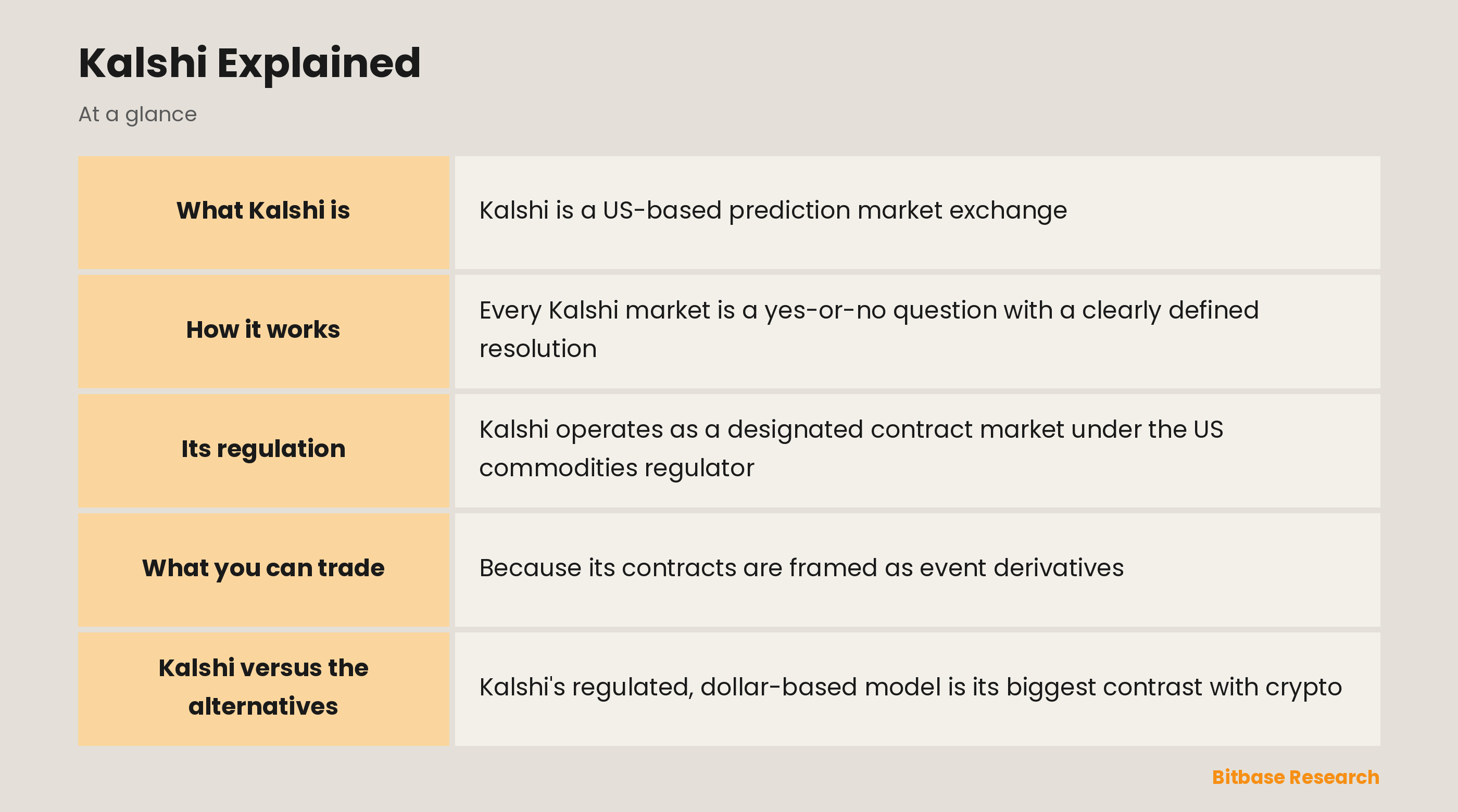
Kalshi is a US-based prediction market exchange, founded in 2018, where people trade contracts on the outcomes of future events. Its defining feature is that it operates under direct federal oversight rather than in a regulatory grey zone. Users deposit ordinary dollars, not crypto, and trade event contracts much as they would trade on a stock brokerage. That regulated, fiat-based design is the main thing that distinguishes Kalshi from crypto-native rivals.
How it works
Every Kalshi market is a yes-or-no question with a clearly defined resolution, such as whether a specific economic figure will exceed a threshold. Each contract is worth one dollar if the answer is yes and zero if no, and it trades at a price in between that reflects the market's estimated probability. Orders are matched through a central limit order book, the same mechanism stock exchanges use, pairing buyers and sellers by price and time rather than routing everything through an automated pool.
Its regulation
Kalshi operates as a designated contract market under the US commodities regulator, the same category used for regulated futures exchanges. This brings real obligations: customer funds are held in segregated accounts, markets must follow federal rules for how they are created and settled, and the exchange is subject to surveillance and reporting. A landmark development came when US courts cleared Kalshi to list contracts on election outcomes, opening a category that regulators had long resisted.
What you can trade
Because its contracts are framed as event derivatives, Kalshi lists a broad and growing range of markets. These include economic indicators such as inflation and interest-rate decisions, election and political outcomes, corporate events, weather, and sports results. The unifying thread is that each market has an objective, verifiable resolution. This mix lets users hedge real-world risks or simply express a view on what will happen, all within a single regulated venue.
Kalshi versus the alternatives
Kalshi's regulated, dollar-based model is its biggest contrast with crypto prediction markets. It offers the reassurance of federal oversight, segregated funds, and familiar fiat rails, at the cost of the openness, global access, and self-custody that on-chain platforms provide. Compared to a traditional sportsbook, Kalshi frames its products as financial event contracts traded peer-to-peer on an exchange, rather than fixed-odds bets against a house. Which suits you depends on how much you value regulation versus permissionless access.
The bottom line
Kalshi is the regulated, US-onshore face of prediction markets: dollar-funded, overseen by the federal commodities regulator, and traded through a familiar order book on questions ranging from economics to elections to sports. It trades the openness of crypto platforms for the assurances of formal regulation and segregated customer funds. For users who prioritise a compliant, fiat-native venue, Kalshi is the benchmark — though, as always, the rules and available markets vary by location and over time.
Disclaimer: This article is educational content from Bitbase Academy, provided for informational purposes only. It is not investment, trading, tax, or financial advice. Written as of July 2026; rely on the latest official information.
References
[1] Kalshi, "How prediction markets work" kalshi.com
[2] Britannica Money, "Kalshi Inc." britannica.com