Choosing where to keep and trade your crypto is one of the highest-stakes decisions you will make, because an exchange holds your funds and its failure becomes your loss. Yet most people pick one on brand recognition alone. Here is a practical framework for researching an exchange before you trust it with your money.
Why researching an exchange matters
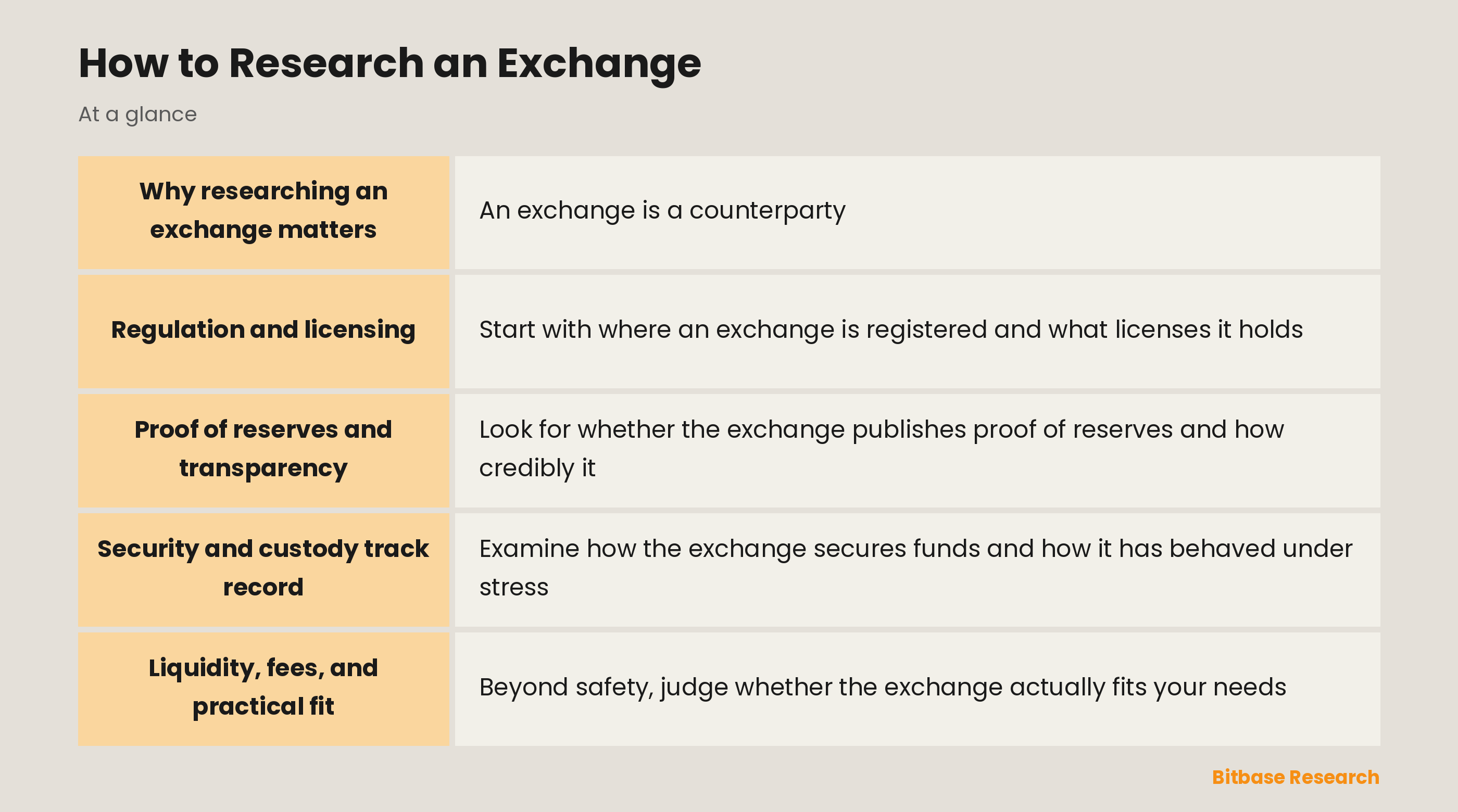
An exchange is a counterparty, not a neutral tool. When your coins sit on it, you are lending the platform your trust that it is solvent, secure, and honest — and history is full of exchanges that were none of these. Doing research does not guarantee safety, but it filters out the obviously weak and helps you size your exposure. The goal is not certainty; it is informed risk, keeping only what you are willing to trust on any single platform.
Regulation and licensing
Start with where an exchange is registered and what licenses it holds. A platform authorised in a serious jurisdiction is subject to capital, custody, and reporting rules that unregulated venues can ignore, and it has a regulator that can act if things go wrong. Check which entity actually serves your country and whether it is registered there. Vague or shifting corporate structures, or a refusal to name a home regulator, are meaningful warnings rather than trivia.
Proof of reserves and transparency
Look for whether the exchange publishes proof of reserves and how credibly it does so. The strongest versions use a Merkle tree of customer balances, ideally with a zero-knowledge proof, and pair on-chain reserve attestations with some accounting of liabilities. Remember that reserves alone do not prove solvency, since off-chain debts stay hidden, so treat a genuine, regularly updated proof as a positive signal and its total absence as a reason for caution.
Security and custody track record
Examine how the exchange secures funds and how it has behaved under stress. Does it keep the bulk of assets in cold storage with a thin hot float, use multisig or MPC, and clearly segregate customer assets? Has it suffered hacks, and if so did it cover user losses or leave them stranded? A long, boring history of handling incidents responsibly tells you more than any marketing claim about being "the most secure."
Liquidity, fees, and practical fit
Beyond safety, judge whether the exchange actually fits your needs. Deep liquidity means your orders fill near the quoted price rather than slipping, which matters most for larger trades. Compare the full fee picture — trading, deposit, withdrawal, and spread — not just the headline rate. Confirm it lists the assets you want and supports your region, funding methods, and language. A safe exchange you cannot use well is still the wrong choice.
Red flags and the bottom line
Weigh everything against the warning signs: promised guaranteed returns, aggressive referral schemes, anonymous teams, withdrawal complaints, or pressure to deposit fast. Cross-check reputation across independent sources rather than the exchange's own channels, and treat unanimous glowing reviews as suspiciously as unanimous complaints. In the end, research an exchange like a counterparty you are lending to, spread funds across venues, and keep long-term holdings in your own custody.
Disclaimer: This article is educational content from Bitbase Academy, provided for informational purposes only. It is not investment, trading, tax, or financial advice. Written as of July 2026; rely on the latest official information.
References
[1] CoinGecko, "How to evaluate a crypto exchange" coingecko.com
[2] Cointelegraph, "How to choose a crypto exchange" cointelegraph.com