A prediction market is only as trustworthy as the moment it decides who was right. Settlement — the process of resolving a market to "yes" or "no" and paying out — is where the whole system either delivers on its promise or collapses into disputes. Understanding how markets settle, and where they can go wrong, is the difference between an informed participant and a surprised one.
Why settlement is everything
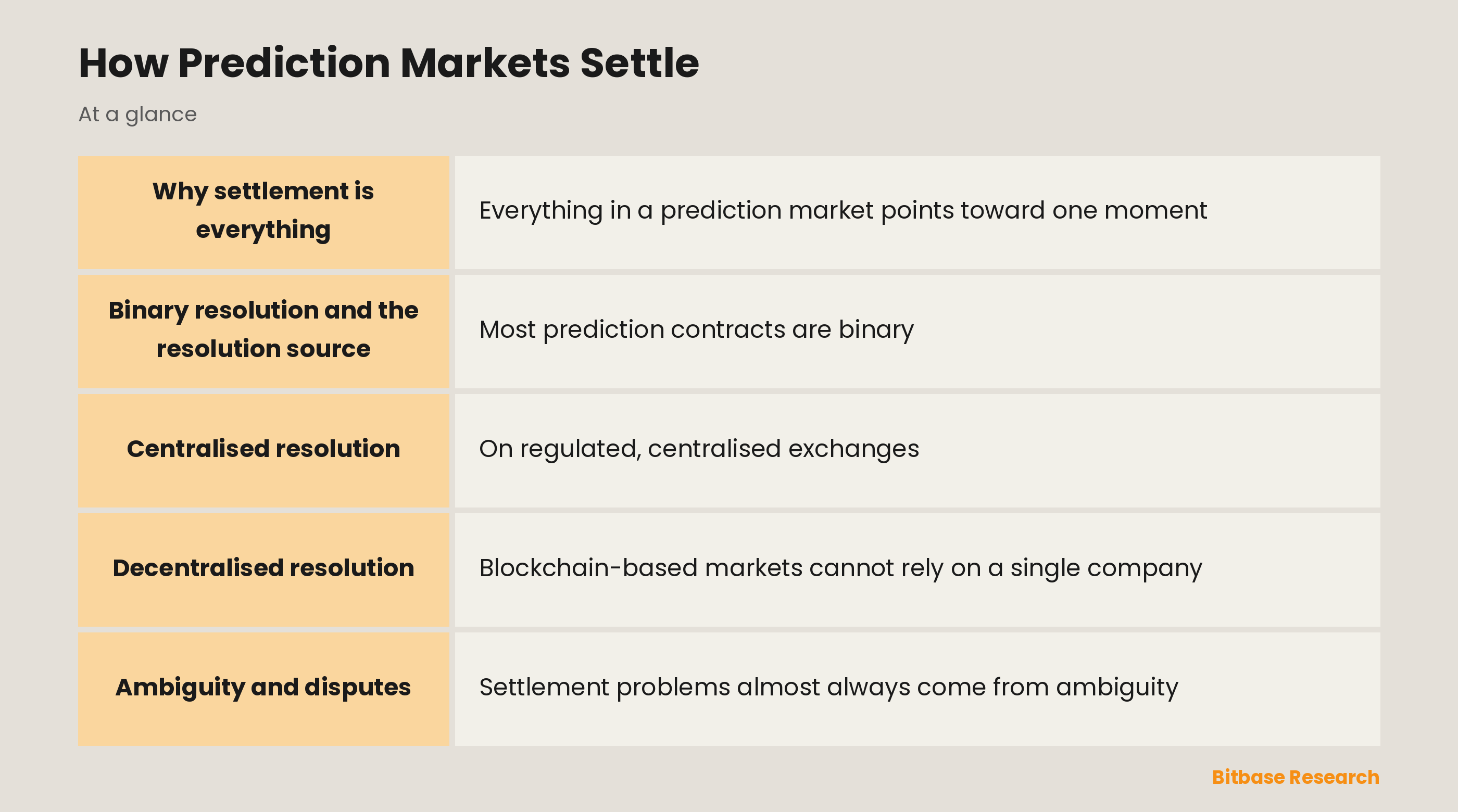
Everything in a prediction market points toward one moment: the resolution, when the outcome is declared and winners are paid. Until then, prices are just estimates; at settlement they become final money. This makes the resolution process the most critical and most vulnerable part of any prediction market. A brilliant, liquid market can still leave traders furious if it settles ambiguously or unfairly, which is why serious platforms invest heavily in how outcomes are determined.
Binary resolution and the resolution source
Most prediction contracts are binary: at settlement each "yes" share pays one unit and each "no" share pays nothing, or vice versa. The key question is who or what decides the answer. Every well-designed market names a resolution source in advance — an official result, a government data release, a named authority — so the outcome is objective and verifiable. The clarity of that source, defined before trading begins, largely determines whether settlement will be smooth or contested.
Centralised resolution
On regulated, centralised exchanges, the platform itself resolves markets using the pre-specified official sources, much as a traditional exchange settles a futures contract. This is fast and simple, and under regulatory oversight it carries accountability and clear rules. The trade-off is trust: users must rely on the operator to resolve honestly and correctly. For most mainstream events with unambiguous outcomes, this works cleanly, which is why regulated venues favour it.
Decentralised resolution
Blockchain-based markets cannot rely on a single company, so they use decentralised oracles to bring outcomes on-chain. A common design is the optimistic oracle: someone proposes the result and posts a financial bond, and if no one disputes it within a set window, it is accepted automatically. If it is challenged, the question escalates to a decentralised vote, and whichever side is wrong forfeits their bond. This makes lying expensive and lets settlement happen without a trusted referee.
Ambiguity and disputes
Settlement problems almost always come from ambiguity, not fraud. A market may ask something that reality answers messily — an event that technically happens but not as expected, a source that goes silent, or wording that two people read differently. Good platforms pre-write detailed rules for edge cases and provide a dispute path; weak ones leave gaps that erupt into controversy. Before trading, always read exactly how a market will resolve, because that fine print is where your money is truly decided.
The bottom line
Settlement is the moment a prediction market turns opinion into payout, and its integrity rests entirely on a clear resolution source and a trustworthy process. Centralised venues resolve using official data under regulatory accountability, while decentralised ones use bonded oracles and disputes to avoid trusting any single party. Both live or die on unambiguous rules. Read the resolution criteria before you trade, and treat any market with vague settlement terms as a risk, not an opportunity.
Disclaimer: This article is educational content from Bitbase Academy, provided for informational purposes only. It is not investment, trading, tax, or financial advice. Written as of July 2026; rely on the latest official information.
References
[1] UMA, "The optimistic oracle" uma.xyz
[2] CFTC, "Event contracts and settlement" cftc.gov