Every action on a blockchain costs a fee, and on networks like Ethereum that fee is called gas. Why it spikes during busy periods, why part of it disappears, and how your wallet decides what to charge can all seem mysterious. Once you understand the few moving parts, gas stops being a random tax and becomes something you can read and even control.
What gas is
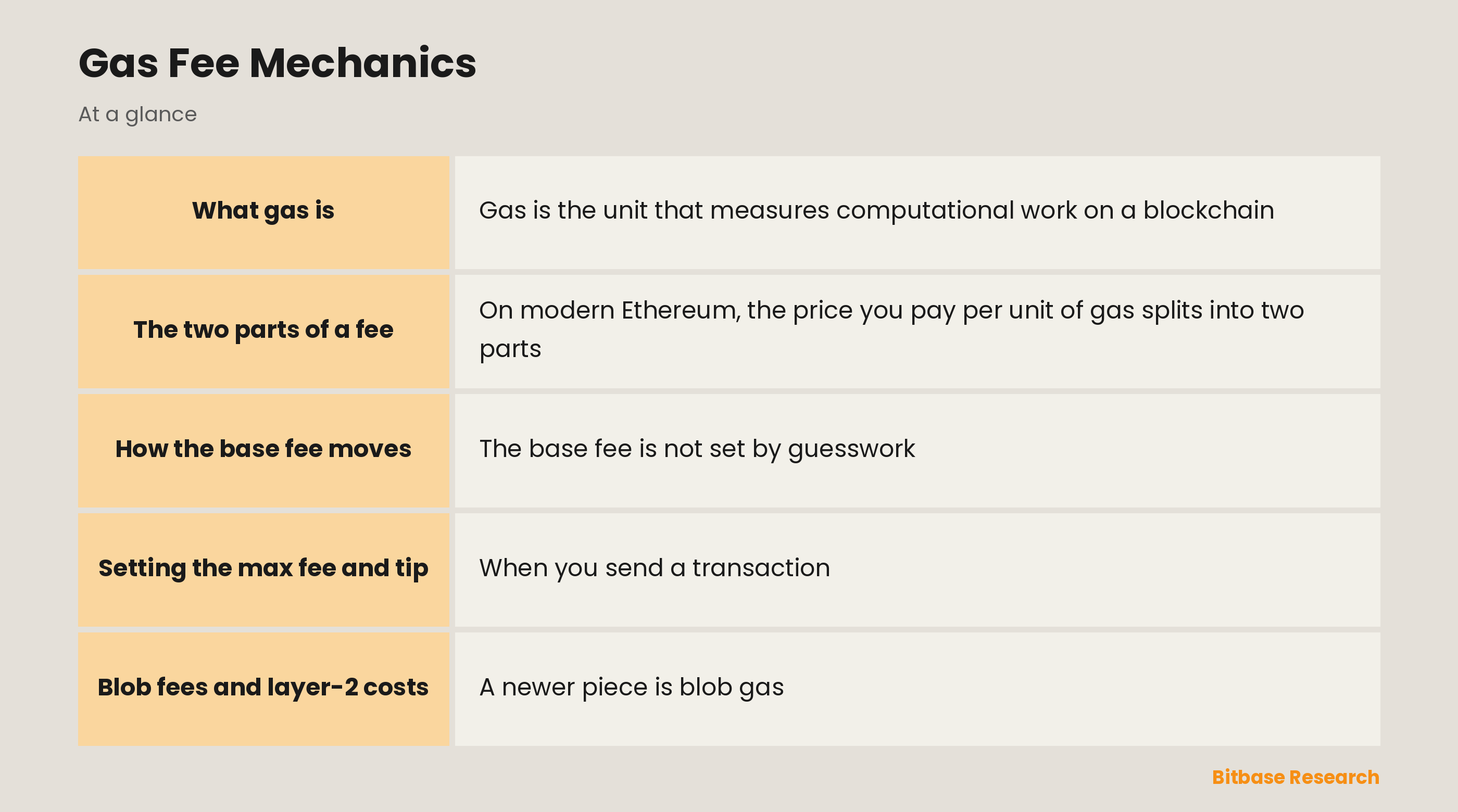
Gas is the unit that measures computational work on a blockchain. Every operation — a simple transfer, a token swap, a complex contract call — consumes a set amount of gas depending on how much work it demands. Your total fee is simply the gas your transaction uses multiplied by the price you pay per unit of gas. Separating the two is the key insight: the amount of work is roughly fixed by what you are doing, while the price per unit floats with demand for blockspace.
The two parts of a fee
On modern Ethereum, the price you pay per unit of gas splits into two parts. The base fee is a network-wide price that every transaction in a block must pay, and it is burned — removed from circulation entirely. On top of it sits a priority fee, or tip, that goes to the validator as an incentive to include your transaction sooner. Your effective price is base fee plus tip, which is why raising only the tip speeds you up without overpaying the whole market.
How the base fee moves
The base fee is not set by guesswork; it adjusts automatically to keep blocks about half full. When a block is more than half full, the base fee rises by up to a eighth for the next block; when demand fades and blocks are under half full, it falls by the same step. This feedback loop means fees climb quickly during congestion and cool just as predictably afterwards, turning the base fee into a live gauge of how busy the network is right now.
Setting the max fee and tip
When you send a transaction, your wallet sets two limits: a maximum fee you are willing to pay per unit of gas, and a priority tip. You are only charged the actual base fee plus your tip, never more than your maximum, so setting a comfortable ceiling protects you from spikes without overpaying when things are calm. Wallets estimate sensible values automatically, but understanding them lets you pay less when you are patient and more when you truly need speed.
Blob fees and layer-2 costs
A newer piece is blob gas, introduced to make layer-2 rollups cheaper. Rollups post their compressed data to Ethereum in a special container called a blob, which uses its own separate fee market rather than competing with ordinary transactions for regular gas. Because blob data is temporary and priced independently, it dramatically lowered the cost of using layer-2 networks. This is a large part of why transacting on a rollup often costs a tiny fraction of doing the same thing on the base layer.
The bottom line
Gas is just work multiplied by price, and on Ethereum that price is a burned base fee that floats with congestion plus a tip that buys priority. You control your maximum fee and your tip, blobs keep layer-2 costs low, and the base fee tells you how crowded the network is. Transact during quieter periods, use layer-2 networks for routine activity, and set your tip to match how urgently you actually need confirmation.
Disclaimer: This article is educational content from Bitbase Academy, provided for informational purposes only. It is not investment, trading, tax, or financial advice. Written as of July 2026; rely on the latest official information.
References
[1] Ethereum.org, "Gas and fees" ethereum.org
[2] Etherscan, "Gas Tracker" etherscan.io