You click withdraw, and for a few minutes nothing seems to happen. Behind that pause is a careful pipeline — queues, security checks, hot-wallet accounting, and finally an on-chain transaction. Understanding how an exchange processes a withdrawal explains why it is sometimes instant, sometimes slow, and occasionally held entirely.
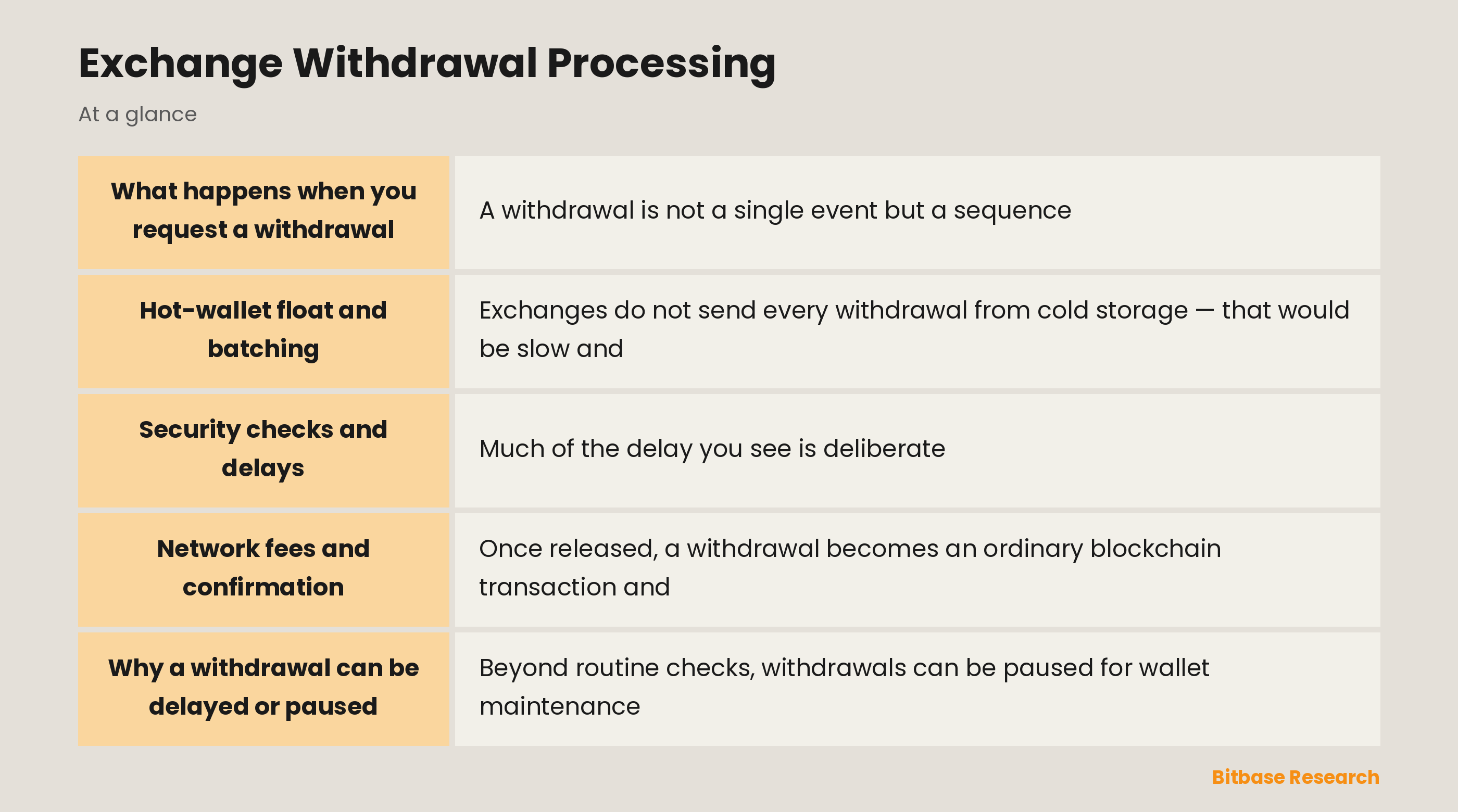
What happens when you request a withdrawal
A withdrawal is not a single event but a sequence. When you submit one, the exchange first checks your balance, your security settings, and whether the destination is allowed, then places the request in a processing queue. Only after these internal checks pass does it broadcast an actual blockchain transaction from its wallets. The number in your account dropped instantly, but the coins do not move on-chain until the pipeline reaches them.
Hot-wallet float and batching
Exchanges do not send every withdrawal from cold storage — that would be slow and insecure. Instead they keep a hot-wallet float, a working balance topped up from cold reserves, and pay withdrawals from it. To save on network fees, many exchanges batch multiple withdrawals into fewer transactions or consolidate inputs during quiet periods. This is efficient, but it means your withdrawal may wait for the next batch rather than going out the instant you click.
Security checks and delays
Much of the delay you see is deliberate. New withdrawal addresses often face a waiting period before they can be used, and a withdrawal soon after a password change, new device, or disabled two-factor may be held for a fixed cool-down as an anti-theft measure. Large or unusual withdrawals can trigger a manual risk review or screening against flagged addresses. These frictions are annoying when you are in a hurry but are exactly what protects a compromised account.
Network fees and confirmation
Once released, a withdrawal becomes an ordinary blockchain transaction and inherits that network's rules. It must be included in a block and then gather confirmations before the receiving side treats it as final, which can take seconds or, during congestion, much longer. The exchange sets or passes on a network fee to get it confirmed. From this point the exchange no longer controls the speed — the blockchain does.
Why a withdrawal can be delayed or paused
Beyond routine checks, withdrawals can be paused for wallet maintenance, cold-to-hot rebalancing, network upgrades, or unusually high demand that drains the hot float. Compliance holds, as covered in AML screening, can also stop a specific transaction. A reputable exchange communicates these states clearly; a suspicious one goes silent. Persistent, unexplained withdrawal problems are one of the earliest warning signs that an exchange may be in trouble.
The bottom line
A withdrawal moves through balance checks, a security queue, a hot-wallet float that is often batched, and finally an on-chain transaction that the network confirms at its own pace. Most delays are protective by design. Knowing the pipeline lets you tell a normal few-minute wait from a genuine red flag — and reminds you that funds truly under your control are the ones already withdrawn to your own wallet.
Disclaimer: This article is educational content from Bitbase Academy, provided for informational purposes only. It is not investment, trading, tax, or financial advice. Written as of July 2026; rely on the latest official information.
References
[1] Gemini, "How crypto withdrawals work" gemini.com
[2] BitGo, "Hot and cold wallet operations" bitgo.com