When you hold crypto on an exchange, you do not really hold it — the exchange does, on your behalf. How it stores those keys, and whether it keeps your assets separate from its own, is the difference between a boring intermediary and the next collapse. Here are the custody models exchanges use and what separates a safe one from a dangerous one.
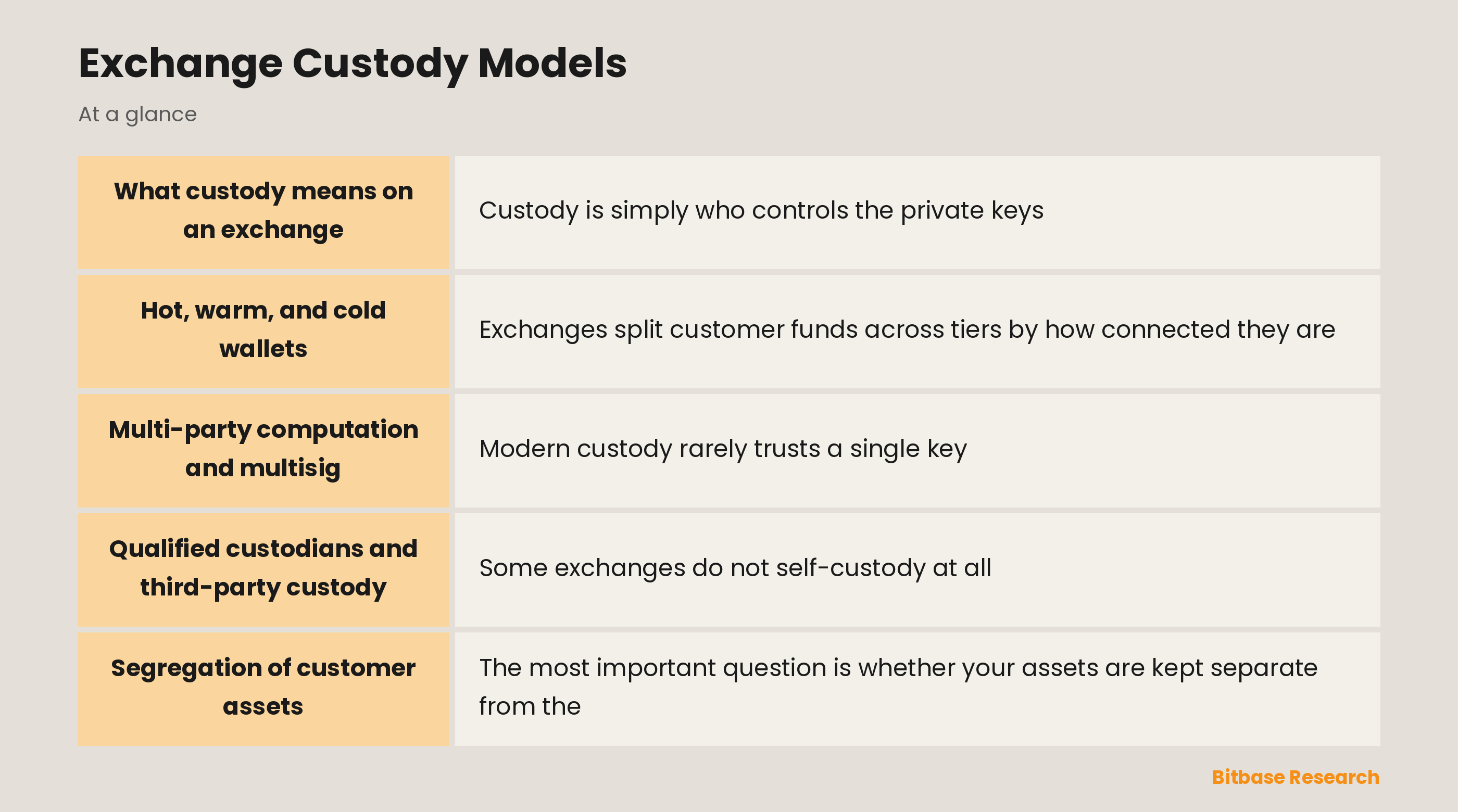
What custody means on an exchange
Custody is simply who controls the private keys. On a custodial exchange, the platform holds the keys to the wallets your balance lives in, and your on-screen number is a claim against the exchange rather than coins you directly control. This is convenient — no seed phrase to lose — but it means the exchange's security and honesty are now your risk. Everything below is about how a serious exchange manages that responsibility.
Hot, warm, and cold wallets
Exchanges split customer funds across tiers by how connected they are. Hot wallets are online and hold the small float needed for instant withdrawals; they are convenient but the most exposed. Cold wallets are kept fully offline, often in hardware in secure facilities, and store the large majority of assets safely. A warm layer sits in between for semi-frequent operations. The healthy pattern is a thin hot float and deep cold reserves, so an online breach can only ever reach a fraction of funds.
Multi-party computation and multisig
Modern custody rarely trusts a single key. Multisignature (multisig) wallets require several independent keys to approve a movement, so no one person or device can move funds alone. Multi-party computation (MPC) goes further, splitting a single key into shares that are never assembled in one place, with signing done collaboratively. Both approaches remove the single point of failure that doomed earlier exchanges, distributing control across people, devices, and locations.
Qualified custodians and third-party custody
Some exchanges do not self-custody at all, instead placing assets with a qualified custodian — a regulated, specialised firm whose only job is safekeeping. This separates the trading venue from the vault, so a problem at the exchange does not automatically put the keys at risk. Institutional custody providers offer insurance, audits, and regulatory oversight that many exchanges cannot match alone, which is why large holders often insist on it.
Segregation of customer assets
The most important question is whether your assets are kept separate from the exchange's own. Commingling — mixing customer funds with company funds — is how a trading loss becomes a customer loss, as the FTX collapse showed. Regulated frameworks such as the EU's MiCA now require authorised providers to segregate client assets, so customer coins cannot be lent out or spent to cover corporate obligations. Segregation is what turns "trust me" into an enforceable promise.
The bottom line
An exchange's custody model is one of the clearest signals of how seriously it takes your money. Look for deep cold storage with a thin hot float, key security through multisig or MPC, ideally a qualified custodian, and above all clear segregation of customer assets. No custodial arrangement is risk-free, which is why long-term holdings still belong in self-custody — but among exchanges, these are the features that separate safe from sorry.
Disclaimer: This article is educational content from Bitbase Academy, provided for informational purposes only. It is not investment, trading, tax, or financial advice. Written as of July 2026; rely on the latest official information.
References
[1] Fireblocks, "What is MPC custody" fireblocks.com
[2] Coinbase, "Institutional custody" coinbase.com