Staking Ethereum is not instant. Validators join and leave through queues, and the rewards they earn come from a deliberately modest issuance schedule. Both shape what staking ETH actually looks like in practice.
Why there are queues
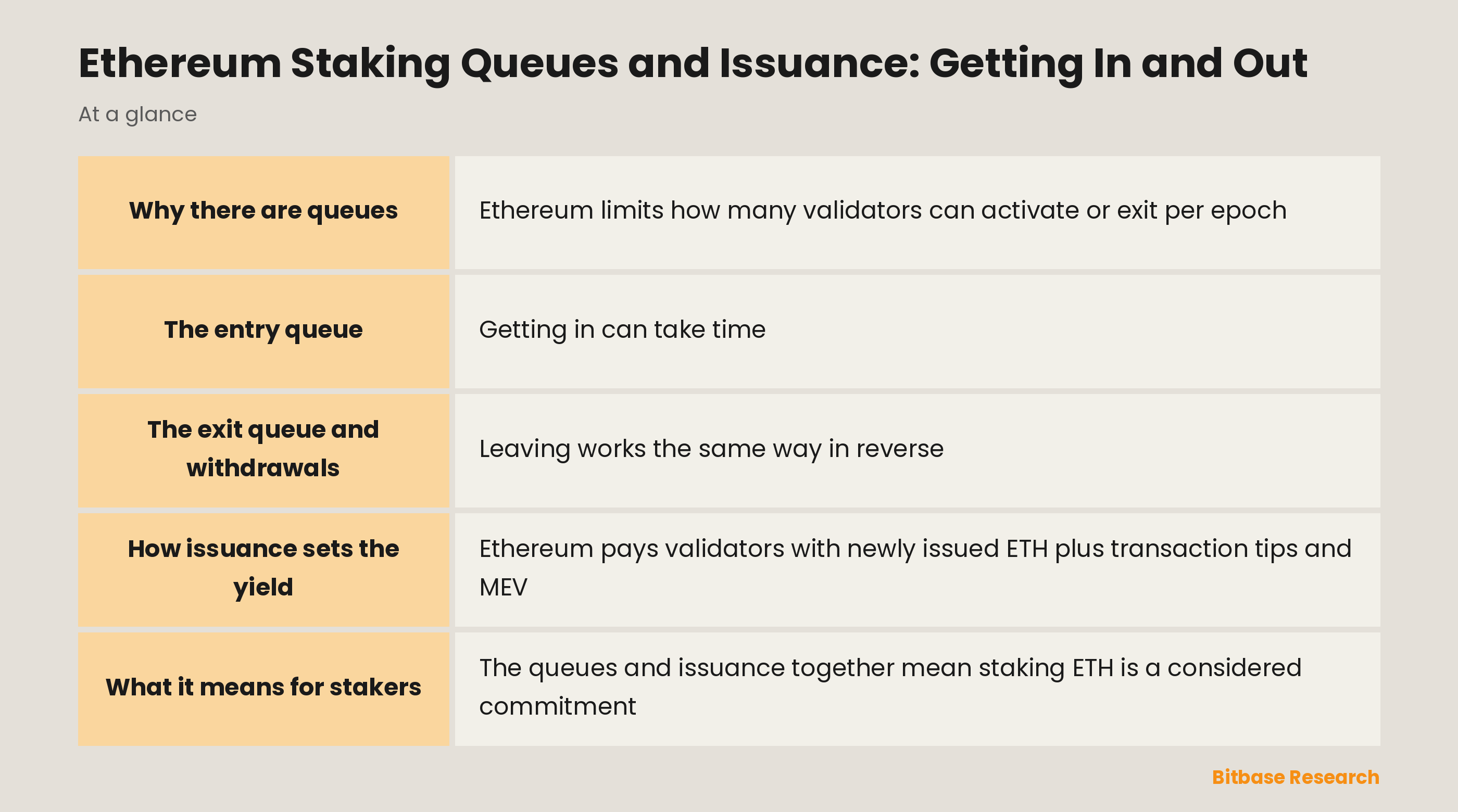
Ethereum limits how many validators can activate or exit per epoch, to keep the network stable. When demand to stake surges, new validators wait in an entry queue; when many leave at once, they wait in an exit queue. These limits stop sudden swings in the validator set that could weaken security or destabilize rewards.
The entry queue
Getting in can take time. In early 2026, demand pushed the entry queue to millions of ETH, creating a backlog of weeks for new validators. A recent upgrade moved activation to Ethereum's execution layer, cutting the technical activation step from days to minutes, though the queue itself still depends on how many others are waiting ahead of you.
The exit queue and withdrawals
Leaving works the same way in reverse. After the Shanghai upgrade enabled withdrawals and later improvements streamlined exits, the exit queue has at times fallen to near zero, with full withdrawals clearing in about a minute. That removed a long-standing worry that staked ETH was hard to get back.
How issuance sets the yield
Ethereum pays validators with newly issued ETH plus transaction tips and MEV. Issuance is deliberately low and scales with how much ETH is staked: the more validators, the smaller each one's share. In 2026 the base staking rate sits under 3%, with MEV lifting well-run validators a little higher. It is a modest, sustainable yield by design, not a high-inflation giveaway.
What it means for stakers
The queues and issuance together mean staking ETH is a considered commitment, not a quick trade. Entry and exit can be fast or slow depending on demand, and the reward is steady rather than spectacular. Check current queue times before staking or unstaking, and judge the yield against ETH's low issuance rather than against higher-inflation chains.
Disclaimer: This article is educational content from Bitbase Academy, provided for information only. It does not constitute investment, trading, tax, or financial advice. Written as of July 2026; refer to the latest official information.
References
[1] KuCoin, "Ethereum Staking in 2026: Yield, Validator Queue, MEV" kucoin.com
[2] Ryder, "Ethereum Staking Yield in 2026: After Pectra" ryder.id