Rollups move computation off Ethereum, but they must still publish their transaction data somewhere everyone can check. That "somewhere" is the data availability problem, and how a rollup solves it decides whether it is truly secured by Ethereum or only loosely attached to it.
Why rollups need data availability
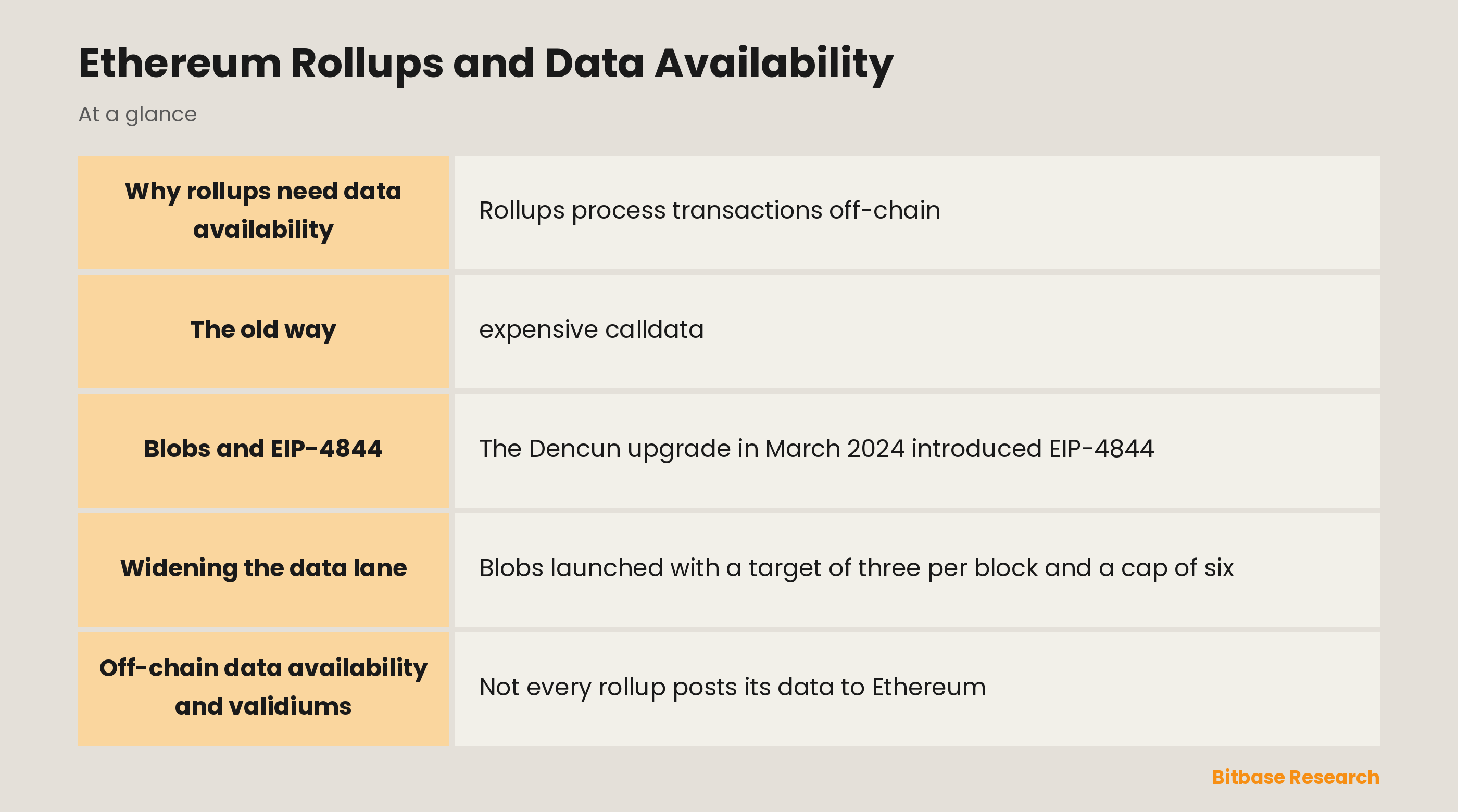
Rollups process transactions off-chain, then post a compressed record back to Ethereum. For anyone to verify that record — or to rebuild the rollup's state if its operator disappears — the underlying data must actually be available to download. If the data is withheld, users cannot prove what they own. Publishing the data is exactly what lets a rollup inherit Ethereum's security instead of asking you to trust its operator.
The old way: expensive calldata
Before 2024, rollups wrote their data into ordinary Ethereum transactions, called calldata. It worked, but it was costly: rollup users were paying for permanent storage they did not need, and those fees passed straight through to every transaction. Data availability, not computation, was the main thing making Layer-2 expensive.
Blobs and EIP-4844
The Dencun upgrade in March 2024 introduced EIP-4844, also called proto-danksharding, adding a new data type known as a blob. Each blob is a roughly 128 KB packet attached to a block but kept separate from normal execution, and it is automatically deleted after about 18 days — long enough for anyone to check, short enough to stay cheap. Because blobs gave rollups a dedicated, temporary data lane, Layer-2 fees fell by over 90 percent almost overnight.
Widening the data lane
Blobs launched with a target of three per block and a cap of six. Later upgrades kept widening that lane: Pectra in 2025 raised the targets, and Fusaka in late 2025 added PeerDAS, which lets nodes confirm data is available by randomly sampling small pieces instead of downloading everything. Follow-up "blob parameter" forks pushed the per-block count higher still, on the road toward the long-term goal of full danksharding.
Off-chain data availability and validiums
Not every rollup posts its data to Ethereum. Some designs, often called validiums, publish data to a separate network — such as Celestia, EigenDA, or Avail — or to their own committee. This is cheaper and higher-capacity, but it trades away part of Ethereum's guarantee: if that outside layer fails or withholds data, your funds can be stuck. Where the data lives is the single biggest security decision a rollup makes.
The bottom line
Data availability is the quiet foundation under every rollup. Posting data to Ethereum through blobs is what makes a rollup genuinely Ethereum-secured, while cheaper off-chain options accept weaker guarantees for lower cost. When you judge a Layer-2, look past the fees and ask where its data goes — that answer tells you who you are really trusting.
Disclaimer: This article is educational content from Bitbase Academy, provided for informational purposes only. It is not investment, trading, tax, or financial advice. Written as of July 2026; rely on the latest official information.
References
[1] Ethereum.org, "Danksharding" ethereum.org
[2] thirdweb, "Ethereum Blob Space Explained" thirdweb.com