Modern AI runs on a handful of giant companies that own the chips, the data, and the models. A growing crypto movement wants to break that concentration by building AI infrastructure — compute, training, and inference — as open, token-incentivised networks instead. Here is what decentralized AI infrastructure is trying to do, how it works, and how far the reality still trails the vision.
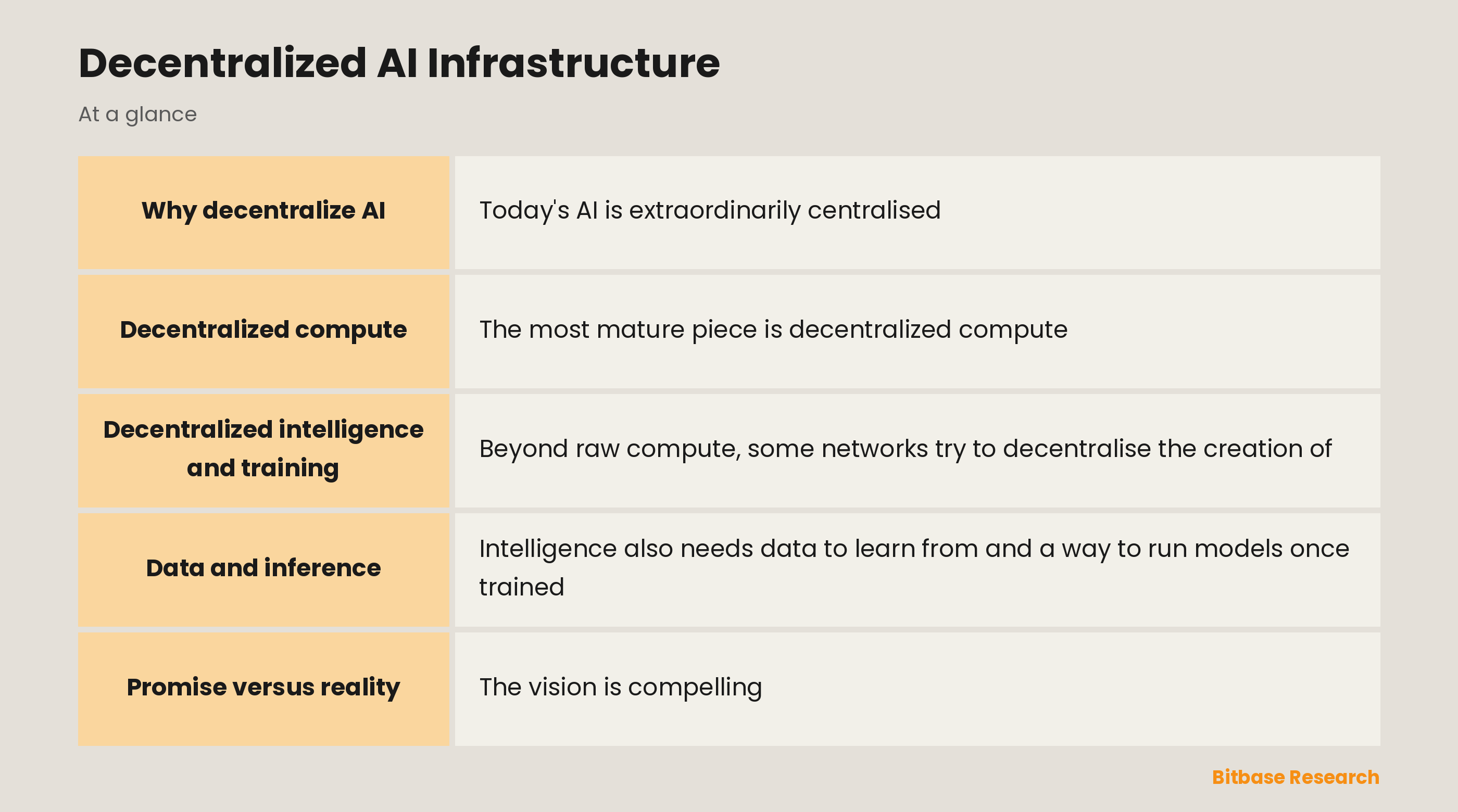
Why decentralize AI
Today's AI is extraordinarily centralised. A few firms control most of the advanced chips, the largest datasets, and the leading models, which concentrates power, raises costs, and lets a small number of gatekeepers decide who gets access and on what terms. Decentralized AI infrastructure aims to spread this out: to let anyone contribute computing power, data, or models to open networks and be paid in tokens for it. The goal is cheaper, more open, and more censorship-resistant AI that no single company controls.
Decentralized compute
The most mature piece is decentralized compute, which pools graphics processors from many owners into a shared marketplace. Instead of renting from a single cloud provider, users tap idle hardware contributed by data centres and individuals worldwide, coordinated and paid through a token network. This taps a large supply of underused chips and can undercut centralised clouds on price. Several networks now specialise in supplying GPU power for rendering, model training, and inference in this way.
Decentralized intelligence and training
Beyond raw compute, some networks try to decentralise the creation of intelligence itself. The best-known designs run a marketplace of machine-learning models where independent participants compete to produce useful outputs and are rewarded with tokens according to the value they add. Organised into specialised subnetworks, this turns model-building into an open, incentivised competition rather than a closed corporate effort. The aim is to crowdsource and continuously improve AI in the same permissionless way blockchains crowdsource security.
Data and inference
Intelligence also needs data to learn from and a way to run models once trained. Decentralized infrastructure extends to open, shared datasets that are not locked inside one company, and to decentralised inference, where requests to run a model are served by a distributed network rather than a single provider. A recurring hard problem is verification: proving that a remote machine actually did the computation it was paid for, honestly and correctly, without a trusted middleman to vouch for it.
Promise versus reality
The vision is compelling, but the gap to centralised AI is real. Coordinating distributed hardware adds latency and complexity, verifying honest work at scale is unsolved, and the very largest models still favour tightly integrated data centres. Token incentives can also attract speculation that outruns genuine usage. Where decentralized infrastructure works best today is in supplying flexible, lower-cost compute and in niche or specialised tasks, rather than in dethroning the frontier labs outright.
The bottom line
Decentralized AI infrastructure tries to rebuild the AI stack — compute, training, data, and inference — as open networks coordinated by tokens instead of owned by a few corporations. Decentralized GPU marketplaces are already useful and competitive on cost, while decentralised intelligence and inference remain earlier and face hard verification challenges. The direction matters because it pushes back against AI concentration, but treat the sector as promising and unproven, and its many tokens as speculative rather than settled infrastructure.
Disclaimer: This article is educational content from Bitbase Academy, provided for informational purposes only. It is not investment, trading, tax, or financial advice. Written as of July 2026; rely on the latest official information.
References
[1] Bittensor, "Decentralized machine intelligence" bittensor.com
[2] CoinGecko, "Decentralized AI and compute networks" coingecko.com