
Whether you can legally buy, hold, or trade crypto depends entirely on where you are. The same activity that is routine in one country is tightly licensed in another and outright banned in a third. This is a plain-language overview of how crypto legality varies around the world and the frameworks now shaping it — not legal advice, and no substitute for checking your own jurisdiction's current rules.
Why legality varies so widely
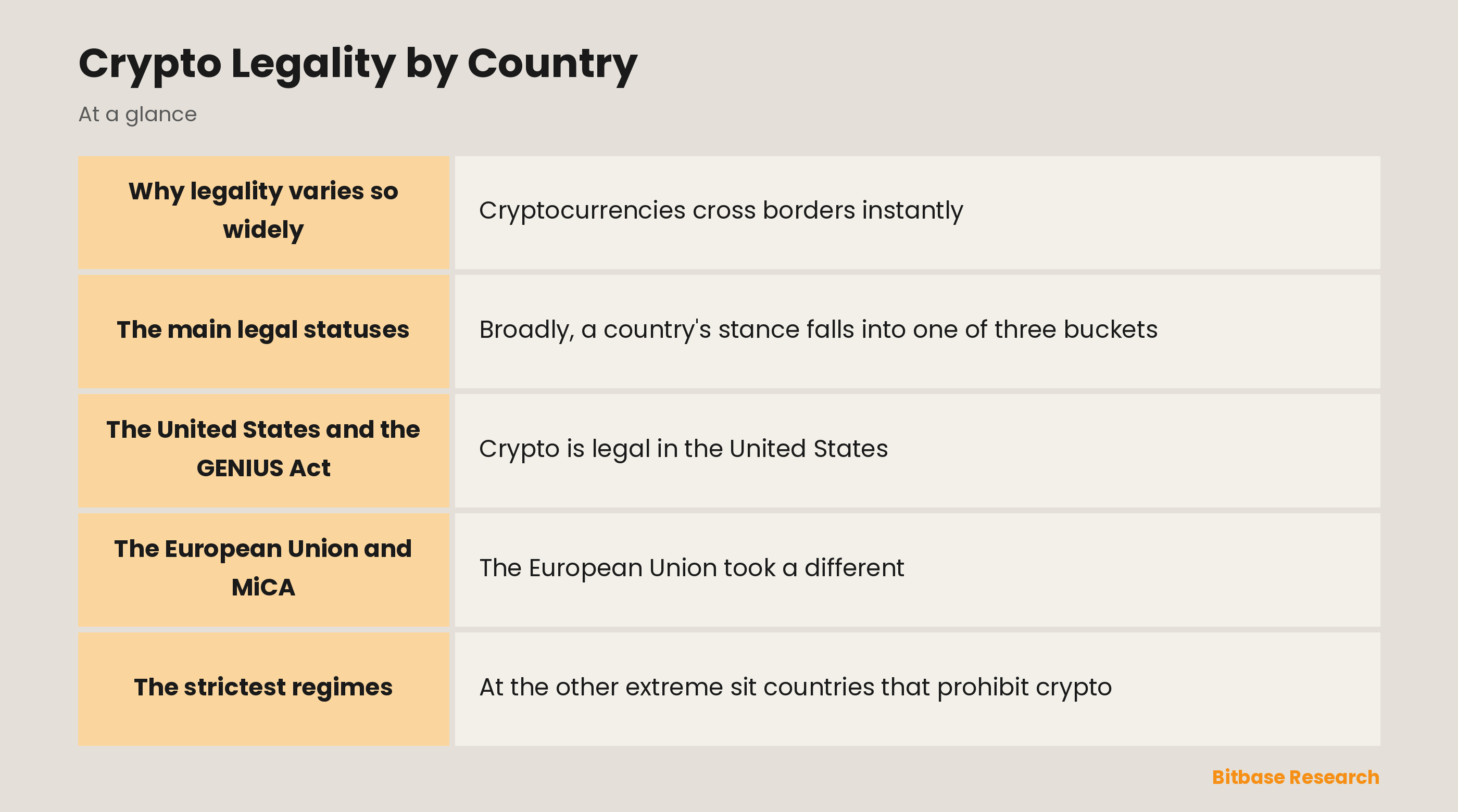
Cryptocurrencies cross borders instantly, but laws stop at them. Each government weighs the same technology against its own priorities — financial stability, consumer protection, monetary control, crime prevention — and reaches very different conclusions. The result is a patchwork: a wide majority of countries permit crypto in some form, a significant number impose partial restrictions, and a smaller group ban it outright. Because these positions shift with new laws and enforcement, "legal" is never a permanent or global status.
The main legal statuses
Broadly, a country's stance falls into one of three buckets. In fully legal jurisdictions, individuals and businesses can use crypto, though usually under registration, licensing, and tax rules. In partial-ban jurisdictions, some activities are allowed while others — such as banks handling crypto, or exchanges operating locally — are restricted. In full-ban jurisdictions, trading, exchanges, or mining are prohibited entirely. Surveys of dozens of major economies consistently find most in the first group, a meaningful share in the second, and a hard core in the third.
The United States and the GENIUS Act
Crypto is legal in the United States, and its framework has been sharpening. A landmark development was federal legislation establishing rules for payment stablecoins, requiring issuers to fully back their tokens with high-quality reserves — the country's first dedicated federal crypto law of its kind. Alongside it, broader efforts aim to clarify how different tokens are regulated and by which agency. The direction is toward clearer, stricter rules rather than prohibition, integrating crypto into the regulated financial system.
The European Union and MiCA
The European Union took a different, more unified path with its Markets in Crypto-Assets regulation, which became fully enforceable across member states. MiCA created a single, comprehensive licensing regime, so a crypto platform serving European users must be authorised and follow common rules on custody, disclosures, and stablecoins. Rather than a patchwork of national laws, the EU offers one harmonised framework, widely seen as the most complete large-scale crypto regulation yet and a model other regions study.
The strictest regimes
At the other extreme sit countries that prohibit crypto. The most far-reaching example bans mining, trading, exchange services, and related activity entirely, treating the whole sector as off-limits. Other governments stop short of a full ban but bar banks from touching crypto or block local exchanges, pushing activity offshore or underground. These regimes usually cite financial stability, capital controls, and crime as justifications, and enforcement can be strict, so the risks of ignoring them are serious.
The bottom line
Crypto legality is a global mosaic: legal and regulated in much of the world, partially restricted in many places, and fully banned in a determined few. The clearest current frameworks, such as the EU's unified regime and new US stablecoin rules, point toward regulation rather than prohibition, but the picture keeps changing. Before using crypto, always confirm the current law where you live and where any service you use is based, and treat this overview as a starting point, not legal advice.
Disclaimer: This article is educational content from Bitbase Academy, provided for informational purposes only. It is not investment, trading, tax, or legal advice, and laws vary by country and change over time. Written as of July 2026; rely on the latest official information and consult a qualified professional.
References
[1] Atlantic Council, "Cryptocurrency regulation tracker" atlanticcouncil.org
[2] CoinDesk, "Global crypto regulation: GENIUS Act and MiCA" coindesk.com