
A breakout is one of the most exciting moments in trading: price finally leaves a range or key level, potentially starting a big new move. But breakouts are also one of the most common traps, because not every break holds. A false breakout, or fakeout, lures traders in only to snap back and stop them out. Here is how to tell a real breakout from a fake one, and how volume and a retest can help you confirm it.
What a breakout is
A breakout happens when price moves decisively beyond a key level it had been respecting, such as the resistance atop a range, the support below it, or a trendline. The break signals that the balance has shifted and a new move may be starting in the breakout's direction. Breakouts attract traders because a genuine one can be the beginning of a strong trend, so they get in early hoping to catch the whole move as it develops.
The false breakout
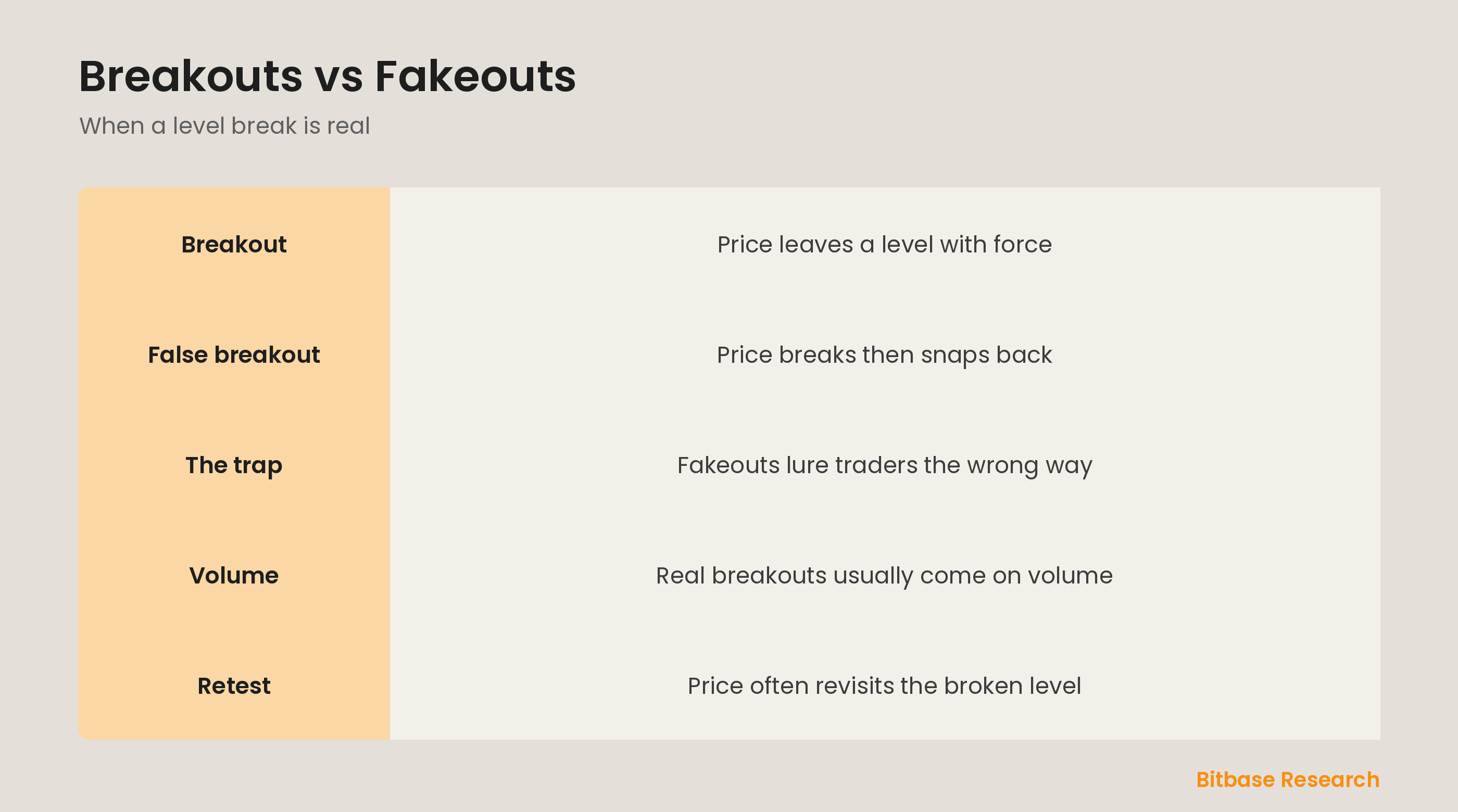
The problem is the false breakout, or fakeout: price pushes past the level, appears to break out, then quickly reverses back inside where it came from. Traders who jumped in on the initial break are now trapped on the wrong side as price snaps back against them. Fakeouts are common because a level attracts orders and can be briefly pierced without real follow-through, and they are a major reason breakout trading is harder than it looks.
Why fakeouts happen
False breakouts occur for structural reasons. Stop orders cluster just beyond obvious levels, so a brief push past a level can trigger them and create a spike that looks like a breakout but has no lasting force behind it. Sometimes larger participants push price past a level specifically to trigger these stops and trap breakout traders, then let price fall back. Understanding that a level break can be a trap, not a signal, is the key defense against fakeouts.
Confirming a breakout
Two things help separate real breakouts from fakes. First, volume: a genuine breakout usually comes on a surge of volume, showing real participation, while a break on weak volume is suspect. Second, the retest: after a real breakout, price often comes back to touch the broken level, which should now act as support or resistance from the other side, and holds. Waiting for volume and a successful retest, rather than chasing the first push, avoids many fakeouts.
The bottom line
A breakout is price decisively leaving a key level, potentially starting a new move, but a false breakout pushes past the level then snaps back, trapping traders who chased it. Fakeouts happen because stops cluster beyond levels and brief pushes lack follow-through. To confirm a breakout, look for strong volume behind it and a successful retest of the broken level, rather than jumping in on the first move past the line. To keep learning the fundamentals, follow more from Bitbase Academy.
Disclaimer: This article is educational content from Bitbase Academy, provided for information only. It does not constitute investment, trading, tax, or financial advice. Crypto assets are volatile; assess your own risk. Written as of June 2026; refer to the latest official information.
References
[1] Investopedia, "Breakout: What It Means, Examples, and How To Trade" investopedia.com
[2] Investopedia, "Whipsaw: What It Is and How It Works in Trading" investopedia.com
[3] Investopedia, "Support (Support Level): Definition and Trading Strategies" investopedia.com